


The Supreme Court of India has recently affirmed that breaking free from a live-in relationship is not illegal, underscoring the legal stance that consensual relationships involving adults are not crimes in India. The court explained that live-in relationships rely on the consent of both parties, and either person is allowed to end the relationship without facing criminal charges. This comment came while hearing cases related to disputes over long-term relationships and post-separation harassment. The decision affirms the boundaries between individual relationship matters and criminal law, and that consensual relationships aren’t mistaken for offences in India.
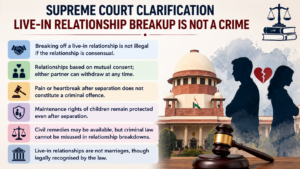
Supreme Court Clarification on Live-In Relationship Breakup Is Not a Crime
- India’s Supreme Court noted that breaking off a live-in relationship is not illegal if the relationship is consensual.
- This was observed in cases where there is a dispute between partners after prolonged cohabitation.
- The Court stressed that such relationships are consensual, and one partner could withdraw from the relationship.
- It was explained by the Court that these relationships are not equivalent to marriage, as we know, and therefore, the separation cannot be a crime.
- The Court pointed out that pain suffered after separation does not constitute an offence.
- It outlined the difference between consensual relationships and criminal acts such as rape or assault.
- What sets these cases apart is the concern for children – the Court highlighted that maintenance rights in children’s cases remain uncompromised even in separation.
- The case was heard amid growing cases of false promises of marriage in live-in relationships.
- The Court noted long-term co-residence is usually an indication of mutual consent.
- It also explained that relief might be available in civil law, but the criminal law cannot be abused in cases of relationship breakdown.
- The verdict supports the judicial view that live-in relationships are not marriages, though legally recognised.
- In all, the Supreme Court’s observations seek to curtail misuses of criminal law in personal relationships and preserve personal freedom.
Court Questioned the Nature of Relationship
On Monday, the Supreme Court of India noted that the termination of a live-in relationship, in and of itself, does not form the basis for a criminal charge, so long as it was consensual in nature. The court posed a legal inquiry into the nature of long-term cohabitation between consenting adults when considering post-separation allegations. It stressed that such relationships are consensual and need to be separated from criminal actions such as rape and assault. The court also emphasised that simply being upset or having a relationship break down is not enough to find someone guilty of a crime and went on to stress that “consensual relationships should not be construed as crimes”.
Conclusion – A Live-In Relationship Breakup Is Not a Crime
The Supreme Court commentary reiterates that a live-in relationship is consensual between two adults and does not involve legal and social obligations of marriage. As such, the termination of a live-in relationship, in and of itself, cannot be a criminal act. The Court has clearly separated consensual intimate relationships and criminal offences, thus ensuring that disputes arising during the split-up process are not abused for criminal accusations. This ensures the freedom of individuals, preservation of the liberty of persons and proper application of provisions of law in the breakdown of relationships.