

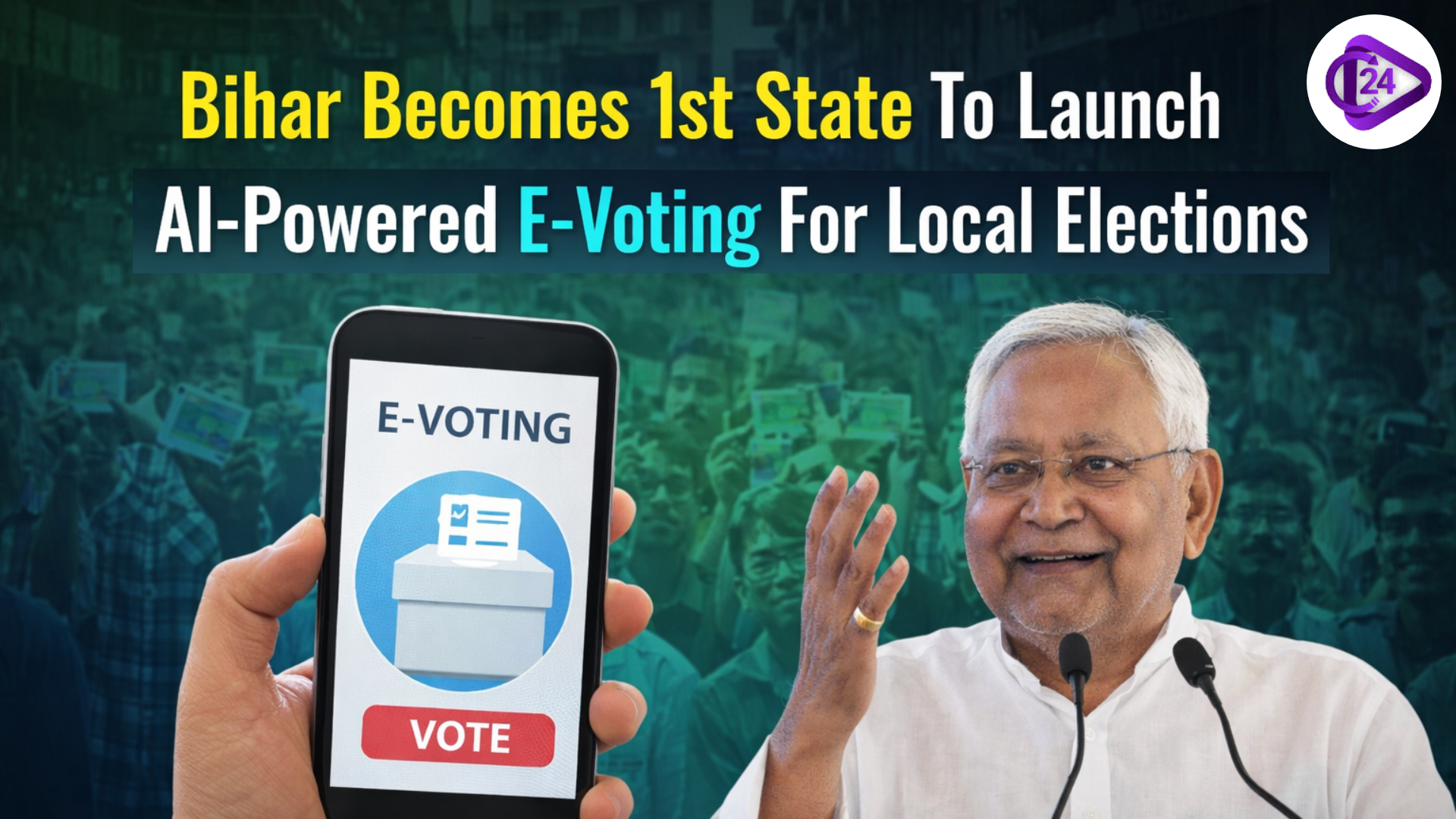
Bihar has become the first state in India to introduce an AI-enabled electronic voting system for local body elections. The initiative was implemented by the State Election Commission, Bihar, to expand voter access and improve transparency. The new platform allows eligible citizens, including migrant workers, senior citizens, persons with disabilities, and pregnant women, to cast their votes remotely using a secure digital system. The technology integrates artificial intelligence, facial recognition, and blockchain features to strengthen identity verification and data security. The system was highlighted at the India AI Impact Summit 2026, marking a significant move toward digital governance and electoral reform in India.
Significance of AI-Powered E-Voting For Local Elections
-
Bihar became the first Indian state to introduce an AI-enabled remote voting system for urban local body elections, setting a precedent for technology-driven electoral reform.
-
The initiative was implemented by the State Election Commission, Bihar, to make the voting process more inclusive and accessible.
-
The system allows eligible voters to cast their votes remotely through a secure mobile application, reducing the need to visit physical polling booths.
-
It particularly benefits migrant workers, students living outside their home districts, senior citizens, persons with disabilities, pregnant women, and individuals with medical constraints.
-
Artificial intelligence is used for facial recognition and live identity verification, helping prevent impersonation and duplicate voting.
-
Blockchain technology secures vote storage through encryption and decentralised record-keeping, ensuring data integrity and protection against tampering.
-
The digital platform is designed with verification and audit features to strengthen transparency and accountability in the electoral process.
- The system was showcased at the India AI Impact Summit 2026, highlighting its potential to shape future electoral innovations.
-
Overall, the initiative marks a major step toward expanding democratic participation through secure digital governance.
Best MCQs on Election Commission of India
Q. The Election Commission of India derives its authority from:
(a) Representation of the People Act
(b) Article 324 of the Constitution
(c) Parliamentary resolution
(d) Presidential ordinance
Answer: (b) Article 324
Explanation: Article 324 provides constitutional status and powers to the Commission.
Q. The Election Commission conducts elections to:
(a) Parliament only
(b) State Legislatures only
(c) Local bodies only
(d) Parliament, State Legislatures, President and Vice-President
Answer: (d) Parliament, State Legislatures, President and Vice-President
Explanation: Its jurisdiction covers all major constitutional elections.
Q. The Election Commission became a multi-member body in:
(a) 1985
(b) 1989
(c) 1993
(d) 2000
Answer: (c) 1993
Explanation: Since 1993, it has consisted of the Chief Election Commissioner and two Election Commissioners.
Q. The voting age was reduced to 18 years by:
(a) 42nd Amendment
(b) 44th Amendment
(c) 61st Amendment
(d) 73rd Amendment
Answer: (c) 61st Amendment
Explanation: The 61st Constitutional Amendment Act, 1988, lowered the voting age from 21 to 18.
Q. National Voters’ Day is observed on:
(a) 26 January
(b) 15 August
(c) 25 January
(d) 2 October
Answer: (c) 25 January
Explanation: It marks the foundation day of the Election Commission in 1950.
Q. The Chief Election Commissioner is appointed by the:
(a) Prime Minister
(b) Chief Justice of India
(c) President of India
(d) Parliament
Answer: (c) President of India
Explanation: The President appoints the CEC and other Election Commissioners.
Q. The tenure of the Chief Election Commissioner is:
(a) 5 years fixed
(b) 6 years or until 65 years of age
(c) 6 years or until 62 years of age
(d) 4 years fixed
Answer: (b) 6 years or until 65 years of age
Explanation: The term ends after six years or at age 65, whichever comes first.
Q. The Chief Election Commissioner can be removed in the same manner as a:
(a) Governor
(b) Supreme Court Judge
(c) Cabinet Minister
(d) Attorney General
Answer: (b) Supreme Court Judge
Explanation: Removal requires a parliamentary process similar to impeachment.
Q. Which of the following acts primarily governs the conduct of elections in India?
(a) Indian Penal Code
(b) Representation of the People Act, 1950 & 1951
(c) Government of India Act, 1935
(d) Anti-Defection Law
Answer: (b) Representation of the People Act, 1950 & 1951
Explanation: These Acts provide the legal framework for elections and electoral rolls.
Q. Which body supervises elections to Panchayats and Municipalities?
(a) Election Commission of India
(b) Parliament
(c) State Election Commission
(d) Supreme Court
Answer: (c) State Election Commission
Explanation: Articles 243K and 243ZA provide for State Election Commissions for local body elections.
Conclusion (Bihar Becomes 1st State To Launch AI-Powered E-Voting)
Bihar’s decision to introduce AI-powered e-voting for local elections marks a major step toward modernising India’s democratic process. By combining artificial intelligence, facial recognition, and blockchain-based security, the system aims to make voting more accessible, transparent, and secure. It especially benefits migrant workers, senior citizens, and persons with disabilities who may face difficulties reaching polling booths. This initiative reflects a growing shift toward digital governance and inclusive participation. If implemented effectively and securely, it could serve as a model for other states and potentially influence broader electoral reforms across the country in the coming years.