

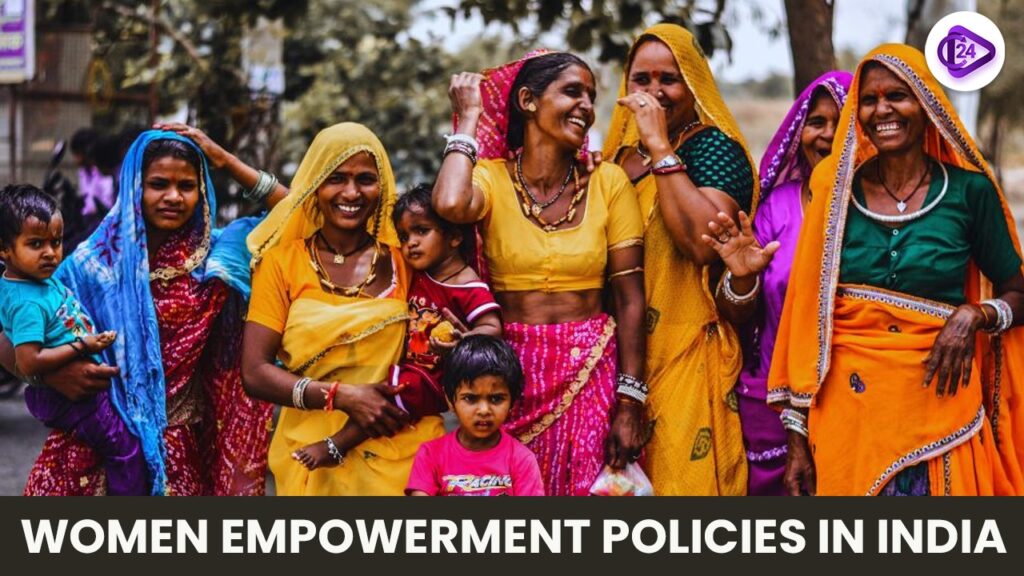
India's women empowerment journey is being shaped by bold policies that enhance financial inclusion, entrepreneurship, governance, and access to sanitation. Initiatives like Swachh Bharat Abhiyan and Jal Jeevan Mission have improved hygiene and reduced daily struggles for women. Government schemes such as Mudra Yojana and Stand-Up India are fostering female entrepreneurship. Increased representation in governance and judiciary is paving the way for long-term gender equality. The focus now is to sustain this momentum and drive inclusive growth.
Sanitation and Clean Water Initiatives
-
Swachh Bharat Abhiyan (SBM)
-
The initiative focused on delivering a holistic improvement in women's sanitary facilities as well as their sense of dignity and safety.
-
A total of 116 million homes received benefits which helped decrease open defecation activities and enhanced hygiene standards across the country.
-
Through its effort Maa Tarini Self-Help Group in Rourkela created shared bathrooms for patients with leprosy that improved feminine hygiene standards and maintained individual dignity
-
-
Jal Jeevan Mission (JJM)
-
The initiative established convenient access to drinking water for houses and thus lightened the water-related responsibilities of women.
-
Increased rural female workforce participation from 24.6% to 41.5% (2017-2023), especially in Bihar and Jharkhand.
-
The number of households with tap water connections has exceeded 150 million properties across India.
-
Women-Led Businesses and Financial Inclusion
-
Startup India Initiative
-
A total of 73,000 new businesses function with a minimum of one female representative on their leadership boards.
-
-
Government-backed Financing Programs
-
Stand-Up India Scheme distributed ₹53,609 crore worth of loans for 236,000 entrepreneurship ventures.
-
Mudra Yojana has sanctioned ₹32.36 lakh crore in loans which primarily benefited women entrepreneurs to the extent of 68 percent.
-
-
Digital Connectivity for Economic Inclusion
-
BharatNet & PM-WANI enabled high-speed Internet access at 199,000 villages and 247,000 Wi-Fi hotspots.
-
The Jan Dhan Yojana scheme succeeded in creating more than 300 million bank accounts for women.
-
-
E-commerce and Government Procurement
-
Women entrepreneurs form 8% of the sellers who conduct business on the Government e-Marketplace (GeM).
-
A total of 100,000 women-owned MSEs obtained contracts which resulted in ₹46,615 crore sales.
-
-
Women’s Representation in Governance
-
33% Reservation for Women in Legislative Bodies
-
Prime Minister Narendra Modi enacted this historic reform as a part of his governance measures.
-
-
Grassroots Leadership in Panchayati Raj Institutions (PRIs)
-
Neighborhood self-governance includes 46 percent women participation and 1.4 million women lead this system.
-
The governance system led by women provides better healthcare facilities together with better educational services and stronger public security measures.
-
-
Women in STEM and Other Sectors
-
The research and technological innovation sector benefits from 43% STEM-trained female graduates.
-
Increasing presence in sports, governance, and entrepreneurship.
-
-
Closing the Gender Gap in the Higher Judiciary
-
For the last century law professionals around India have steadily achieved notable progress in their representation of women. The upper judiciary contains few women judges while structural obstacles preside as major barriers to female legal professional growth.
-
Persistent Inequality in Higher Judiciary
-
Low Representation in High Courts
-
Women account for 14.27% of judiciary members since they comprise 109 judges within 764 positions.
-
Eight of the High Courts lack women judges while all others maintain single female members.
-
All high courts in Uttarakhand Meghalaya and Tripura remain without any female judges.
-
Out of 79 judges in Allahabad High Court, this judicial institution maintains only 3 female representatives (2 percent).
-
The later appointment of women judges at age 53 compared to men at age 51.8 results in their inability to assume senior roles in the judiciary.
-
Only one woman Chief Justice (Gujarat High Court) among 25 High Courts.
-
-
Low Representation in the Supreme Court
-
Justice B.V. Nagarathna and Justice Bela Trivedi (reaching retirement age in June 2025) make up the complete number of women judges within the Superior Courts of India today.
-
Since 2021 a total of 28 judicial appointments were made while no female judges were included in the list.
-
Since 1947 until today the Supreme Court has received only one female direct Bar appointment while nine male attorneys achieved this milestone.
-
Systemic Barriers to Women’s Appointment
-
Lack of Equal Opportunities
-
The process of selecting female judges receives more intense examination than the process used for men.
-
The verification process for judging talent requires women judges to demonstrate comparable abilities and competence above their male peers.
-
-
Opaque Collegium System
-
The judiciary lacks specific qualifying factors or evaluation standards to select appointees.
-
Many Collegium panels consist entirely of men who continuously fail to identify and propose worthy female candidates.
-
During the period from 2020 to the present day nine women nominees for High Courts encountered rejection and five women were denied judicial positions.
-
Steps Towards Gender Equality in Judiciary
-
Transparent and Inclusive Appointment Process
-
The collegium needs to create precise selection criteria that can be used for appointing judges.
-
Lawyers who wish to become judges need an established program to show their interest.
-
The selection process should define a definite period to speed up recommendations.
-
-
Ensuring Gender Diversity in Appointments
-
Judicial bodies that embrace all population sectors develop unbiased practices because diversity goes together with merit-based selection.
-
Gender diversity holds an equal importance in representation compared to State and religious and caste démographics.
-
The higher judiciary must include women who amount to at least one-third of all their members and ideally stand at fifty percent.
-
-
Building Public Confidence in an Inclusive Judiciary
-
A judiciary that reflects diversity strengthens both institutional legitimacy and fairness along with public trust of the judicial system.
-
The judiciary needs to establish gender equality as a fundamental goal for personnel selection within its appointments process.
-
Normalizing Women’s Leadership in Judiciary
-
Respecting women judges as routine exists above any form of special treatment.
-
Justice Banerjee emphasized to the media she refused any special distinction due to her gender during her appointment to the judgeship.
-
The target exists to completely normalize women's participation within the judiciary.
Conclusion
Indian society is transforming economically and sociologically as the country continues its efforts to empower women through enterprise programs and education opportunities and by extending financial access while providing equal representation in governance bodies and judicial roles. Maintaining this current buildup will result in long-term progress toward equality for the upcoming generations.