


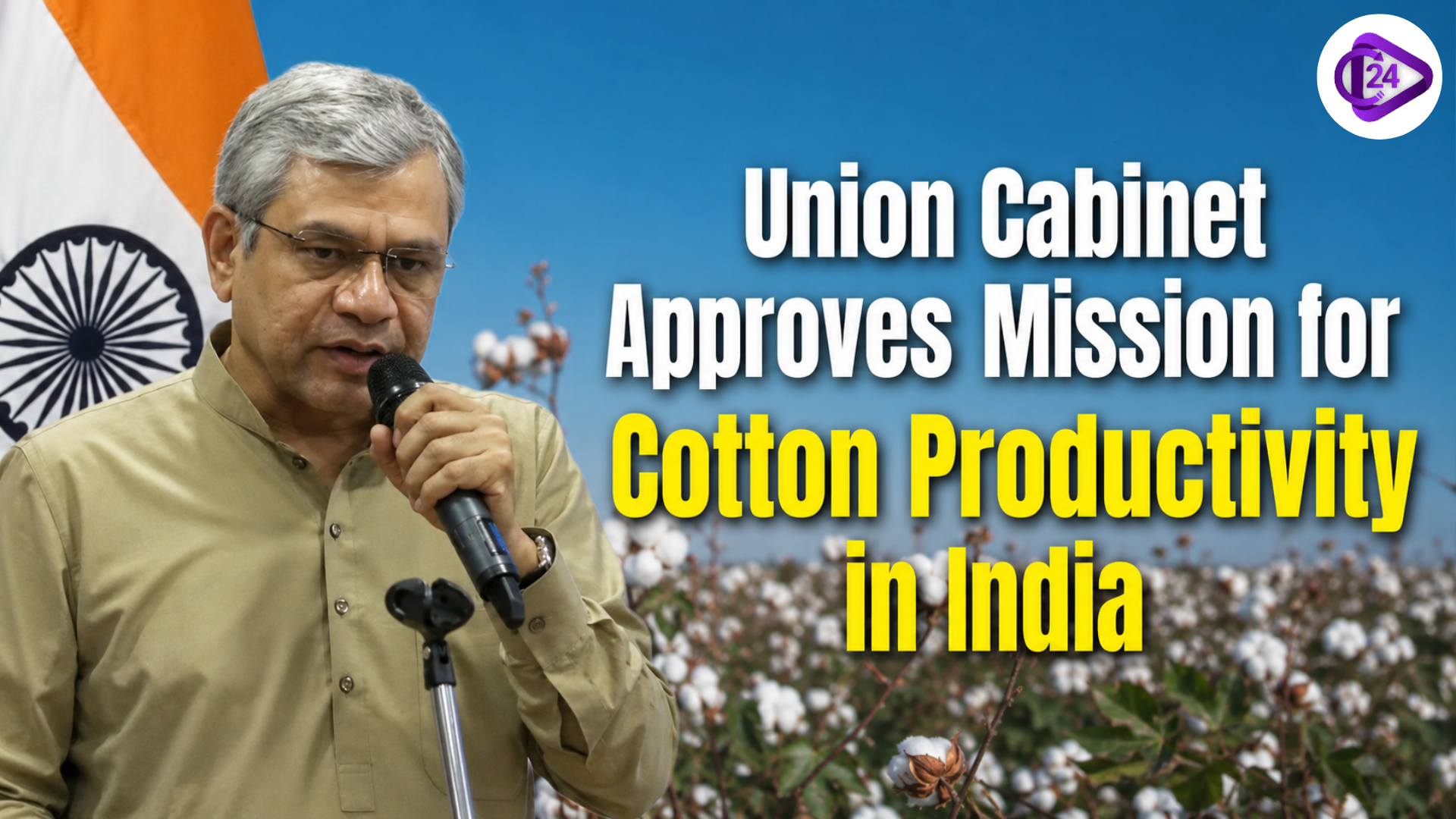
Mission for Cotton Productivity in India approved with an outlay of ₹5,659.22 crore for the 2026–27 to 2030–31 period by the Union Cabinet. The mission is to tackle cotton productivity and quality decline, along with issues concerning the cotton farmers in the country. Implementing this programme, the government aims to encourage sustainable production, improving the original quality of cotton and modern agricultural techniques and cotton high-yielding and disease-resistant varieties. The mission meshes with the Government of India’s 5F vision: Farm to Fibre to Factory to Fashion to Foreign. It is expected that it will boost farmer income, enhance the textile industry and, in turn, boost the export of cotton and help India become cotton-independent by 2030–31.
Key Highlights of Union Cabinet Approves Mission for Cotton Productivity
- The Union Cabinet gave its approval to the Mission for Cotton Productivity 2026-27, which is Rs 5,659.22 crore and to be implemented for 5 years from 2026-27 to ’30-’31.
- The mission was launched to address issues of bottlenecks, lack of growth and quality issues with the cotton sector in India.
- The initiative aims at improving the productivity of cotton and boosting the competitiveness of the Indian textile industry in the world.
- The government has targeted 498 lakh bales of cotton, bringing in scientific and technological practices till 2031.
- The productivity of lint is targeted to reach 440 to 755 kg/ha by 2031.
- This is a huge project for cotton farmers, with around 32 lakh farmers expected to benefit nationwide.
- It will help promote high-yielding, climate-resilient, and pest-resistant cotton seed varieties to enhance the mission.
- The advancement of the technologies for crop production will be done through Krishi Vigyan Kendra, state agricultural universities and the state governments.
- This programme will be implemented in a phase in the first place in 140 districts of 14 main cotton-producing states in India.
- There are also expected to be enhanced around 2,000 ginning and processing factories.
- Kasturi Cotton Bharat will be the platform to promote quality improvement, traceability & certification from the government.
- The mission also includes lowering the amount of cotton contamination and trash content to less than 2 per cent.
- Sustainable and natural fibres, including flax, bamboo, banana, ramie, sisal, and milkweed, will also be encouraged.
- This initiative will be implemented jointly by the Ministry of Agriculture & Farmers Welfare & Ministry of Textiles.
- Research and activities of implementation will be supported by various institutions such as ICAR, CSIR and state agricultural universities.
- Training of farmers, raising awareness and modernisation of agriculture will be key to enhancing productivity.
- The mission aligns with 5F vision of the Government – Farm to Fibre to Factory to Fashion to Foreign.
- The officials are confident that the programme will prove to be a positive change in the quality of cotton, boost Indian cotton exports, create a stronger textile sector, and make India self-reliant through cotton cultivation by 2030-31.
Why Does India Need the Mission for Cotton Productivity?
The Mission for Cotton Productivity should be implemented in India to solve various problems related to falling cotton yields, pest attacks, climate change, and quality defects in the cotton industry. India has one of the world’s largest cotton cultivation areas, but cotton production in India is still far less than the average level of the world. The textile sector is using imported superior quality cotton, particularly the Extra Long Staple (ELS) cotton, on which it also relies heavily. The mission will seek to boost productivity by introducing high-yield and climate-resistant seeds, modern farming techniques, effective pest control, and greater uptake of technology, the official government data reads. The initiative will also boost the textile value chain, farmer income, minimise dependency on imports, and boost India’s global competitiveness in the textile market.
Previous Year Questions and Answers on Cotton
| Question | Options | Answer |
| Which soil is most suitable for cotton cultivation in India? | A) Alluvial Soil B) Black Soil C) Laterite Soil D) Red Soil | Black Soil |
| Which state is the largest producer of cotton in India? | A) Punjab B) Maharashtra C) Gujarat D) Haryana | Gujarat |
| Cotton is primarily which type of crop? | A) Beverage Crop B) Fibre Crop C) Plantation Crop D) Pulse Crop | Fibre Crop |
| Which process separates cotton fibres from seeds? | A) Harvesting B) Ginning C) Threshing D) Winnowing | Ginning |
| Cotton is mainly grown during which season in India? | A) Rabi B) Kharif C) Zaid D) Winter | Kharif |
| Which climatic condition is ideal for cotton cultivation? | A) Cold and Wet Climate B) Moderate Temperature with Heavy Snowfall C) High Temperature with Moderate Rainfall D) Extremely Dry Climate | High Temperature with Moderate Rainfall |
| Which soil is also known as Black Cotton Soil? | A) Regur Soil B) Laterite Soil C) Peaty Soil D) Red Soil | Regur Soil |
| Which pest is commonly associated with damage to cotton crops? | A) Locust B) Bollworm C) Aphid D) Whitefly | Bollworm |
| Which region of India is famous for cotton cultivation? | A) Indo-Gangetic Plain B) Deccan Plateau C) Himalayan Region D) North-East Hills | Deccan Plateau |
| Which of the following is an important cash crop of India? | A) Wheat B) Rice C) Cotton D) Gram | Cotton |
Vande Mataram Insult to Become Punishable Offence
Conclusion – Mission for Cotton Productivity
The cotton productivity mission is expected to take cotton production to greater heights, uplift the cotton producer’s income, and boost the cotton industry in India. Highly productive and quality seeds, farming methods, and sustainable agricultural practices are some of the ways the mission seeks to address these low-productivity and poor-quality problems with cotton. It is expected to give a big boost to the Indian textile industry and to make India independent of imports. The project will also empower cotton farmers with decades of life span by providing technology-driven and climate-smart farming practices for a sustainable future.