

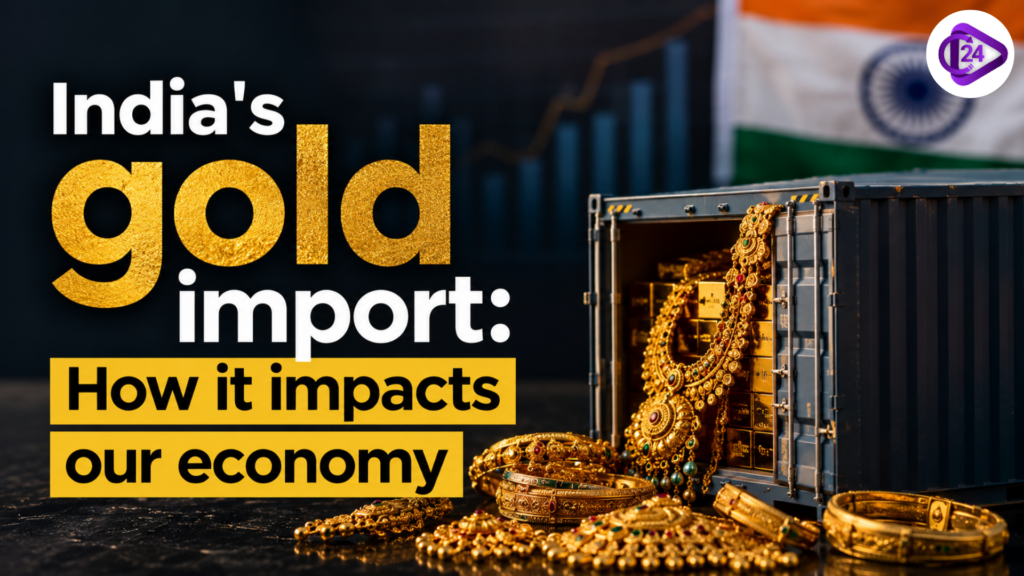
India is a major user, consumer and importer of gold. Domestic manufacturing of gold is minimal and the country heavily relies on imports to cater to the demand of jewellery, investment, and cultural purposes. The World Gold Council says imports accounted for almost 86% of gold availability in India during 2016 to 2020. High imports of gold lead to higher import bill and pressure on foreign exchange reserves as most of the gold payments are made in US dollars. For this, the Government of India often raises and lowers import duties and implements schemes such as the Gold Monetisation Scheme to curb the reliance on imported gold.
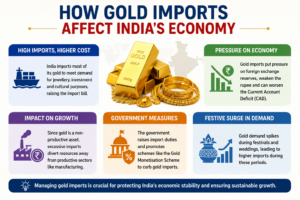
How Gold Imports Affect India’s Economy
- Gold is extensively being imported to India annually as there is a high demand for jewellery and investment.
- More money would flow out than in if more gold is imported than is exported.
- After imports of gold, pressure on foreign currency reserves will be created because all payments will be done in dollars.
- With a surge in gold imports, the rupee can get appreciably weaker than the dollar.
- Some times, government will increase customs duty on gold to minimize unnecessary import of gold.
- To control gold imports and shore up the rupee, India increased import duty on gold to 15% from 6% in May 2026.
- If imports rise substantially, there is a risk of worsening of the CAD, an important economic indicator.
- As reported by WGC, gold imports in 2010 went beyond 900 tonnes raising doubts on possible economic instability.
- Gold is not a productive asset because generally it is not being used in industry, but is simply being stored.
- Uncontrolled gold transaction decreases investments in the productive sectors such as manufacturing business.
- In India, gold demand goes up during festive seasons, weddings and when the economy is uncertain.
- Often high import duties provoke gold smuggling and illegal transactions.
- During 2013-2014, Indian Government imposed strict restriction on import and sell a lot of Gold in India.
- The government took the initiative to launch the Gold Monetisation Scheme to shift the stagnant gold collected from households and cut down on import of gold.
- It also helps the jewellery sector, besides enabling jobs in export market, which is fuelled by gold imports.
- Gems and jewellery industry is an important sector of exports and employment in India.
- The upswing in global gold rates push India’s import costs up even more.
- In times of crisis around the world, Indians tend to invest more weight in purchasing gold which is a safe asset.
- To keep the economy stable and foreign reserves intact, economists say it is important to import and export balanced gold coins.
- RBI and Government keep a check on the gold import to shield the economy against external financial pressures regularly.
Reasons Why Gold Imports Are Important for India
Gold imports are a vital part of the Indian economy because gold is an integral part of the Indian culture, their savings and investment practices. India is one of the biggest gold markets in the world with millions of families buying gold during marriage and festivals. Imported gold also ensures jobs for lakhs of people working in the jewellery business and exports from the country. Too much reliance on imported gold, however, leads to a pressure on the foreign exchange reserves and trade deficits. Government imposes import charges, makes policy changes and implements monetisation schemes to maintain economic growth while controlling financial stability. Experts estimate that by limiting fruit imports and encouraging productive investments, one will bolster India’s economy in the long run.
Most Important PYQs
| Exam Name | Year | Question | Options | Answer |
| UPSC Prelims | 2015 | What is the main objective of the Gold Monetisation Scheme? | A. Increase gold imports B. Reduce idle gold and imports C. Promote gold smuggling D. Increase GST | B. Reduce idle gold and imports |
| RBI Grade B | 2021 | High gold imports mainly affect which economic indicator? | A. Fiscal Deficit B. CAD C. Repo Rate D. GDP Deflator | B. CAD |
| SSC CGL | 2020 | India imports gold mainly because: | A. High domestic mining B. Low gold demand C. Low domestic production D. Gold export policy | C. Low domestic production |
| UPSC Prelims | 2019 | Which institution releases reports on India’s gold market trends? | A. SEBI B. NABARD C. World Gold Council D. NITI Aayog | C. World Gold Council |
| Banking Exam | 2022 | Gold imports are paid mainly in which currency? | A. Rupee B. Yen C. Euro D. US Dollar | D. US Dollar |
| SSC CHSL | 2023 | Which sector benefits directly from gold imports in India? | A. Textile B. Jewellery C. Agriculture D. Railways | B. Jewellery |
Conclusion – India’s gold import
The import of gold still poses economic difficulties and is a significant cultural essential to India. On the one hand, gold supports jewellery industries, provides employment opportunities and helps in saving for the households, on the other hand, too many imports brings about a trade deficit and strain on foreign exchange reserves. In order to ensure an economic balance on an ongoing basis, the government periodically adjusts import duties and implements measures to reduce the dependence on imported gold. It is thought that growing demand for investment and utilising unutilised gold as a form of income could help to reduce dependency on imports in the future. The gold policy of the Government of India will strike a balance between public demand for gold and longrun economic stability. Essential is therefore the proper management of gold imports in order to boost the Indian economy and save the value of the rupee.