


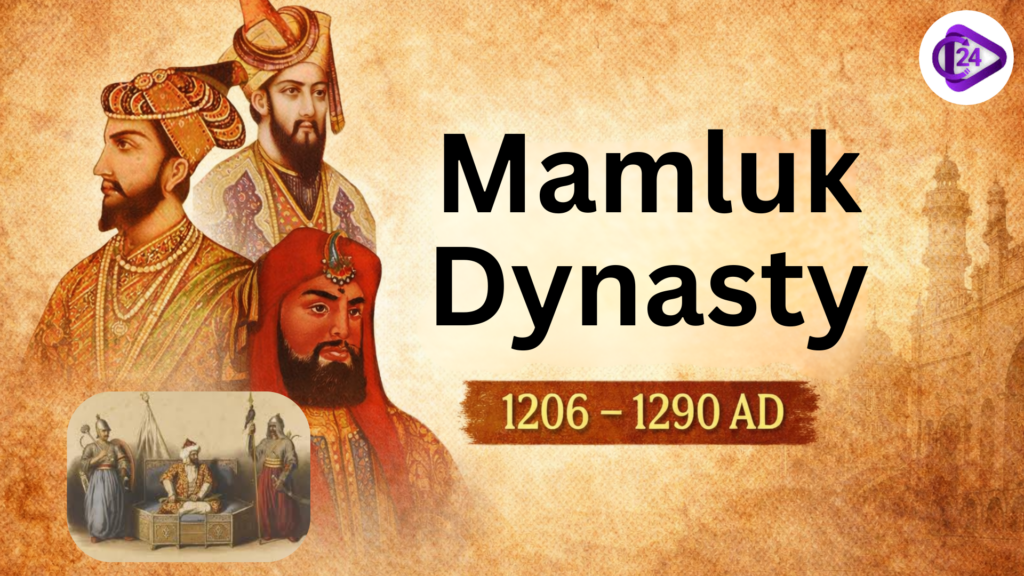
Mamdani, or Mamluk Dynasty, or Slave Dynasty (1206-1290 AD), was the reign of a dynasty that marked the start of the Delhi Sultanate. This dynasty was founded by Qutb-ud-din Aibak, a former slave who became the ruler and established the basis for a centralised form of governance in northern India. Qutb-ud-din Aibak will always be remembered for laying the foundation of the construction of the Qutub Minar in Delhi, which is a masterpiece of Indo-Islamic architecture. The dynasty concentrated on the enhancement of administration, military structure, and the enforcement of laws. The Mamluk rulers, despite other issues like regional rebellions, created political stability and left an impressive legacy in architecture, governmental systems, and culture.
Emergence of Slave Dynasty
- Qutb al-Din Aibak was the founder of the Slave Dynasty, or the Mamluk Dynasty.
- Aibak was originally a slave and ascended the hierarchy of the Ghurid ruler, who was the Mohammed of Ghor, and he played a decisive role in bringing about the Muslim rule in India after the Ghurid conquests.
- He claimed to be the Sultan of Delhi, and the Delhi Sultanate began in the year 1206.
- His rule was marked with a lot of architectural work, such as the Qutub Minar being built, and he is given credit for putting the roots of a new political structure in northern India.
- The rule of Aibak began the consolidation and expansion era as well, which was a precursor to other dynasties in the region.
- He is famous because his legacy created a unique Indo-Islamic culture, which would succeed in the future.
Qutb-ud-din Aibak (1206-10 AD)
- One of the most skilful warriors who served the dynasty was Qutb-ud-din Aibak, after the death of Muhammad Ghori in AD 1206.
- Qutb-ud-din Aibak had played a pivotal role in furthering his empire in India, especially after the second Battle of Tarain.
- The real founder of the Delhi Sultanate is Qutb-ud-din Aibak, the first independent Muslim leader in Northern India.
- ‘Lakha Baksh Sultan’, or ‘giver of lakhs’, was the title given to Qutb-ud-din Aibak because he was so generous.
- Qutb-ud-din Aibak was a warrior of true faith.
- Qutb-ud-din Aibak was later killed in 1210 on the ground by injuries from falling off his horse during the game of chaughan (polo).
- Qutb-ud-din Aibak was an excellent patron of learning and sponsored such writers as Hasan-Un-Nizami and Fakhruddin.
- It was Qutb-ud-din Aibak who started the work on Qutb Minar (in honour of the legendary saint, Sufi Khwaja Qutubuddin Bakhtiyar Kaki), and his successor Iltutmish was able to finish the work on Qutb Minar after his death.
- Qutb-ud-din Aibak also built the Quwwat-ul-Islam mosque at Delhi and Adhai Din Ka Jhonpra at Ajmer.
Aram Shah (1210-1211 AD)
- After the death of Qutb-ud-din Aibak, the Amir and Malik of Lahore put Aram Shah on the throne.
- His reign was short, and he was held as a weak and useless leader.
- Aram Shah was defeated by the governor of Badaun, Iltutmish, and the throne was attained by him.
Shams-ud-din Iltutmish (1211-36 AD)
- The second most notable ruler of the Mamluk was Iltutmish. The Baghdadi caliph addressed him with the title of Sultan.
- There were several challenges that he had to contend with during his tenure. Many important commanders, Ali Mardan Khalji, Nasir ad-din Qabacha and Taj al-din Yildiz, contested for independent territories.
- The emergence of Mongol power posed a formidable threat to the North-West Frontier of the Sultanate.
- Moreover, in spite of this considerable danger, he fought it out and attained numerous achievements. He formed a company of forty (40) loyal slave amirs, who were also called Turkan-i-Chihalgani, or Chalisa.
- Iltutmish contributed a lot to the currency system, the army, and the Iqtas in the field of administration.
- He led the introduction of the Iqta-dar System, where the nobles and their officers were granted lands in place of salary.
- Iltutmish completed the construction of the Qutb Minar and also built a mosque.
- To augment the military of the Sultan, Iltutmish tried to form a centrally recruited army. He also helped market the silver tanka and the billion jital, which were the two circulating coins during the time.
- The twenty-six years of Iltutmish may be considered in the following three phases:
- First Phase (1210-20 AD): At the time, he was busy with the elimination of power rivals to his reign.
- Second Phase (1221-27 AD): He also took care of the Mongol menace at this time.
- Third Phase (1228-36 AD): It was a significant time when he committed himself to consolidating his dynasty.
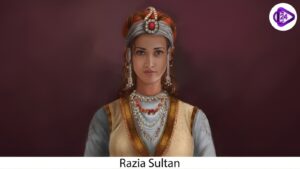
Razia Sultan (1236-40 AD)
- The one and only female ruler in the Sultanate and Mughal power was Razia Sultan.
- Iltutmish believed that all of his sons were useless to the throne and appointed her daughter, Razia, as heir to the throne.
- She was a highly eligible administrator, and there was absolute law and order under her rule.
- Razia was able to defeat the Multan, Lahore and Hansi revolts.
- She established herself as the master of horses (akhara) with the help of an Abyssinian slave named Jamal-ud-Din Yakut.
- The Turkish upper class and religious leaders, who were mostly Turkish, did not treat her as their leader and hatched a plot to assassinate her. The reign of Razia was terminated in 1240 AD.
- There was a serious rebellion in Bhatinda. Altunia, the governor of Bhatinda, did not acknowledge the suzerainty of Razia. Razia followed with Yakut to attack Altunia.
- Although Altunia killed Yakut and sent Razia to prison. Then, Razia got married to Altunia and marched to Delhi.
- Razia fell prey to a conspiracy in 1240 and was assassinated at Kaithal (Haryana).
Nasir-ud-din Mahmud (1246-66 AD)
- This younger son of Iltutmish was declared the ruler of the Sultanate between 1246 AD and 1266 AD.
- He was considered a kind-hearted and God-fearing ruler. He used most of his hours in making verses of the Quran.
- Mahmud was a strict adherent of monotheism, unlike many of his predecessors and successors.
- Nasir-ud-din Mahmud was married to the daughter of Balban, his prime minister, and handed him all the powers.
- Ibn Battuta reports, and Islami repeats his account: Balban had the poison milked out of Nasir-ud-din and mounted on the throne.
Ghiyas-ud-din Balban (1266-87 AD)
- A Turkish slave, Ghiyas-ud-din Balban alias Ulugh Khan, took over the reign of the dynasty upon the demise of Nasiruddin Mahmud.
- The law and order in Delhi and the Doab region were at a very bad state during the time of Balban.
- The Rajput zamindars had set up forts in the eastern region of Awadh and the Ganga-Yamuna doab. Balban strived to improve the status of the sultan and continue the autocratic rule.
- Historians regard Balban’s reign as one characterised by consolidation and not expansion.
- Law and order in and around Delhi, as well as the Doab, deteriorated.
- Robbers and dacoits overran the highways, making communication difficult
- Balban tried to address these factors by using a blood and iron policy. In Mewat, a lot of them were brutally hunted down and killed.
- In the districts of Badayun, the strongholds of the Rajput were ruined, the jungles deforested, and groups of Afghan soldiers were posted along the country roads. Through these cruel means of action, Balban kept the situation under control.
- The Petering of Balban introduced much in administrative and military reform:
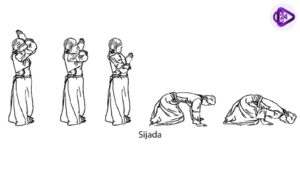
- Ballan came up with the ceremony of Sijadah (prostration) and Paibos (kissing the feet) to elevate the stature of the Sultan.
- Balban restructured the army and had an effective spy network.
- Balban broke the power of Chalisa and resorted to the prestige of the crown.
- The increased powers of Balban displeased several of the Turkish lords. They, consequently, hatched a conspiracy (1253) and dethroned Balban from his office.
- Imaduddin Raihan, who was an Indian Muslim, replaced Balban.
- His elder son, Prince Muhammad Khan, died in a battle with the Mongols in 1285 and became the heir of Balban.
- With his power consolidated, Balban took the magnified title of Zil-I-Ilahi.
- The theory Niyamat-e-Khudia (representative of God) was propounded by Balban.
- In his inscription on the walls of the mosque at Garhmukteshwar, Balban called himself the Helper of the Caliph.
- Balban reinforced his empire against the Mongol invasion.
- Balban ordered the nobles to stop living in luxury.
- Balban also presented the Persian festival of Nowruz to impress the nobles and people with his wealth and power.
- Balban encouraged many Muslim scholars and provided refuge to numerous Central Asian refugees.
- Balban restructured the military sector (diwan-i-arz) and stationed the army in other regions of the country.
- Balban was regarded as the architect of the Sultanate of Delhi, primarily on government and institutional scales.
- Following his death in the year 1287 AD, the grandson of Qaiqabad took over the throne. The state of affairs of the government during this time became disorganised, and the nobles started to establish war alliances that would take over the government.
- The Araz-I-Mamalik (minister of war), Jalaluddin Khalji, concentrated all the powers in his hands and killed Qaiqabad.
- This event saw the termination of the Slave dynasty in 1290 AD, and the new dynasty of Khalji rose to power, led by the leadership of Jalaluddin Khalji.
Sijada and Paibos – Ghiyas-ud-din Balban
- He initiated sijada (prostration) and paibos, which is kissing the feet of the king.
- Balban believed in masculine despotism. He felt he could only find obedience from his people through an autocrat to provide security for the state.
- The best input Balban made was creating a standing army in the centre and a section of the army known as the Diwan-i-Arz.
- Balban believed that kingship honour could only be achieved through the Persian way, which he strictly adhered to in both his personal and official lives.
- Balban emphasized on Genealogy, where he asserted that he was a descendant of the mythical Turkish hero Afrasiyab. His kingship theory, combined with his blood and iron policy, was a significant dividend. He promoted the greatness of the Delhi sultanate.
Art and Architecture of Slave Dynasty
The Mamluk dynasty erected several spectacular monuments and structures in their rule. Some of the important buildings constructed by the Mamluk, or Slave, dynasty include the following:
- The Qutb complex,
- The Qutb Minar,
- The tomb of Iltutmish,
- The Tomb of Balban,
- The Quwwat ul-Islam mosque,
- Nasir-ud-din Mahmud, the tomb of.
- The Adhai Din ka Jhonpara etc.
Administration of Mamluk Dynasty
- The spread of the Delhi sultanate resulted in the development of a strong and effective administration system.
- A sultan was the leader of the government and the sovereign of a given territory, independent of any other power. The royal household had numerous officials to take care of.
- The wazir was the most important person in the central administration as the head of the diwan-i-wizarat.
- The wizarat collected revenue, balanced expenditure, maintained accounts, paid salaries, and provided revenue distribution (Iqra) at the request of the sultan.
- The Diwan-i-arz, or military department, was under the leadership of the ariz-i mumalik. Administration of military affairs was under his responsibility. He examined the forces kept by the iqta holders.
Conclusion – Slave Dynasty
Slave Dynasty was the cornerstone of the Delhi Sultanate and contributed heavily to Indian history during medieval times. Qutb-ud-Din Aibak, Iltutmish, and Balban were rulers who strengthened administration, coined centralized rule, and rescued the empire against the foreign enemies. It is also during this time that the architecture and the culture in the area were hugely developed. The Slave Dynasty was subsequently characterised by internal conflicts; however, the matter left a significant mark on the administration and legacy of India as the dynasty established a substantive political and administrative base for succeeding dynasties.