

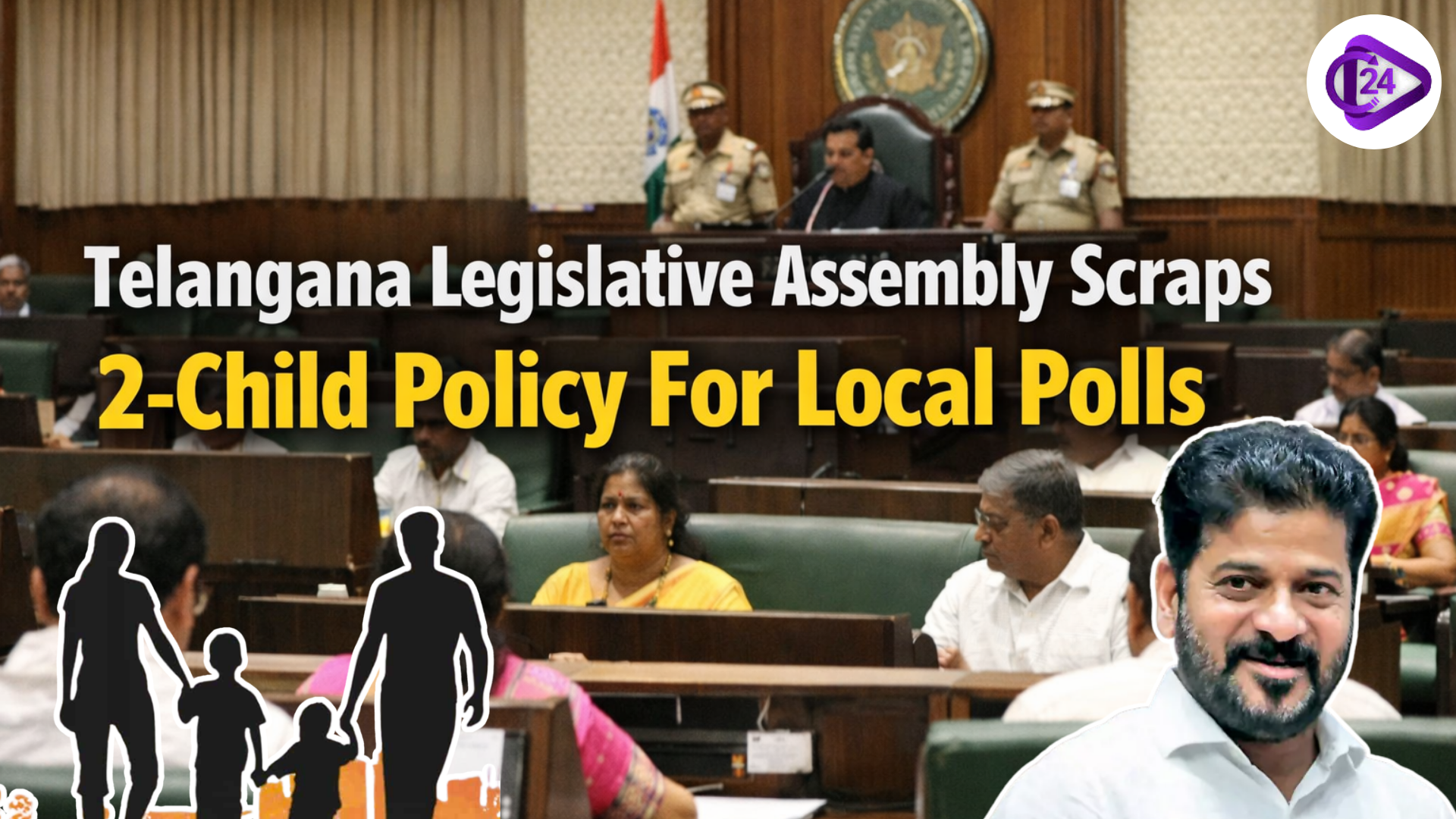
The Telangana Legislative Assembly has passed a bill abolishing the two-child norm that had been in force since the 1980s and which previously disqualified adults with more than two children from being elected to local bodies. Initially introduced in 1994 as a rule to respond to high population growth and the problems that followed, such as food security issues and high unemployment rates, the rule can now be regarded as old-fashioned, given recent demographic trends. With rural Telangana’s fertility rate having fallen to 1.7, a below-replacement level, the amendment is intended to bring electoral rules in line with current realities and to stimulate broader political engagement at the grassroots.
Telangana Scraps 2-Child Policy for Local Elections: Key Details
-
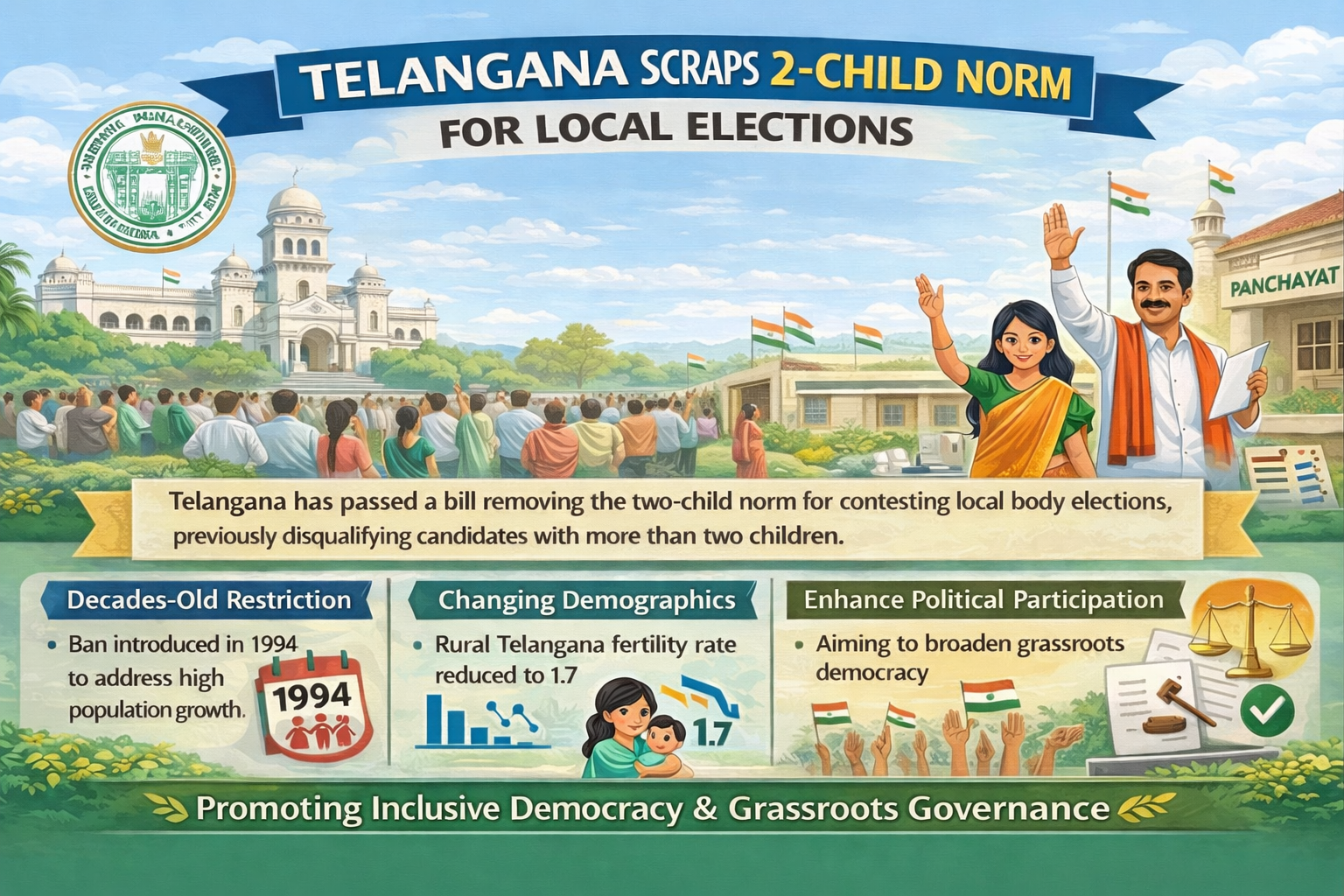
In an attempt to eliminate the long-standing two-child norm used in local body elections, the Telangana Legislative Assembly passed the Telangana Panchayat Raj (Amendment) Bill, 2026, to abolish it.
-
This rule used to prevent people with more than two children from contesting Gram Panchayat elections.
-
The restriction was introduced in 1994 to address concerns about population growth, food security, and unemployment.
-
State ministers reported that demographic behaviour has changed; the total fertility rate in rural Telangana stood at 1.7, below replacement level.
-
The repeal is intended to align electoral laws with current demographic reality and to promote greater participation in the political arena at the grassroots level.
Important Previous Year Questions For Panchayat Raj
| Exam | Year | Question (Panchayati Raj) | Correct Answer |
|---|---|---|---|
| RPSC 2nd Grade I | 2022 | Which constitutional amendment gave Panchayati Raj institutions constitutional status and security? | 73rd Amendment |
| CET (Graduation) | 2024 | Which constitutional amendment grants Panchayati Raj institutions constitutional status? | 73rd Amendment |
| UPSSSC Gram Panchayat Adhikari | 2025 | In which state was Panchayati Raj first established? | Rajasthan |
| UPSSSC Gram Panchayat Adhikari | 2025 | The Panchayati Raj system began on 2 October 1959 in which place? | Nagaur, Rajasthan |
| UPSSSC Gram Panchayat Adhikari | 2025 | Panchayati Raj was first started in India in the state of __________. | Rajasthan |
MCQs Based on Exam Orientation
Which constitutional amendment gave Panchayati Raj institutions constitutional status in India?
A. 42nd Amendment
B. 73rd Amendment
C. 44th Amendment
D. 74th Amendment
Answer: 73rd Amendment
Explanation: The 73rd Amendment Act, 1992, provided constitutional recognition, structure, and powers to Panchayati Raj institutions.
Who chaired the Balwantrai Mehta Committee, which laid the foundation for the Panchayati Raj system?
A. Balwantrai Mehta
B. Ashok Mehta
C. L.M. Singhvi
D. R. Narayanan
Answer: Balwantrai Mehta
Explanation: The Balwantrai Mehta Committee recommended the three-tier Panchayati Raj system, emphasising democratic decentralisation.
In which state was the Panchayati Raj system first implemented in India?
A. Gujarat
B. Maharashtra
C. Rajasthan
D. Uttar Pradesh
Answer: Rajasthan
Explanation: Rajasthan implemented the Panchayati Raj system in Nagaur district in 1959, following the Balwantrai Mehta Committee recommendations.
Which of the following statements regarding the Ashok Mehta Committee is correct
-
Recommended a two-tier Panchayati Raj system
-
Suggested strengthening Zilla Parishads and Panchayat Samitis
-
Introduced the concept of district-level planning
A. 1 and 2 only
B. 2 and 3 only
C. 1 and 3 only
D. All three
Answer: All three
Explanation: The Ashok Mehta Committee emphasised district planning, consolidation of Panchayati Raj, and creating stronger Zilla Parishads and Panchayat Samitis.
The tenure of Panchayati Raj bodies, as per the 73rd Amendment, is
A. 3 years
B. 4 years
C. 5 years
D. 6 years
Answer: 5 years
Explanation: Every Panchayat is elected for five years, with elections held before the expiry of the term.
Which article of the Constitution empowers the State Finance Commission to recommend the distribution of financial resources to Panchayati Raj institutions?
A. Article 243G
B. Article 243H
C. Article 243K
D. Article 243B
Answer: Article 243H
Explanation: Article 243H provides for the constitution of State Finance Commissions every five years to recommend devolution of funds to Panchayats.
The Panchayat Extension to Scheduled Areas (PESA) Act, 1996, mainly aims to
A. Extend Panchayati Raj to urban areas
B. Provide tribal self-governance in scheduled areas
C. Establish Panchayati Raj at the district level only
D. Provide central funding to all Panchayats
Answer: Provide tribal self-governance in scheduled areas
Explanation: PESA empowers tribal communities in Scheduled Areas, allowing them to exercise local self-governance and protect traditional rights.
Which of the following statements regarding Gram Sabha is correct
-
Comprises all adult residents of the village
-
Reviews the annual budget and development plans of the Gram Panchayat
-
Has the power to dissolve the Panchayat
A. 1 and 2 only
B. 2 and 3 only
C. 1 and 3 only
D. All three
Answer: 1 and 2 only
Explanation: Gram Sabha includes all adults and approves budgets, but cannot dissolve the Panchayat, which is done by a higher authority if required.
Who chaired the L.M. Singhvi Committee, which reviewed Panchayati Raj institutions in the early 1980s?
A. Balwantrai Mehta
B. Ashok Mehta
C. L.M. Singhvi
D. R. Bommai
Answer: L.M. Singhvi
Explanation: The L.M. Singhvi Committee suggested measures to improve the effectiveness of Panchayati Raj and strengthen grassroots democracy.
Which amendment also provides constitutional status to urban local bodies, similar to Panchayati Raj?
A. 42nd Amendment
B. 73rd Amendment
C. 74th Amendment
D. 44th Amendment
Answer: 74th Amendment
Explanation: The 74th Amendment, 1992, gives constitutional recognition, powers, and structure to municipalities and urban local bodies.
Conclusion (Telangana Local Elections: 2-Child Restriction Ends)
The Telangana Legislative Assembly's decision to lift the two-child limit on the local elections is indicative of the new demographic dynamics and the desire to become an inclusive government. The elimination of the old limit is expected to promote a greater involvement, enhance the grassroots democracy and make the electoral legislation relevant to the modern social and population reality.