

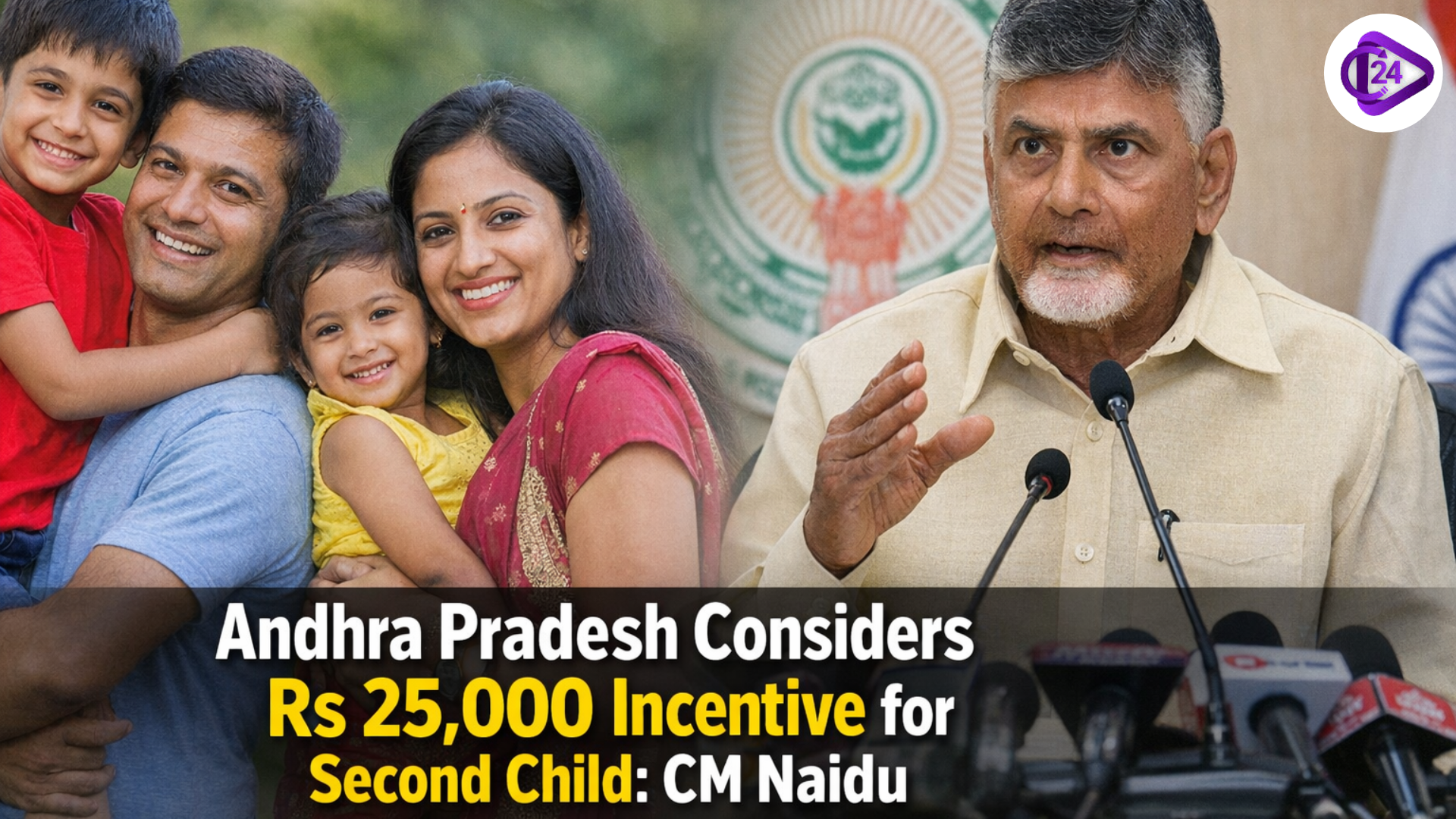
Andhra Pradesh is considering a new population-support initiative aimed at encouraging families to have more children. The proposal, announced by Chief Minister N. Chandrababu Naidu, suggests providing a financial incentive of ₹25,000 for families welcoming a second child. The idea is part of a broader discussion on demographic balance, declining fertility rates in some regions, and long-term economic sustainability. The government of Andhra Pradesh is examining how such incentives could support young families, improve child welfare, and strengthen the state’s future workforce. If implemented, the scheme could become an important step in population and social policy.
Key Points on A P’s Proposed ₹25,000 Incentive for Second Child
-
The government of Andhra Pradesh is exploring a proposal to provide ₹25,000 financial assistance to families for the birth of a second child. The move is aimed at supporting families and addressing demographic concerns.
-
Chief Minister N. Chandrababu Naidu highlighted the importance of maintaining a balanced population structure to ensure long-term economic stability and workforce availability.
-
The proposed incentive would likely be targeted toward eligible families through a state welfare scheme, ensuring that financial support reaches households that need it most.
-
Officials are studying population trends and fertility rates to determine whether policy incentives are needed to encourage family growth.
-
If approved, the incentive could help reduce financial pressure on parents, particularly during early child-rearing stages such as healthcare, nutrition, and education.
-
The proposal also reflects the government’s broader focus on family welfare and social security programs designed to support mothers and children.
-
The initiative may be integrated with existing maternal and child health schemes, ensuring improved healthcare access and better outcomes for infants and mothers.
-
Economists note that balanced population growth is essential for maintaining a stable labor force, supporting economic development, and sustaining social welfare systems.
-
The government is expected to consult policy experts, economists, and health officials before finalizing the details of the incentive program.
-
If implemented successfully, the scheme could become a model for other states in India seeking to address demographic challenges while supporting family well-being.
PYQs on Demography
| Exam | Year | Question | Answer |
|---|---|---|---|
| UPSC Civil Services Prelims | 2011 | India is regarded as a country with a demographic dividend. This is due to which factor? (a) High population below 15 years (b) High population in 15–64 years (c) High population above 65 years (d) High total population |
High population in the age group 15–64 years, which increases the working-age population and economic productivity. |
| UPSC Civil Services Prelims | 2009 | Consider the following statements: (1) Between Census 1951 and 2001 population density increased more than three times. (2) During the same period the annual population growth rate doubled. Which statement is correct? |
Neither statement 1 nor 2 is correct according to census statistics. |
| UPSC Civil Services Prelims | 2019 | What does the term demographic dividend refer to? | Economic growth potential that arises when the working-age population is larger than the dependent population. |
| SSC CGL | 2017 | According to Census 2011, India’s population increased by how much during the decade 2001–2011? | Around 182 million people were added to India’s population during this decade. |
| SSC CHSL | 2018 | Which state has the highest population density in India according to Census 2011? | Bihar has the highest population density among Indian states. |
| NDA & NA | 2017 | Which Indian state has the lowest population density? | Arunachal Pradesh has the lowest population density due to its mountainous terrain and forest cover. |
| CDS | 2018 | During which census did India’s population cross one billion? | Census 2001 recorded India’s population crossing the one billion mark. |
| IBPS Banking Exam | 2019 | Replacement level fertility is approximately how many children per woman? | Around 2.1 children per woman, which maintains a stable population level. |
Raksha Rajya Mantri Opens Chungthang-Lachen Road
Conclusion
Proposal by N. Chandrababu Naidu to provide a ₹25,000 incentive for families having a second child reflects a proactive approach to addressing demographic concerns and supporting family welfare in Andhra Pradesh. The initiative aims to ease financial pressures on parents while encouraging balanced population growth. If implemented effectively, the policy could strengthen social security, improve child welfare, and contribute to the state’s long-term economic stability and workforce development.