

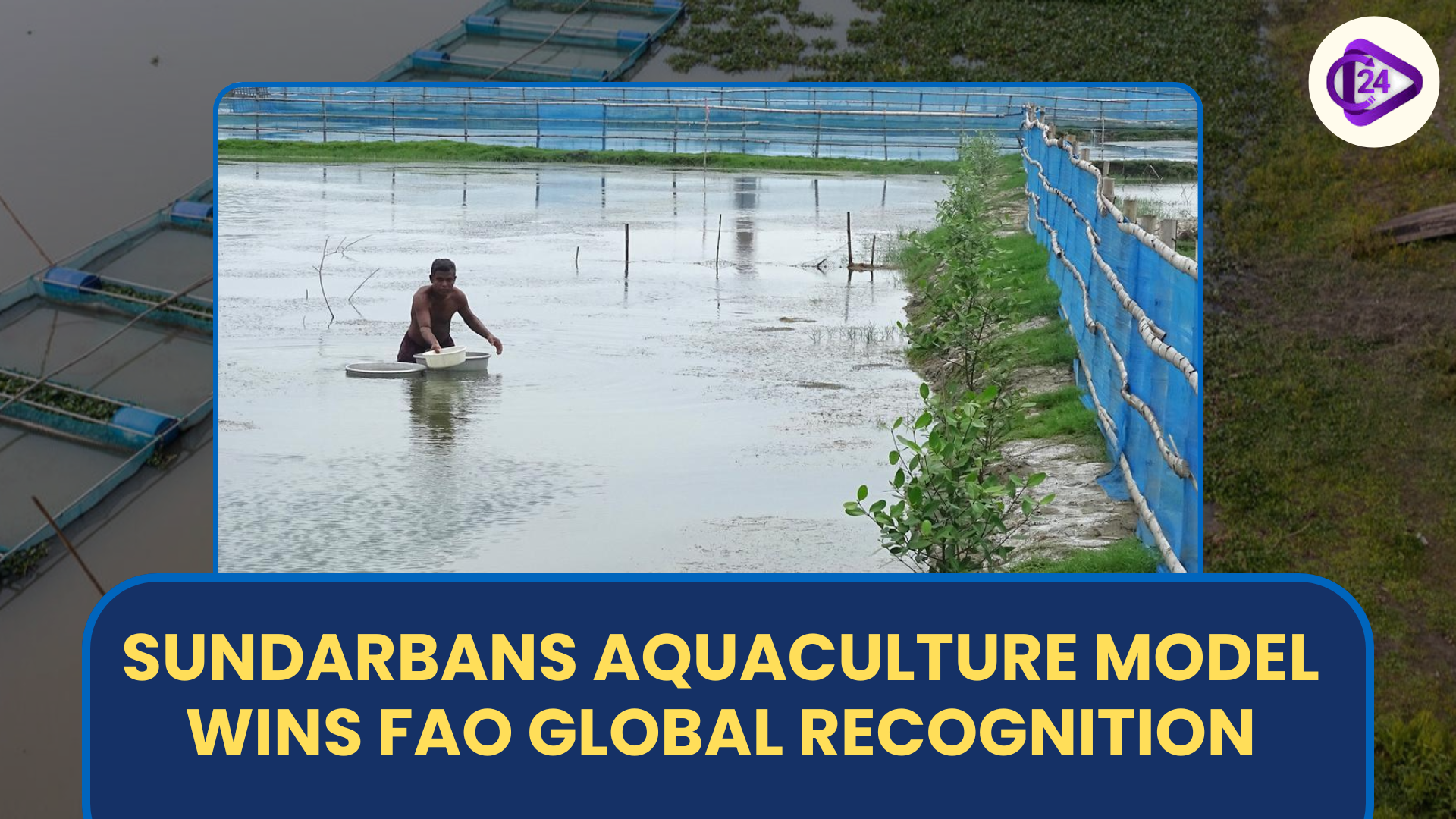
The Sundarbans Aquaculture Model received international recognition from the Food and Agriculture Organization (FAO) of the United Nations in October 2025 for promoting sustainable shrimp farming along with mangrove conservation. The model, known as Sustainable Aquaculture in Mangrove Ecosystems (SAIME), was developed by the Nature Environment and Wildlife Society (NEWS), a non-governmental organisation based in West Bengal.
The initiative combines shrimp cultivation with mangrove protection to support local livelihoods while conserving the fragile coastal ecosystem. It has been implemented across 29.84 hectares and involves 42 fish farmers in the Indian Sundarbans.
The model has helped increase farmers’ average annual net profits by more than 100% through reduced production costs and improved farming practices. It also promotes climate resilience, biodiversity conservation and sustainable livelihoods.
What Is the Sundarbans Aquaculture Model (SAIME)?
SAIME stands for Sustainable Aquaculture in Mangrove Ecosystems. It is an environmentally friendly aquaculture approach that combines shrimp farming with mangrove conservation.
The model was developed by the Nature Environment and Wildlife Society (NEWS) to reduce the environmental damage caused by conventional shrimp farming in mangrove regions.
Key Highlights of SAIME Model
| Particulars | Details |
| Model Name | SAIME |
| Full Form | Sustainable Aquaculture in Mangrove Ecosystems |
| Developed By | Nature Environment and Wildlife Society (NEWS) |
| Location | Sundarbans, West Bengal |
| Recognition | Global Technical Recognition by FAO |
| Recognition Date | 15 October 2025 |
| Implemented Area | 29.84 hectares |
| Participating Farmers | 42 |
| Mangrove Coverage | 5%–30% within aquaculture ponds |
| Major Species | Black Tiger Shrimp |
| Main Objective | Sustainable aquaculture and mangrove conservation |
Key Features of the SAIME Model
- Mangrove Integration: Maintains 5%–30% mangrove coverage within aquaculture ponds.
- Sustainable Shrimp Farming: Promotes the cultivation of Black Tiger Shrimp (Penaeus monodon).
- Natural Nutrients: Uses mangrove litter as a natural nutrient source, reducing dependence on artificial feed.
- Community Participation: Encourages local farmers and communities to adopt environmentally responsible practices.
- Climate Adaptation: Supports coastal resilience against climate-related challenges.
- Lower Production Costs: Reduces certain farming input costs and improves farmers’ profitability.
Why Did FAO Recognise the Sundarbans Aquaculture Model?
The Food and Agriculture Organization recognised the SAIME initiative for demonstrating how aquaculture and environmental conservation can work together.
The model addresses a major challenge in coastal regions: conventional shrimp farming can contribute to mangrove degradation when natural habitats are cleared for aquaculture ponds.
SAIME offers an alternative by integrating mangroves into the farming system.
The Global Technical Recognition was conferred on 15 October 2025 during FAO’s 80th Anniversary celebrations and the World Food Forum at its headquarters in Rome, Italy.
Benefits of the Sundarbans Aquaculture Model
| Area | Benefits |
| Farmers’ Income | Average annual net profits increased by over 100%. |
| Production Costs | Reduced dependence on certain external farming inputs. |
| Mangrove Conservation | Maintains mangrove cover within aquaculture ponds. |
| Biodiversity | Supports mangrove-dependent ecosystems. |
| Climate Resilience | Helps strengthen coastal ecosystems. |
| Livelihood | Supports local fish farmers and communities. |
| Carbon Sequestration | Mangroves help capture and store carbon. |
Important Facts About the Sundarbans
The Sundarbans is the world’s largest contiguous mangrove forest, shared by India and Bangladesh. It is located in the Ganga-Brahmaputra-Meghna delta region and is known for its rich biodiversity.
| Particulars | Details |
| Location | India and Bangladesh |
| Indian State | West Bengal |
| Delta | Ganga, Brahmaputra and Meghna |
| Forest Type | Mangrove Forest |
| Famous Wildlife | Royal Bengal Tiger and Estuarine Crocodile |
| Sundarbans National Park | UNESCO World Heritage Site (1987) |
| Biosphere Reserve | Established in 1989 |
| Major Livelihoods | Fishing, aquaculture, honey collection and tourism |
| Major Threats | Cyclones, coastal erosion, rising sea levels and salinity |
Significance of the FAO Recognition
The recognition highlights the importance of combining economic development with environmental protection.
The SAIME model provides an example of how local communities can improve their livelihoods without putting additional pressure on sensitive mangrove ecosystems.
It also highlights the importance of sustainable aquaculture in addressing climate change, protecting biodiversity and supporting coastal communities.
Important Facts for Competitive Examinations
- SAIME stands for Sustainable Aquaculture in Mangrove Ecosystems.
- The model was developed by Nature Environment and Wildlife Society (NEWS).
- It received Global Technical Recognition from FAO in October 2025.
- The recognition was conferred on 15 October 2025 in Rome, Italy.
- It has been implemented across 29.84 hectares.
- It involves 42 fish farmers.
- It maintains 5%–30% mangrove coverage within aquaculture ponds.
- Black Tiger Shrimp is the major species cultivated.
- The Sundarbans is located in India and Bangladesh.
- The Sundarbans National Park was declared a UNESCO World Heritage Site in 1987.
Conclusion
The Sundarbans Aquaculture Model is an important example of sustainable development through the integration of aquaculture and environmental conservation. FAO’s recognition of the SAIME initiative in 2025 highlights its potential to improve farmers’ incomes while protecting mangrove ecosystems.
The model demonstrates that economic activities and environmental protection can work together to support climate-resilient livelihoods in vulnerable coastal regions.