
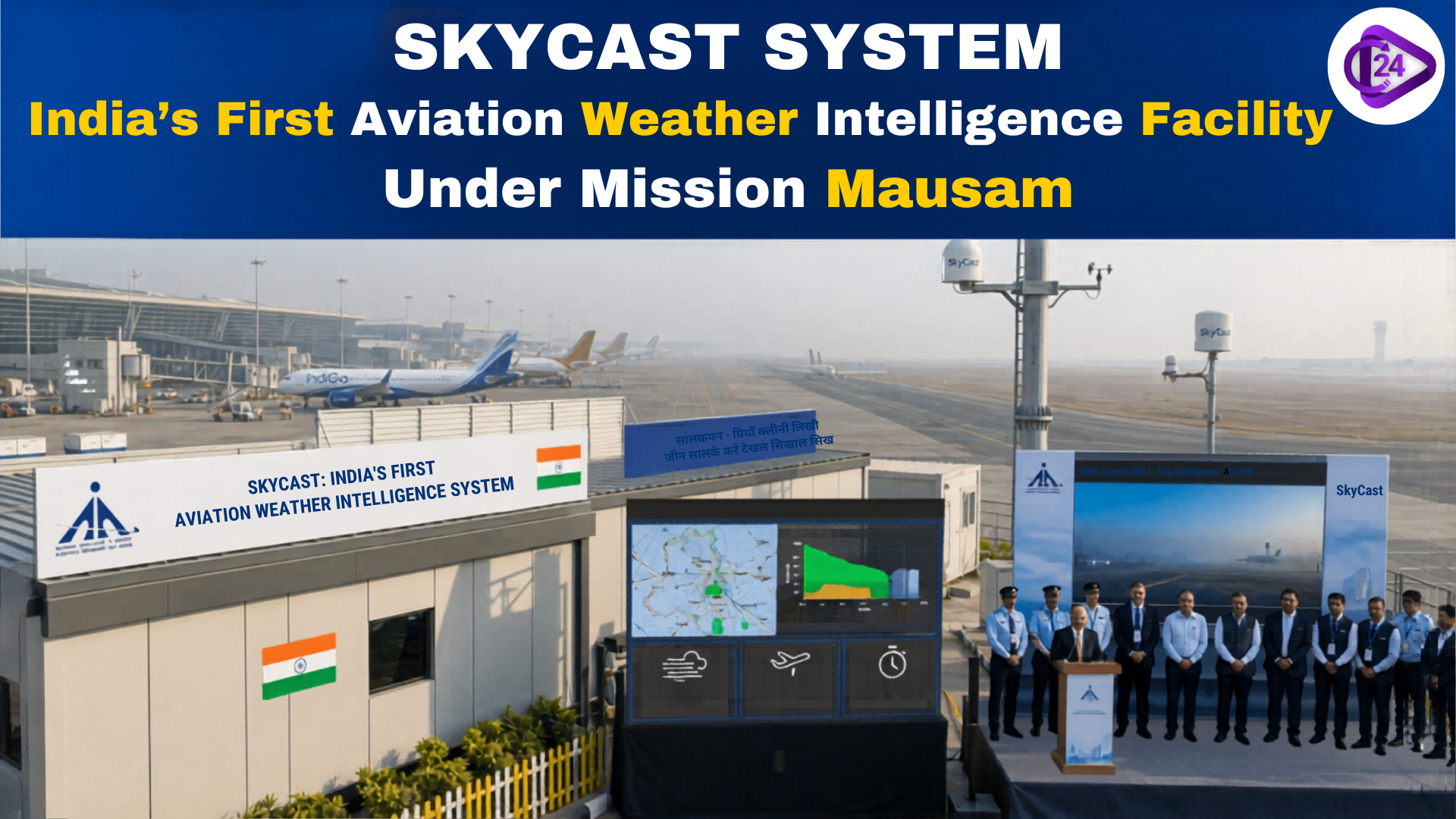
The launch of the SkyCast System has marked a significant milestone in modernising aviation weather services in India, the first under Mission Mausam. To help aircraft get the correct weather data by the time it reaches the airport, the advanced weather intelligence facility has been created at Indira Gandhi International Airport (IGI) in New Delhi. Mission Mausam – SkyCast System India’s First Aviation Weather Intelligence Facility will help to advance the flight safety standards, reduce weather-related disruptions, increase operational efficiency and provide support to the fast-growing aviation industry of India. Besides, the project collectively fits in with Mission Mausam’s overall goal of improving weather forecasting and the country’s climate resilience.
What is the purpose of SkyCast System?
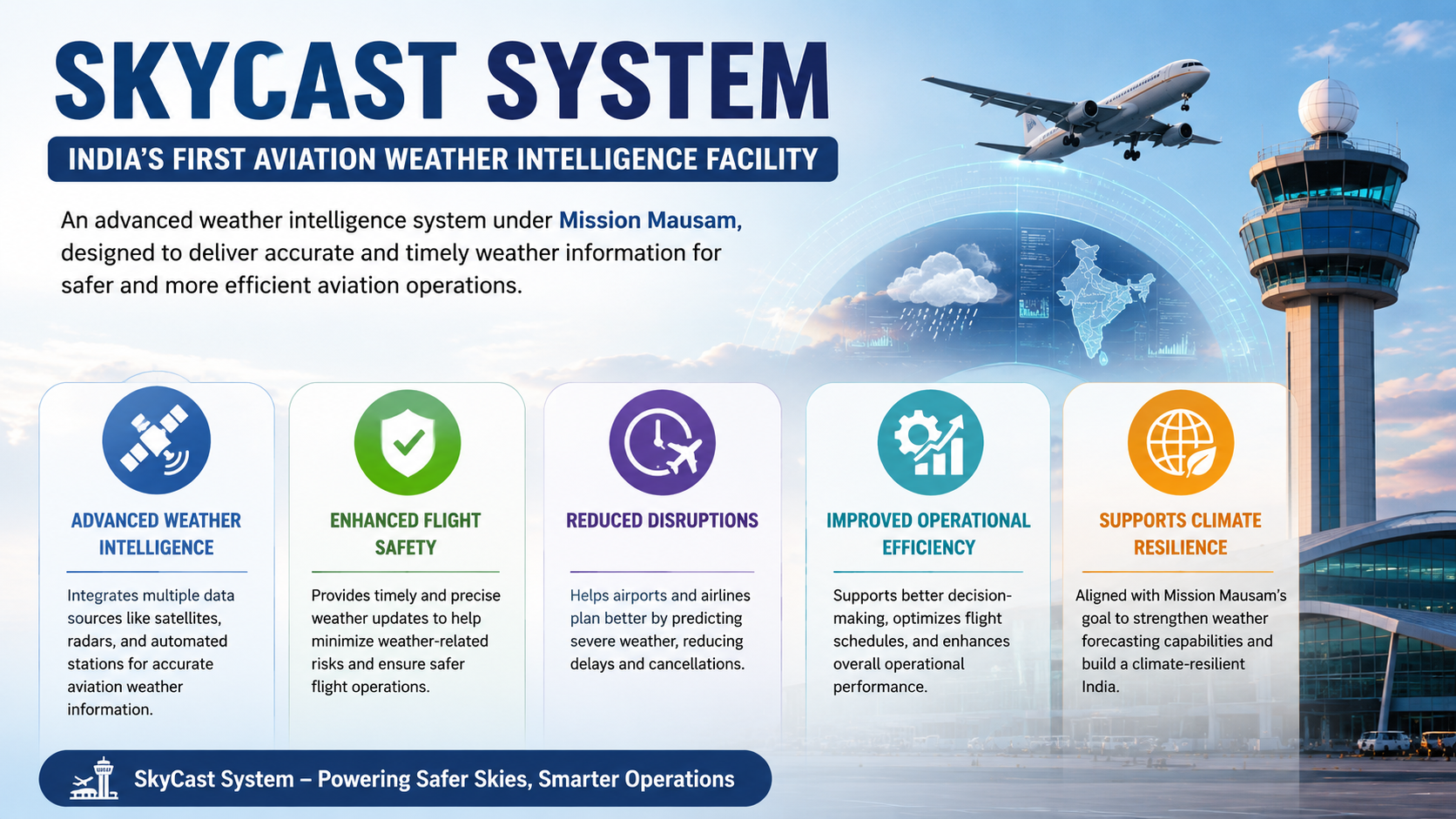
The SkyCast System, India’s First Aviation Weather Intelligence System under Mission Mausam, is a state-of-the-art platform for weather forecasting and monitoring designed for aviation tasks. Multiple sources of meteorological data, satellite observations, Doppler Weather Radar data, AI-based forecasting tools and automated weather stations are combined in the system to provide very precise meteorological information for aviation. This then allows the airlines and airport authorities to make correct operational decisions and reduce risk from adverse weather conditions.
Why is SkyCast System Important?
The weather is still one of the main difficulties encountered by aviation activity in Algeria. Weather-related delays and flight cancellations are frequently caused by sudden storms, fog, thunderstorms, turbulence, lightning and low visibility. To this end, the SkyCast System, India’s First Aviation Weather Intelligence Facility Under Mission Mausam, has been developed with the aim of tackling these challenges with state-of-the-art technologies.
Key Objectives
Weather information is a key essential to aviation safety. Weather upheavals like thunderstorms, heavy rain, fog, wind shear and turbulence pose great risks to aircraft, particularly on take-off and landing. The SkyCast System is India’s first Aviation Weather Intelligence Facility under Mission Mausam that delivers real-time weather intelligence and helps pilots and ATCs ahead of the adverse weather scenarios affecting flight operations. As a result, the system will help decrease the number of accidents, make a better picture of situations and keep millions of passengers safer in the air every year.
Improve Flight Operations
Precise weather forecasts are necessary for efficient flight operations to plan routes, schedules and fuel requirements. Advanced forecasting capabilities, such as the SkyCast System, India’s First Aviation Weather Intelligence Facility Under Mission Mausam, aid the airlines in minimising aircraft disruptions and optimising flight paths due to unexpected weather events. Also, the turnaround process of the aircraft is better controlled, and delays are avoided. Consequently, travel reliability for travellers is enhanced, and operational efficiency and lower costs for aviation companies are achieved.
Strengthen Disaster Preparedness
Extreme weather can have great impacts on airport systems and aviation services. Hence, the role of early warning systems is crucial to reduce risks and carry out operations in continuity. The Mission Mausam’s SkyCast System, India’s first Aviation Weather Intelligence Facility, helps in disaster preparedness with timely warning of weather-related hazards. This helps airport authorities implement emergency response plans, protect infrastructure and coordinate with other agencies. In this way, the aviation industry is able to withstand climate-related risks and natural disasters better.
Artificial Intelligence-Based Forecasting
Artificial Intelligence has revolutionised weather forecasting by increasing prediction precision and reducing errors related to data from predictions. AI algorithms process massive amounts of meteorological data to determine weather scenarios and is what powers SkyCast System India’s First Aviation Weather Intelligence Facility Under Mission Mausam. These smart systems can predict weather change much more quickly and precisely than traditional methods. Consequently, our industry partners are provided with robust forecasting that makes flying operations safer and more efficient.
What is Mission Mausam?
This flagship initiative, known as Mission Mausam, is aimed at improving weather forecasting and will be implemented by using modern technology, advanced observation systems, and artificial intelligence under the efforts of the Government of India.
The mission focuses on:
- Improved weather forecasting
- Extreme weather prediction
- Climate resilience
- Disaster risk reduction
- Aviation weather services
- Agricultural weather advisories
| Exam | Year | Question | Options | Answer |
|---|---|---|---|---|
| UPSC Prelims | 2020 | Doppler Weather Radar is used for? | A. Soil Mapping B. Weather Monitoring C. Mineral Exploration D. Ocean Survey |
B |
| UPSC Prelims | 2023 | Which organization is responsible for weather forecasting in India? | A. ISRO B. IMD C. DRDO D. NITI Aayog |
B |
| CDS | 2022 | Wind Shear is associated with which sector? | A. Agriculture B. Aviation C. Mining D. Defence Production |
B |
| State PCS | 2023 | Mission Mausam is related to: | A. Agriculture B. Weather Forecasting C. Tourism D. Fisheries |
B |
First Sea Shipment: Botanical-Infused Millets Explained
Conclusion
Under Mission Mausam, the inauguration of the SkyCast System, India’s First Aviation Weather Intelligence Facility, is a landmark initiative in the evolution of India’s meteorological and aviation infrastructure. The incorporation of AI, Doppler radar technologies, satellite data and real-time weather analysis will result in a substantial enhancement to aviation safety and operational efficiency. The SkyCast System, India’s First Aviation Weather Intelligence Facility Under Mission Mausam, will help mitigate weather-related aviation risks and fulfil the objectives of Mission Mausam. Consequently, with the growth of aviation in India, this class of advanced weather intelligence systems will become imperative for safe, efficient and reliable air transportation.
FAQs
|