


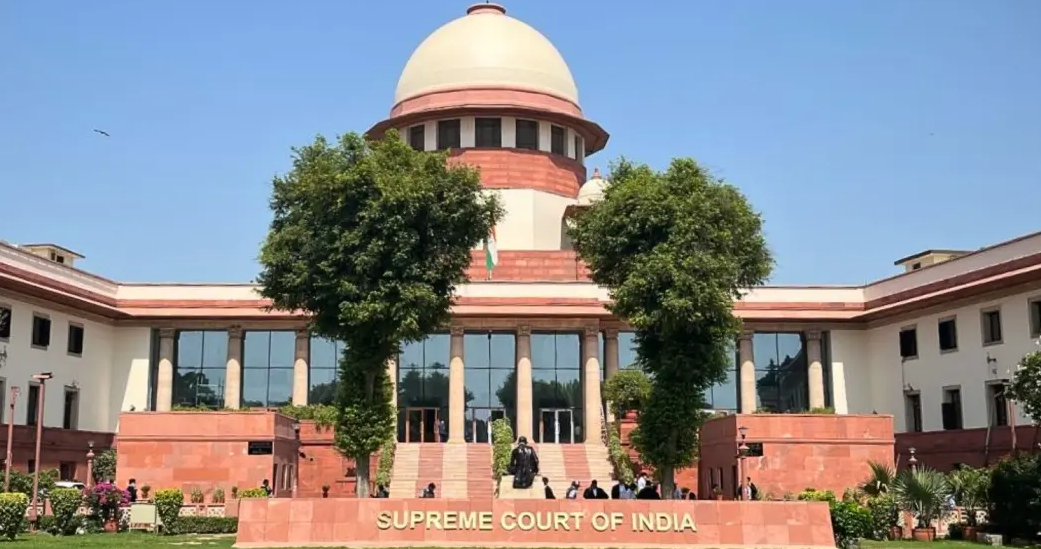
In a major ruling the Indian Supreme Court stated that Urdu demonstrates "finest specimen of Ganga-Jamuni tahzeeb" while expressing the diverse ethnic heritage of India. The Supreme Court issued this ruling because one party filed an appeal to stop using Urdu on the new Patur Municipal Council building signboard located in Akola district Maharashtra. The Court explicitly stated to reject the correlation of languages with religious associations because languages serve communication functions instead of indicating religious beliefs.
Key highlights of Supreme Court Judgement on Urdu
-
The judicial body declared language exists as an integral mental and emotional feature of communities throughout regions and nations since it represents their cultural heritage.
-
The ruling asserted Urdu belongs to the same category as all languages because it exists in the same manner as other linguistic expressions regardless of religion.
-
According to the Court Urdu exists as a naturally developed language of India.
-
The language developed fully within India as intellectuals selected it to express their thoughts which enhanced the country's multicultural character.
The Misconception Around Urdu
-
According to Court analysis the negative perceptions toward Urdu emerged due to false beliefs that the language does not belong to India.
-
Justice Dhulia explained Urdu is an Indo-Aryan language just like Hindi and Marathi which counters the false religious distinction between Urdu and other languages.
-
The judicial author points out that everyday Hindi uses Urdu words frequently alongside saying the word Hindi actually derives from the Persian word 'Hindavi' thus revealing the linguistic connection between the two languages.
Urdu’s Role in Indian States
-
The Indian states of Andhra Pradesh and Bihar and Jharkhand, Telangana, Uttar Pradesh along with West Bengal use Urdu as their second official language under Article 345 of the Constitution.
-
This language status also applies to Union Territories including Jammu and Kashmir and Delhi.

Origin of Urdu Language: Overview
-
Native Urdu speakers total over 70 million people throughout the world and second language speakers exceed 100 million individuals who speak this language.
-
The main geographic area where people speak Urdu is Pakistan and India because Urdu holds fundamental importance in cultural society there.
-
Besides its strong position within South Asian territories Urdu maintains speaking communities throughout different global regions.
-
The United Arab Emirates hosts many Muslim communities who speak Urdu and thus the language has become prominent as well as Europeans in the United States and United Kingdom where populations grew through immigration activities.
-
The origin of Urdu language appeared in the 12th century CE through its development from Apabhramsha which people used to speak in northeastern India.
-
The author Amir Khusrow established Urdu as a literary language through poetry and other works while using Hindvi as his initial poetic basis before Hindvi evolved to become the elegant Urdu language form.

Historical Significance of Urdu Language
-
The development of Urdu as a language received significant influence from the cultural and linguistic patterns under both Delhi Sultanate (1206–1526) and Mughal Empire rule (1526–1878).
-
The Mughal Empire specifically used its rule to create Urdu into a poetic and prose language by combining Persian Turkish and Arabic language elements.
-
The 18th and 19th centuries mark the peak glory era for Urdu poetry which historians recognize as its golden age.
-
The Mughal rule brought out the full potential of Urdu language development beyond which it became a highly refined literary language featuring sophisticated poetic and written literature structures during this time.
-
The expansion of the Delhi Sultanate into the Deccan plateau caused Haryanvi and Punjabi languages to be incorporated into Urdu which strengthened both its vocabulary and writing practices.
Development of Urdu Language
-
Urdu originates from the same grammatical roots as Hindi making the two languages closely related siblings. The Devanagari script serves as Urdu's writing system although Hindi uses the same writing system. At the same time Urdu writers use the Nastaliq script which traces its history back to Persian writing scripts.
-
The basic elements of word arrangement along with language structure remain essentially identical across both languages.
-
The vocabulary foundations of Urdu derived chiefly from Persian and Arabic as well as Turkish although both languages possess the same grammatical system.
-
Most of the Urdu literature produced during its early days addressed religious subjects primarily among Muslims who engaged in its production. New secular Urdu literature emerged in the nineteenth century and developed into an essential component of cultural communication between India and Pakistan and their literary traditions.
Cultural and Literary Significance of Urdu
-
Urdu literature together with its poetry upholds central significance within the cultural traditions of South Asia.
-
The Urdu literary tradition grew through substantial contributions of writers who belonged to Sikhism, Hinduism and Islam.
-
The Indian subcontinent uses Urdu language as a connection that enables diverse communities to relate with one another.
-
Urdu exists today as a principal cultural and linguistic element that guides the musical expressions and literary creations and media content in both Pakistan and India.
Conclusion
Through their ruling the Supreme Court demonstrates that Urdu represents India's multicultural heritage thus supporting the obligation to protect every linguistic expression in the nation. Urdu as a language which originated from the Indian subcontinent showcases the national multicultural essence of the country. The court decision reveals that language functions as a connecting force between different communities rather than creating separation.