


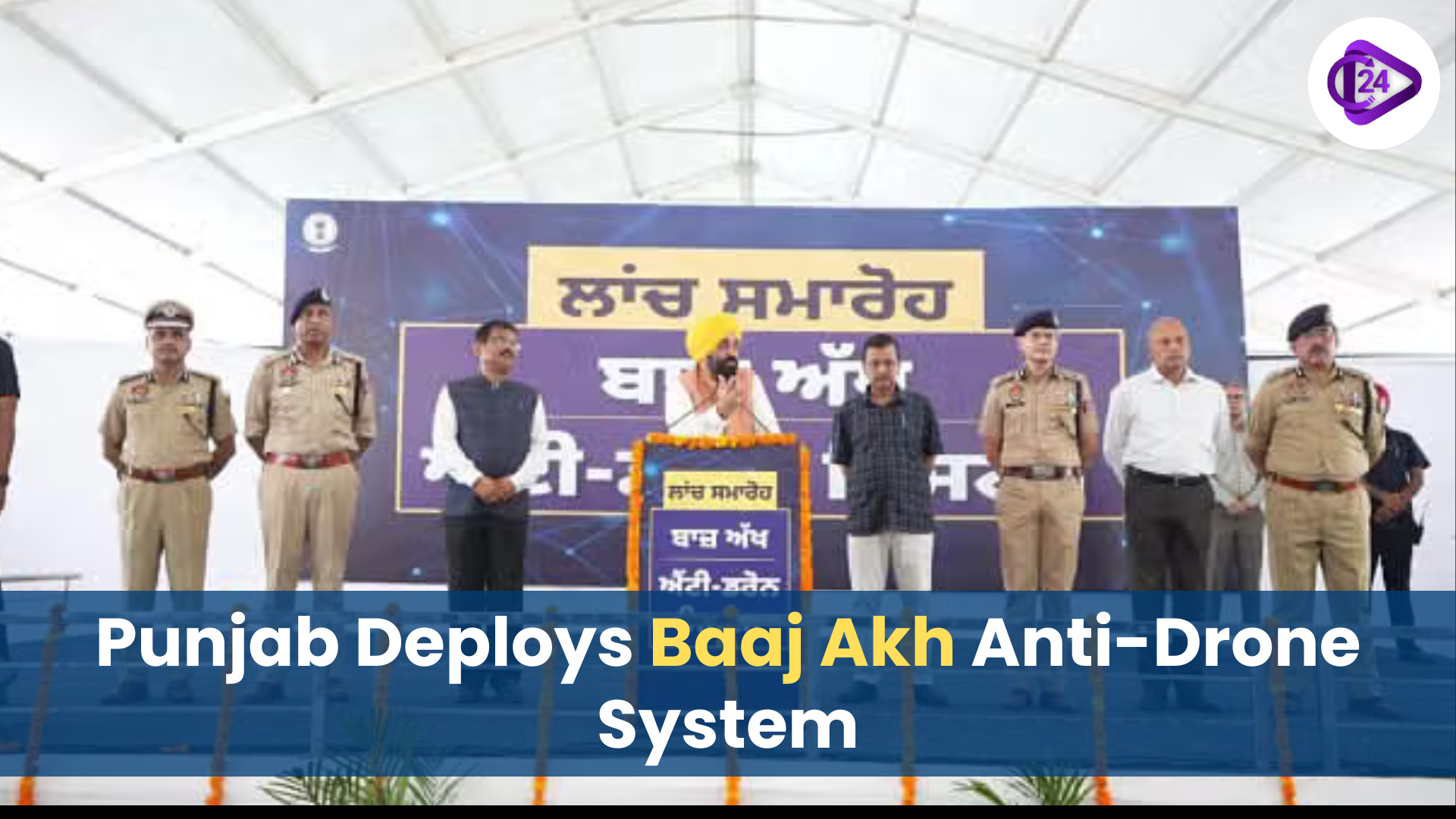
The Baaj Akh Anti-Drone System is an advanced security initiative launched by the Punjab Government in August 2025 to tackle cross-border smuggling of drugs, weapons and ammunition through unmanned aerial vehicles (UAVs). Punjab became the first state in India to deploy its own anti-drone systems along the international border.
The system was launched in the border district of Tarn Taran to strengthen security along the India-Pakistan border. The initiative is part of the Punjab Government’s campaign against drug trafficking, known as Yudh Nasheyan Virudh (War Against Drugs).
Under the initial deployment plan, three anti-drone systems were launched, while six additional units were planned. The project involved an investment of approximately ₹51.4 crore.
The Baaj Akh system is designed to detect suspicious drone movements, identify their control locations and alert security authorities. It will function as an additional layer of protection in coordination with the Border Security Force (BSF) and other security agencies.
Baaj Akh Anti-Drone System: Important Highlights
Here are the important facts about the Baaj Akh Anti-Drone System launched in Punjab.
| Particulars | Details |
| System Name | Baaj Akh |
| Meaning | Hawk Eye |
| System Type | Anti-Drone System (ADS) |
| Launch Year | 2025 |
| Launch Month | August 2025 |
| Launch Location | Tarn Taran, Punjab |
| Launched By | Punjab Government |
| Chief Minister | Bhagwant Singh Mann |
| Initial Deployment | 3 systems |
| Additional Planned Units | 6 systems |
| Total Planned Units | 9 systems |
| Project Cost | Approximately ₹51.4 crore |
| Border | India-Pakistan International Border |
| Border Length in Punjab | Approximately 553 km |
| Main Objective | Preventing cross-border drone-based smuggling |
| Related Campaign | Yudh Nasheyan Virudh |
What Is Baaj Akh Anti-Drone System?
Baaj Akh, meaning Hawk Eye, is an anti-drone security system introduced by the Punjab Government to counter the growing threat of drone-based smuggling along the India-Pakistan border.
Unmanned aerial vehicles are increasingly being used for the illegal transportation of narcotics, weapons and ammunition across international borders.
Traditional border surveillance alone may not be sufficient to detect and respond to every drone intrusion. Therefore, anti-drone technology provides an additional security layer by helping authorities identify suspicious aerial activity.
The Baaj Akh system is designed to:
- Detect suspicious drone movements near sensitive border areas.
- Identify the location of drone activity.
- Help identify the ground control locations associated with detected drones.
- Generate automated alerts for security personnel.
- Support coordinated responses by the concerned security agencies.
- Strengthen surveillance against drone-based smuggling.
The system is intended to complement the existing security arrangements of the BSF rather than replace them.
Baaj Akh Anti-Drone System: Deployment and Cost
The Punjab Government launched three anti-drone systems in August 2025 in the border district of Tarn Taran.
The government announced a plan to deploy nine systems along the international border to strengthen surveillance and prevent illegal drone activities.
Deployment Details
| Particulars | Details |
| Initial Systems Launched | 3 |
| Additional Systems Planned | 6 |
| Total Planned Systems | 9 |
| Project Investment | ₹51.4 crore |
| Initial Launch Location | Tarn Taran |
| Proposed Coverage | Border areas from Pathankot to Fazilka |
The systems were planned for deployment at sensitive locations where drone activity and smuggling risks were considered significant.
The initiative was intended to establish a second line of defence in coordination with the BSF.
Note: The figure of nine refers to the announced deployment plan, not confirmation that all nine units became operational immediately after the launch.
How Does an Anti-Drone System Work?
An Anti-Drone System (ADS) is designed to detect, track and respond to unauthorised or potentially hostile drones.
Different anti-drone systems use technologies such as radar, radio-frequency detection, electro-optical cameras, infrared sensors and electronic countermeasures.
The general working process can be explained in the following steps:
- Drone Detection: The system monitors the surrounding airspace to identify suspicious drone activity.
- Tracking: After detecting a drone, the system helps track its movement and position.
- Identification: Available surveillance and detection technologies help assess whether the detected drone poses a security threat.
- Automated Alerts: Security personnel receive alerts about suspicious drone movements.
- Countermeasures: Depending on the system’s capabilities and operational authorisation, security agencies can take appropriate measures to counter the threat.
The Baaj Akh system is intended to improve automated detection and alerting and support the identification of drone control locations.
Its purpose is to reduce dependence on continuous manual monitoring and improve the response of security agencies.
Why Is the Punjab-Pakistan Border Important for Drone Surveillance?
Punjab shares an approximately 553-kilometre-long international border with Pakistan. This border has been a major area of concern for security agencies because of attempts to smuggle narcotics, weapons and ammunition through drones.
Drone-based smuggling creates additional challenges because small unmanned aircraft can operate without a human pilot physically crossing the border.
According to the Punjab Government’s announcement in August 2025, 283 drones carrying heroin, weapons and ammunition were seized in 2024.
However, a separate Ministry of Home Affairs reply in the Lok Sabha stated that the BSF had seized 294 drones along the Punjab border in 2024.
These figures come from different official reporting contexts and should not be treated as identical datasets.
Major Security Challenges
- Drug Smuggling: Drones can be used to transport heroin and other illegal narcotics.
- Weapons Trafficking: Unauthorised aerial deliveries may include firearms and ammunition.
- Border Surveillance: Detecting small drones across a long international border is challenging.
- Security Coordination: Effective responses require information sharing among different security agencies.
- Technology-Based Threats: Smugglers can use increasingly sophisticated equipment to avoid conventional surveillance.
The Baaj Akh initiative aims to strengthen the technological capabilities available to security agencies in addressing these challenges.
War Against Drugs Campaign in Punjab
The Baaj Akh Anti-Drone System is part of the Punjab Government’s broader campaign against drug trafficking and substance abuse, known as Yudh Nasheyan Virudh (War Against Drugs).
The campaign focuses on reducing the supply of illegal narcotics and creating awareness about the harmful effects of drug abuse.
Major Initiatives Under the Campaign
- Anti-Drug Awareness in Schools
A special drug-awareness curriculum was introduced for students from Classes 9 to 12 in government schools.
According to the announcement made in August 2025, the programme aimed to reach approximately eight lakh students across 3,658 government schools.
- Action Against Drug Traffickers
The government announced enforcement measures against individuals involved in drug trafficking, including action against properties allegedly acquired through illegal drug proceeds.
- Border Surveillance
Anti-drone systems were introduced to strengthen surveillance and counter the use of drones for cross-border smuggling.
- Coordination Among Security Agencies
The initiative involves coordination among the Punjab Police, BSF, Indian Army, Indian Air Force and other concerned agencies.
These measures combine border security, law enforcement and public awareness to address different aspects of the drug problem.
Role of BSF and Other Security Agencies in Countering Drone Threats
The Border Security Force plays an important role in guarding India’s international borders and preventing illegal cross-border activities.
The Baaj Akh system is intended to supplement existing border security arrangements through improved technological surveillance.
Different agencies contribute to counter-drone operations in the following ways:
| Security Agency | Major Role |
| Border Security Force (BSF) | Border surveillance and response to cross-border intrusions |
| Punjab Police | Local intelligence, law enforcement and action against smugglers |
| Indian Army | Support in relevant national security operations |
| Indian Air Force | Airspace-related coordination and support |
| Other Security Agencies | Intelligence sharing and operational coordination |
Information about suspicious drone activity can be shared with the concerned security agencies to improve response and coordination.
Importance of Baaj Akh Anti-Drone System for India’s Border Security
The introduction of Baaj Akh represents the increasing role of modern technology in India’s border management.
Its importance extends beyond Punjab because drone-based smuggling is a security challenge that requires technological preparedness and cooperation among different agencies.
Major Benefits
- Improved Border Surveillance: Anti-drone technology adds another layer of monitoring in sensitive border areas.
- Prevention of Drug Smuggling: It supports efforts to detect and counter drones carrying illegal narcotics.
- Protection Against Weapons Trafficking: It strengthens measures against unauthorised transportation of weapons and ammunition.
- Faster Security Alerts: Automated alerts can help security personnel respond to suspicious drone activity.
- Better Agency Coordination: Information sharing supports cooperation among the BSF, police and other security agencies.
- Technology-Based Border Management: The initiative highlights the growing importance of advanced surveillance systems in national security.
Important Points About Baaj Akh Anti-Drone System for Competitive Exams
Candidates preparing for SSC, UPSC, RRB, Banking and other government examinations should remember these important facts.
| Question | Answer |
| What is Baaj Akh? | An Anti-Drone System |
| What does Baaj Akh mean? | Hawk Eye |
| Which state launched Baaj Akh? | Punjab |
| When was it launched? | August 2025 |
| Where was it initially launched? | Tarn Taran, Punjab |
| Who launched the initiative? | Punjab Government |
| How many systems were initially launched? | 3 |
| How many additional systems were planned? | 6 |
| What was the total planned number? | 9 |
| What was the announced project cost? | Approximately ₹51.4 crore |
| Which international border is being protected? | India-Pakistan Border |
| What is the approximate Punjab border length? | 553 km |
| Which campaign is associated with the initiative? | Yudh Nasheyan Virudh |
| What is the main objective? | Preventing drone-based smuggling |
Conclusion
The Baaj Akh Anti-Drone System is an important technology-based initiative launched by the Punjab Government in August 2025 to strengthen security along the India-Pakistan international border.
With an announced investment of approximately ₹51.4 crore and an initial deployment of three systems, the initiative aims to improve the detection of suspicious drones and support efforts against cross-border smuggling of drugs and weapons.
The system also forms part of the broader Yudh Nasheyan Virudh campaign, which combines border surveillance, law enforcement and public awareness.
For competitive examinations, the most important facts are its launch in Punjab, the meaning of Baaj Akh, the initial deployment of three systems, the planned total of nine systems and its role in preventing drone-based smuggling.