

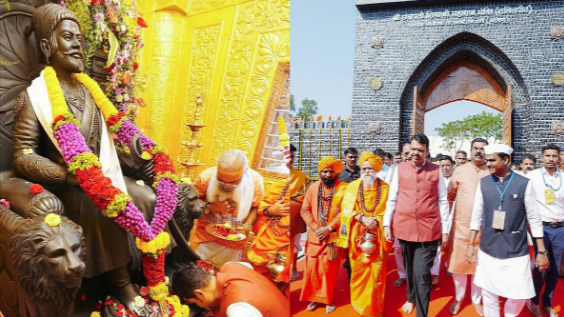
The state of Maharashtra unveiled its inaugural temple for Chhatrapati Shivaji Maharaj in Bhiwandi which falls under Thane district. Chief Minister Devendra Fadnavis attended the event to stress the cultural and spiritual value of the temple at its inauguration. The temple construction serves as a tribute to Shivaji Maharaj while striving to establish itself as a sacred journey spot for those who love the Maratha leader.
Introduction:
-
Maharashtra CM Devendra Fadnavis inaugurated the first-ever temple dedicated to Chhatrapti Shivaji Maharaj in Bhiwandi, Thane. On the occasion of Shivaji’s birth anniversary.
Key Highlights:
-
Vijaykumar Patil designed this temple which consists of 2,500 sq. ft. space enclosed by a 5,000 sq. ft. fortified boundary.
-
The temple repository features the Statue of Shivaji Maharaj which Arun Yogiraj sculpted to a height of 6.5 feet.
-
The main entry of the temple stands 42 feet tall while the adjacent assembly hall matches this height.
-
The life of Shivaji Maharaj is portrayed through 36 different sculptures arranged sequentially to illustrate important historical periods.
-
The shrine functions as a cultural landmark which demonstrates Shivaji Maharaj's vital part in developing Hindu identity while presenting his essential contributions to Indian historical events.

Early Life and Influences
Birth and Parentage:
-
The date of February 19th 1630 marks his birth at Shivneri Fort which exists today in Maharashtra.
-
Son of Shahaji Bhosle and Jijabai.
Formative Years:
-
His upbringing by Jijabai taught him to develop a solid link to his religious background as well as cultural customs.
-
Under the guidance of Dadoji Kondadeo who served as Pune administrator Shivaji received training that combined administrative skills with military tactics together with revenue management techniques.
Ancestry and Family Legacy:
-
During the reign of Ahmadnagar Sultanate from 1552 to 1597 the general Maloji Bhosle served as his grandfather.
-
Maloji received the titles of Deshmukh for Pune as well as Supe, Chakan and Indapur and received Shivneri Fort from the rulers.
Wars and Conquests
Conflict with the Bijapur Sultanate
-
Shivaji started his military journey at 16 years old by taking control of Torna Fort during 1646.
-
He increased his dominion through the capture of Purandar Fort as well as Kondhana (Sinhagad) and Chakan Forts.
-
Battle of Pratapgarh (1659): A decisive victory against Afzal Khan of the Bijapur Sultanate.
-
Shivaji first seized Panhala Fort during the year 1659-1660 after which Siddi Jauhar took control before Shivaji took it back during 1673.
-
Even though the Marathas suffered a tactical defeat at Pavan Khind in 1660 they showed their exceptional capabilities in guerrilla warfare tactics.
Conflict with the Mughal Empire
-
Before breaking their allegiance with the Mughals in 1657 Shivaji formed an alliance with them.
-
Marathas conducted a successful resistance against the Mughal forces led by Shaista Khan in the Battle of Chakan year 1660 but had to surrender in the end.
-
During the Battle of Surat (1664) Shivaji conducted a surprise attack against Surat which became one of the wealthiest Mughal territories thus depriving the Mughals of considerable amounts of money.
-
Shivaji was required to surrender 23 defensive forts as well as send his son Sambhaji to Mughal authority after signing the Treaty of Purandar with Mirza Raja Jai Singh in 1665.
-
Shivaji escaped the Mughal captivity at Agra through a bold break on August 17th, 1666.
-
Soldiers under Tanaji Malusare brought back possession of Sinhagad Fort during the battle of 1670.
-
Battle of Salher (1672): A significant Maratha victory against the Mughals.
Southern Campaigns and Naval Expansion
-
Starting in 1674 the Marathas launched their southern offensive that resulted in taking Ponda, Karwar and Kolhapur.
-
Shivaji made an alliance with Qutubshah who ruled Golconda during 1677 to improve his position.
-
The Maratha navy expanded during this period through which they took possession of coastal forts to build Sindhudurg Fort.
Administrative Reforms
Governance System
-
Shivaji gained the title of Chhatrapati at Raigad Fort in 1674.
-
The Ashta Pradhan council consisting of eight members became responsible for governing the Maratha Empire in 1674.
-
Peshwa (Prime Minister): Administration
-
Amatya: Finance and Revenue
-
Sachiv: Royal correspondence
-
Mantri: Internal intelligence
-
Senapati: Military affairs
-
Sumant: Foreign affairs
-
Nyayadhish: Justice
-
Panditrao: Religious affairs
-
Cultural and Linguistic Policies
-
Marathi along with Sanskrit gained preference for administrative use by eliminating Persian language.
-
Used Sanskrit inscriptions on his royal seal.
-
His government promoted religious unity as he selected both Muslim and European personnel to work in both administrative and naval positions.
Military Strategies
-
According to Marathi locals his advanced mastery in strikes made him renowned as Ganimi Kawa.
-
Surprise attacks originated from his forces making use of the mountainous terrain.
-
Strengthened fort-based defense, controlling 240-280 forts by his death.
-
The establishment of India's first naval force occurred after he fully acknowledged the need to protect the Konkan coast.
Legacy and Successors
-
Chhatrapati Shivaji Maharaj left this world at Raigad Fort on April 3rd of 1680.
-
Sambhaji became the ruler after his father but the Mughals subsequently took him captive before executing him.
-
The fight continued under Rajaram (1689-1700) until Shivaji II (Ramaraja) took power with Tara Bai serving as his regent.
-
During his 42-year reign Shahu Maharaj facilitated the growth of Peshwas who would expand the Maratha Empire all across India.
Conclusion
Bhiwandi residents celebrate a major cultural achievement through the opening of the Chhatrapati Shivaji Maharaj Temple. The temple exists beyond its religious significance to commemorate Shivaji Maharaj's eternal contributions that motivate generations to come. The temple demonstrates architectural greatness along with historical value and religious importance which positions it to become an influential monument that honors Maratha warrior achievements throughout Indian historical and cultural records.