

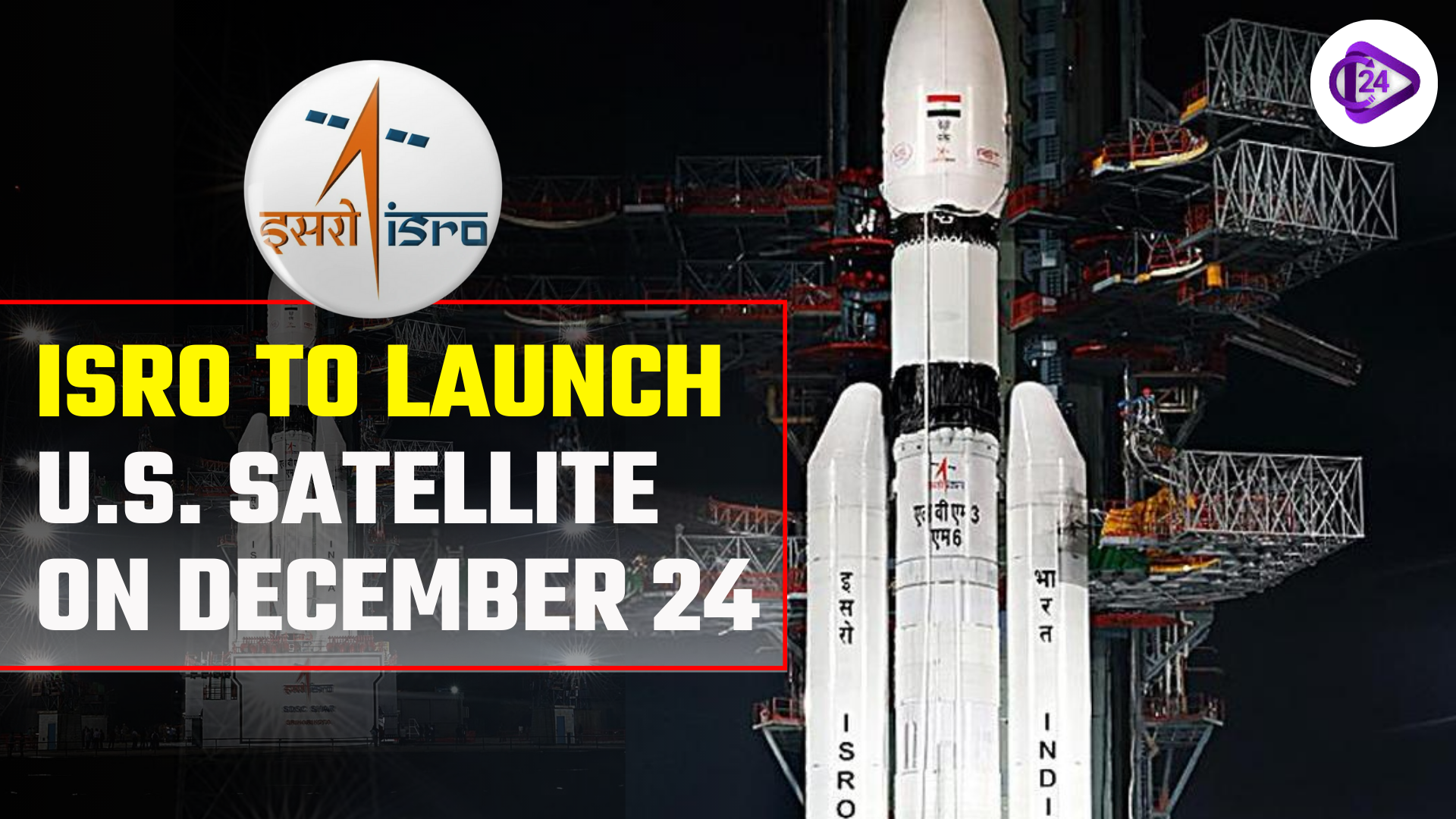
The Indian Space Research Organisation (ISRO) achieved another important milestone in space technology on 24 December 2025, when its LVM3-M6 rocket successfully launched the United States’ BlueBird Block-2 communication satellite. The mission took place from the Satish Dhawan Space Centre in Sriharikota, Andhra Pradesh, and highlighted India’s growing role in the international commercial space launch market.
The satellite was developed by the US-based company AST SpaceMobile. Its main purpose is to support a next-generation communication network designed to deliver cellular broadband connectivity directly to ordinary mobile smartphones through satellites.
The successful ISRO BlueBird Block-2 launch was significant for two reasons. It demonstrated the capability of India’s heavy-lift launch vehicle to carry a large commercial satellite into Low Earth Orbit (LEO), and it strengthened India’s position as a launch service provider for international customers.
The mission was conducted through a commercial agreement involving NewSpace India Limited (NSIL), the commercial arm of India’s Department of Space.
Key Highlights of the ISRO LVM3-M6 Mission
Here are the important facts about the mission:
- Launch date: 24 December 2025
- Launch vehicle: LVM3-M6
- Satellite: BlueBird Block-2
- Satellite operator and developer: AST SpaceMobile, United States
- Launch site: Satish Dhawan Space Centre, Sriharikota, Andhra Pradesh
- Orbit: Low Earth Orbit (LEO)
- Approximate satellite mass: 6,100 kg
- Mission type: Dedicated commercial satellite launch
- Commercial partner: NewSpace India Limited (NSIL)
- LVM3 flight number: Sixth operational flight
- Major achievement: Heaviest satellite launched from Indian soil using an Indian launch vehicle at the time
The mission successfully placed the satellite into its intended orbit, according to ISRO. It marked another step forward for India’s heavy-lift launch capabilities and international commercial space services.
What Is the BlueBird Block-2 Satellite?
BlueBird Block-2 is a next-generation communication satellite developed by AST SpaceMobile, a US-based company working to provide mobile broadband connectivity through space-based infrastructure.
Traditional mobile phones usually depend on terrestrial cellular networks, including mobile towers and associated ground infrastructure. In remote locations, at sea or in areas affected by natural disasters, these networks may be limited or unavailable.
AST SpaceMobile’s satellite system aims to address some of these connectivity gaps by enabling compatible standard smartphones to connect directly to satellites. The technology is designed to support cellular broadband services without requiring users to carry a separate satellite phone or specialised external satellite equipment.
The BlueBird Block-2 satellite is part of the company’s broader satellite constellation. The system is intended to support services such as voice calls, messaging and mobile broadband, subject to network availability, compatible devices, regulatory approvals and service agreements.
It is important to understand that the satellite does not automatically provide universal mobile coverage everywhere. Actual service depends on the satellite network, partner mobile operators and the availability of authorised services in different regions.
Why Was the ISRO BlueBird Block-2 Launch Important?
The ISRO LVM3-M6 mission was important for India’s space programme, commercial launch industry and international cooperation.
1. A Major Achievement in Heavy-Lift Launch Capability
The satellite weighed approximately 6,100 kg, making it the heaviest satellite launched from Indian soil by an Indian launch vehicle at that time.
Carrying a payload of this size requires a launch vehicle with substantial thrust, carefully coordinated stages and reliable guidance systems. The successful mission demonstrated the LVM3 rocket’s ability to handle a demanding commercial payload.
2. Growth of India’s Commercial Space Market
Satellite operators around the world require dependable launch services to deploy their spacecraft. By successfully carrying the BlueBird Block-2 satellite into orbit, India demonstrated its ability to serve an international commercial customer.
Commercial launches can generate revenue, support specialised jobs and create opportunities for Indian suppliers and engineering companies.
3. Stronger International Cooperation
The mission involved Indian launch infrastructure, an Indian commercial space company and a US-based satellite developer. Such cooperation illustrates how the global space industry brings together different countries and organisations to complete complex missions.
4. Progress in Satellite Communication
The BlueBird Block-2 mission is also relevant to the future of telecommunications. Satellite-based connectivity may help extend mobile services to areas where building conventional network infrastructure is difficult or expensive.
What Is the LVM3 Rocket?
The Launch Vehicle Mark-3, commonly known as LVM3, is ISRO’s heavy-lift launch vehicle. It was developed to carry large satellites and support demanding space missions.
The rocket has three main propulsion components:
- Two S200 solid strap-on motors: These provide a large amount of thrust during the initial phase of launch.
- L110 liquid core stage: This stage provides propulsion during the vehicle’s ascent.
- C25 cryogenic upper stage: This stage uses cryogenic propellants and helps deliver the payload towards its intended orbit.
LVM3 has a lift-off mass of approximately 640 tonnes and a height of about 43.5 metres. Its published payload capability includes carrying up to approximately 4,200 kg to Geosynchronous Transfer Orbit (GTO). Payload capacity varies by orbit and mission requirements.
The vehicle has previously launched major Indian missions, including Chandrayaan-2 and Chandrayaan-3. It has also supported commercial OneWeb missions that deployed groups of communication satellites.
The successful LVM3-M6 launch further demonstrated the vehicle’s usefulness for large commercial payloads destined for Low Earth Orbit.
What Is Low Earth Orbit (LEO)?
Low Earth Orbit is a region of space relatively close to Earth, generally extending up to about 2,000 kilometres above the planet’s surface.
Satellites operating in LEO can be useful for Earth observation, scientific research, communications and other applications. Their proximity to Earth can reduce communication delays compared with satellites operating in much higher orbits.
However, satellites in LEO travel at high speeds and generally cannot remain above a single location continuously. Communication services therefore often depend on satellite coverage, network coordination and the availability of multiple satellites.
For the BlueBird Block-2 mission, Low Earth Orbit is important because the satellite is designed to support direct-to-smartphone communication services through a space-based cellular network.
Role of NewSpace India Limited (NSIL)
NewSpace India Limited is a government-owned company under the Department of Space and serves as the commercial arm of ISRO.
Its role includes commercialising space-related services and supporting the delivery of launch services to domestic and international customers. NSIL helps connect the capabilities of India’s space programme with the requirements of commercial satellite operators.
In the BlueBird Block-2 mission, the commercial agreement between NSIL and AST SpaceMobile helped make the launch possible.
International commercial missions are important because they allow India to use its launch infrastructure and technical capabilities to serve customers beyond its own government space programmes.
How Is This Mission Different from Chandrayaan-3?
Both the BlueBird Block-2 mission and Chandrayaan-3 used ISRO’s LVM3 launch vehicle, but their objectives were very different.
Chandrayaan-3 was an Indian lunar exploration mission designed to demonstrate a successful soft landing and rover operations on the Moon. It became a major milestone in India’s planetary exploration programme in August 2023.
The BlueBird Block-2 mission, in contrast, was a dedicated commercial launch for a US-based company. Its objective was to deploy a communication satellite into Low Earth Orbit for a planned space-based cellular broadband network.
This comparison shows the flexibility of LVM3. The same launch vehicle family can support ambitious national scientific missions as well as commercial satellite deployment, provided the vehicle configuration and mission requirements are appropriate.
Significance for India’s Space Sector
The successful launch reflects the progress made by India’s space sector in developing reliable launch systems and providing services to international customers.
A strong commercial launch industry can help attract investment, support advanced manufacturing and encourage cooperation between government institutions and private companies.
The mission also highlights the importance of launch reliability. Satellite operators invest significant resources in spacecraft development, so placing a payload into its intended orbit is essential to the success of a commercial launch contract.
India’s expanding role in commercial launches can create further opportunities for aerospace engineers, researchers, component manufacturers and space technology companies.
At the same time, the global space industry remains competitive. Continued investment in launch technology, infrastructure, safety and cost-effective operations will be important for India to strengthen its position.
Important Facts for Competitive Exams
Students preparing for UPSC, SSC, banking, railway and other competitive examinations can remember the following points:
| Question | Answer |
| Which organisation launched BlueBird Block-2? | ISRO |
| What was the mission name? | LVM3-M6 |
| When was it launched? | 24 December 2025 |
| Who developed the satellite? | AST SpaceMobile, USA |
| Which launch vehicle was used? | LVM3 |
| From where was it launched? | Satish Dhawan Space Centre, Sriharikota |
| Which orbit was targeted? | Low Earth Orbit |
| What was the satellite’s main purpose? | Supporting direct-to-smartphone cellular broadband connectivity |
| Which Indian company facilitated the commercial launch? | NewSpace India Limited (NSIL) |
| Which operational flight of LVM3 was this? | Sixth |
Conclusion
The successful ISRO BlueBird Block-2 launch on 24 December 2025 was an important milestone for India’s space programme. Using the LVM3-M6 rocket, ISRO deployed a large US communication satellite into its intended Low Earth Orbit, demonstrating the capabilities of India’s heavy-lift launch system.
The mission also strengthened India’s position in the commercial space market and highlighted the growing importance of satellite-based communication technologies. With NSIL facilitating international commercial launches, India continues to expand its role in providing space transportation services to customers around the world.
For current affairs preparation, the most important facts are the launch date, the LVM3-M6 mission, the BlueBird Block-2 satellite, AST SpaceMobile, NSIL and the satellite’s planned direct-to-smartphone connectivity services.