

To incorporate Artificial Intelligence (AI), Machine Learning (ML), and Big Data Analytics in its activity, the Indian Army has developed a roadmap that should be fulfilled by 2026-27. Implementation will be under the office of a special AI Task Force reportable to the Directorate General of Information Systems (DGIS). Notable uses are drone swarming, real-time battlefield surveillance, LLM-based summarisation systems and sensor data fusion. Following Operation Sindoor, a cyber-intelligence operation of the Army against terror infrastructure in the Pakistan-occupied Kashmir, the roadmap was expedited. The AI drive will be used to change decision-making, surveillance, and threat analysis in line with the preparation of modern warfare.
Context:
-
AI is something that was investigated by the Indian Army, so Operation Sindoor made it clear that such technologies require accelerated adoption.
-
A recent Army-led cyber-intelligence operation in Pakistan-occupied Kashmir, Operation Sindoor was against terror infrastructure.
AI in Army Operations – Key Areas of Deployment:
|
Domain |
AI-based Application |
|
Surveillance & Reconnaissance |
Drone swarming, sensor fusion, satellite and ground data analysis |
|
Information Warfare |
AI tools to summarise large data (LLMs), generate battlefield awareness |
|
Decision-Making |
Real-time data processing from multiple sources for faster, accurate decisions |
|
Command Centres |
Smarter, AI-assisted war rooms with predictive threat modelling |
|
Operational Coordination |
Seamless info sharing, simulation, and mission planning using AI models |
Focus Tools & Technologies:
-
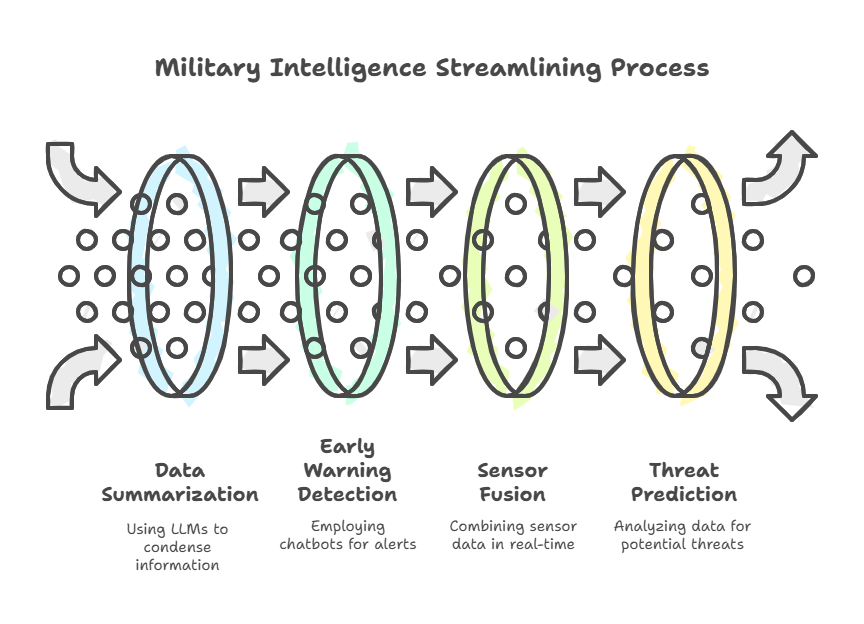
Large Language Models (LLMs): In order to summarise and streamline military intelligence in minimal time.
-
Chatbots and pattern detectors: Chatbots that are powered by AI and are used in the field of early warnings.
-
In real time, sensor fusion: To combine drone-based, satellite, aircraft and ground sensor feeds.
-
Slimming threat prediction based on past and real time data feeds.
Institutional Mechanism:
-
Directorate General of Information Systems (DGIS): this is an existing entity that will also have an AI Task Force created
-
External Experts and representatives of Army Directorates will be involved.
-
Training, technology integration, strengthening of capacity and R&D partnerships will also come under the task force.
Implications:
-
The strategy is a milestone towards the preparation of next-gen warfare.
-
Boosts the cyber capabilities, situational awareness and border security of India.
-
Provides quicker, independent operation in the high-stakes counter-terrorist and border forces.
-
Enhances civil-military Artificial Intelligence partnership in national defence.
Conclusion
The faster AI implementation timeline of the Indian Army marks a huge step into digitised systems of defence hunting, where the latest technology, including LLMs, unmanned aerial vehicles, and sensor fusion are being included to provide a new meaning to modern combat.
Under the protection of an institution and practical stimuli such as Operation Sindoor, technology has become the force multiplier in the national security of India.