


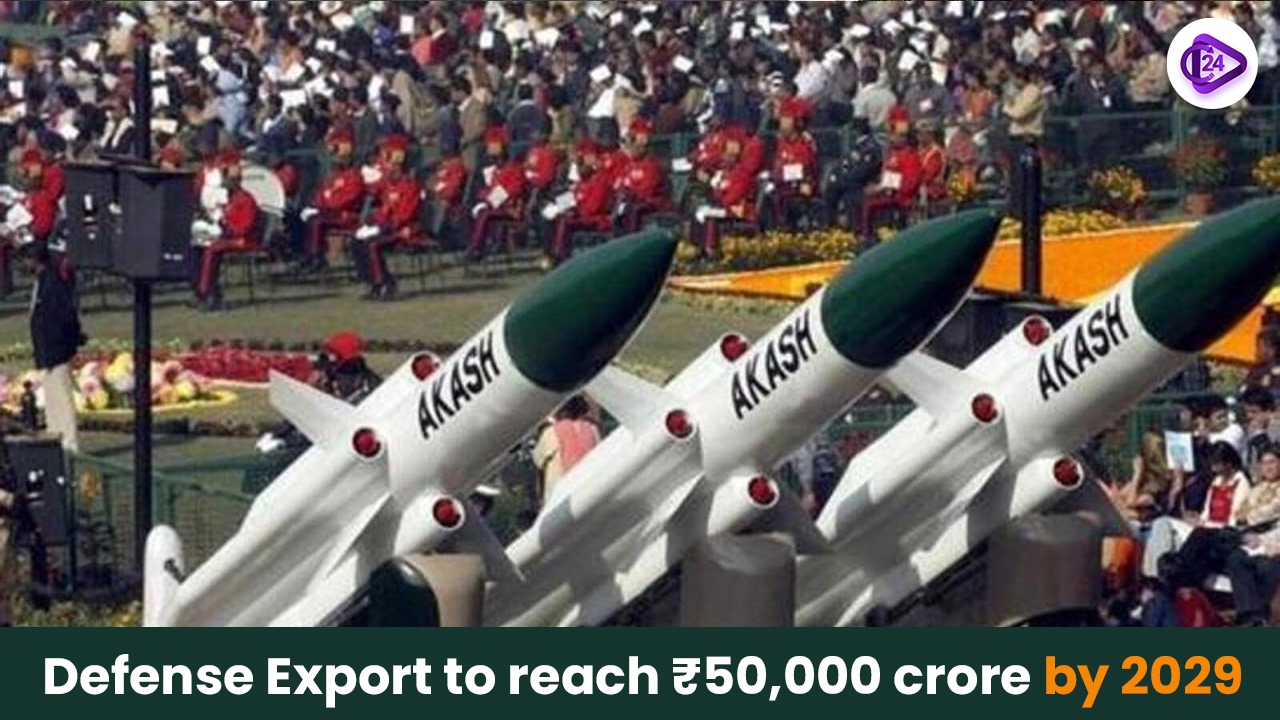
India has set a target of achieving ₹50,000 crore in defence exports by 2029, highlighting its growing focus on domestic defence manufacturing and self-reliance. Defence Minister Rajnath Singh announced this target while addressing the 16th Foundation Day celebration of the Indian Institute of Technology (IIT) Mandi in Himachal Pradesh on 24 February 2025.
During his address, the Defence Minister highlighted India’s progress in ammunition production, defence exports and indigenous manufacturing. He also encouraged students and researchers to develop advanced technologies for national security, particularly in artificial intelligence (AI), cybersecurity, quantum technology and digital innovation.
The speech connected India’s defence ambitions with its expanding technology and startup ecosystem. It also highlighted the role of educational institutions in developing solutions for the country’s future economic and security requirements.
India Defence Exports Target 2029: Key Highlights
| Particulars | Details |
| Defence Minister | Rajnath Singh |
| Event | 16th Foundation Day of IIT Mandi |
| Date | 24 February 2025 |
| Venue | IIT Mandi, Himachal Pradesh |
| Defence Export Target | ₹50,000 crore by 2029 |
| Ammunition Self-Sufficiency | 88%, as stated in the address |
| Defence Exports in FY 2023–24 | ₹21,083 crore (official figure) |
| Defence Production in FY 2023–24 | ₹1,26,887 crore |
| Major Focus | Aatmanirbharta, innovation and indigenous defence technology |
India’s Defence Self-Reliance and Export Goals
India has been working to reduce its dependence on imported defence equipment by strengthening domestic manufacturing and encouraging participation from both public and private industries.
During his IIT Mandi address, Rajnath Singh stated that India had achieved 88% self-sufficiency in ammunition production. This reflects progress in developing domestic capabilities for meeting the requirements of the armed forces.
The government has also introduced several initiatives to encourage indigenous defence production, research and development, and technology transfer.
1. Defence Export Target of ₹50,000 Crore
India aims to increase defence exports to ₹50,000 crore by 2029.
The target is intended to expand the domestic defence manufacturing ecosystem and strengthen India’s position in the international defence market.
Indian companies export a range of defence products, including:
- Aircraft and aircraft components.
- Naval equipment and systems.
- Defence electronics.
- Protective equipment.
- Ammunition and related products.
- Military communication and surveillance systems.
2. Growth in Defence Exports
India’s defence exports have increased significantly over the past decade.
According to the Ministry of Defence, exports reached ₹21,083 crore in FY 2023–24, compared with ₹686 crore in FY 2013–14.
Rajnath Singh referred to exports of approximately ₹23,000 crore during his February 2025 address. The official FY 2023–24 figure is ₹21,083 crore.
3. Expansion of Defence Production
India’s defence production also reached a record level in FY 2023–24.
The value of domestic defence production stood at ₹1,26,887 crore, according to government data released in July 2024.
Both Defence Public Sector Undertakings (DPSUs) and private companies contributed to this growth.
Defence Production and Export Figures
| Indicator | Figure |
| Defence production in FY 2023–24 | ₹1,26,887 crore |
| Defence exports in FY 2023–24 | ₹21,083 crore |
| Defence exports in FY 2013–14 | ₹686 crore |
| Ammunition self-sufficiency stated in February 2025 | 88% |
| Defence export target by 2029 | ₹50,000 crore |
India was also supplying defence products to more than 90 countries at the time of the announcement.
Role of Technological Innovation in Defence Development
Rajnath Singh emphasised that technological innovation is essential for strengthening India’s defence capabilities.
Modern warfare increasingly depends on advanced technologies, including artificial intelligence, digital communication, cyber systems and autonomous platforms.
He encouraged IIT Mandi students and researchers to develop indigenous technological solutions that can be used by the armed forces.
Some important technology areas highlighted during the address were:
1. Artificial Intelligence and Machine Learning
AI and machine learning can support modern defence systems through data analysis, intelligent surveillance, predictive maintenance and decision-support applications.
These technologies can help improve the speed and accuracy of information processing.
2. Cybersecurity
As defence infrastructure becomes increasingly connected, protecting digital networks and sensitive information is essential.
Cybersecurity research can help develop secure communication systems and protect critical defence infrastructure against digital threats.
3. Quantum Technology
Quantum technologies have potential applications in secure communication, sensing and advanced computing.
Research in this area can support the development of future technologies relevant to national security.
4. Indigenous Technology Development
The Defence Minister encouraged students to work on technologies that India currently imports or needs to develop further.
Greater domestic research and innovation can support technological independence and reduce dependence on foreign suppliers.
IIT Mandi and the Role of Young Innovators
The announcement was made during the 16th Foundation Day celebration of IIT Mandi, an institution located in Kamand, Himachal Pradesh.
The event provided a platform to discuss the relationship between education, scientific research, entrepreneurship and national development.
Rajnath Singh encouraged students to adopt the innovation-oriented approach described through the phrase:
Initiate, Improve and Transform (IIT).
The message highlighted the importance of starting new ideas, improving existing technologies and transforming research into practical solutions.
Educational institutions such as IITs can contribute to defence research by working with government agencies, research organisations, startups and private industries.
India’s Expanding Digital Economy
The Defence Minister also discussed India’s digital transformation and the growing contribution of technology to the national economy.
He highlighted the importance of innovation, digital infrastructure and entrepreneurship in building India’s future economic capabilities.
1. Growth of the Indian IT Industry
India’s technology sector has become an important contributor to economic activity, employment and exports.
During the address, the Minister referred to projections that India’s IT industry could reach a value of approximately US$300–350 billion over the following five years.
This growth was linked to increasing demand for software services, digital solutions, artificial intelligence and other emerging technologies.
2. Startup and Unicorn Ecosystem
India has developed a large startup ecosystem, supported by entrepreneurship, technology innovation and investment.
The figures cited during the address included approximately 1.25 lakh startups and 110 unicorns.
Startups can contribute to defence and civilian technology development through research in AI, robotics, cybersecurity, electronics and advanced manufacturing.
3. India’s Telecom Sector
India has the world’s second-largest telecommunications market.
The expansion of mobile networks, broadband connectivity and digital infrastructure has supported the growth of online services, digital education, e-commerce and financial technology.
4. Unified Payments Interface (UPI)
The Unified Payments Interface (UPI) has transformed digital payments in India.
Developed by the National Payments Corporation of India (NPCI), UPI allows users to make instant bank-to-bank payments through mobile applications.
Its adoption has also attracted international interest, creating opportunities for India’s digital payment technology to expand globally.
Major Government Initiatives Supporting Defence Self-Reliance
Several government initiatives support domestic defence manufacturing and innovation.
| Initiative | Main Objective |
| Make in India | Encourage domestic manufacturing |
| Aatmanirbhar Bharat | Promote self-reliance across sectors |
| Innovations for Defence Excellence (iDEX) | Support defence innovation and startups |
| SRIJAN Portal | Encourage indigenisation of defence components |
| Defence Industrial Corridors | Develop defence manufacturing clusters |
| Positive Indigenisation Lists | Promote domestic sourcing of identified defence items |
These initiatives aim to connect research institutions, startups, manufacturers and the armed forces.
The iDEX initiative, in particular, provides a platform for startups and innovators to develop technology solutions for defence requirements.
Significance of the ₹50,000 Crore Defence Export Target
The export target has several implications for India’s defence and economic development.
- Greater Domestic Manufacturing: Increased demand for Indian defence products can encourage companies to expand manufacturing capabilities.
- Technology Development: Higher investment in research and development can support advanced indigenous defence systems.
- International Partnerships: Defence exports can create opportunities for long-term cooperation with other countries.
- Employment Generation: Expansion of manufacturing, engineering and research activities can create skilled employment opportunities.
- Strategic Self-Reliance: Greater domestic production can help reduce dependence on imported defence equipment.
However, achieving the target will also require attention to product quality, delivery timelines, technology standards, research investment and international competition.
Conclusion
India’s target of achieving ₹50,000 crore in defence exports by 2029 reflects its focus on strengthening domestic manufacturing and developing indigenous defence technologies.
Rajnath Singh’s address at IIT Mandi highlighted the importance of ammunition self-sufficiency, defence exports, artificial intelligence, cybersecurity and research-driven innovation.
The connection between defence manufacturing and India’s digital economy also underlines the role of educational institutions, startups and technology companies in national development.