

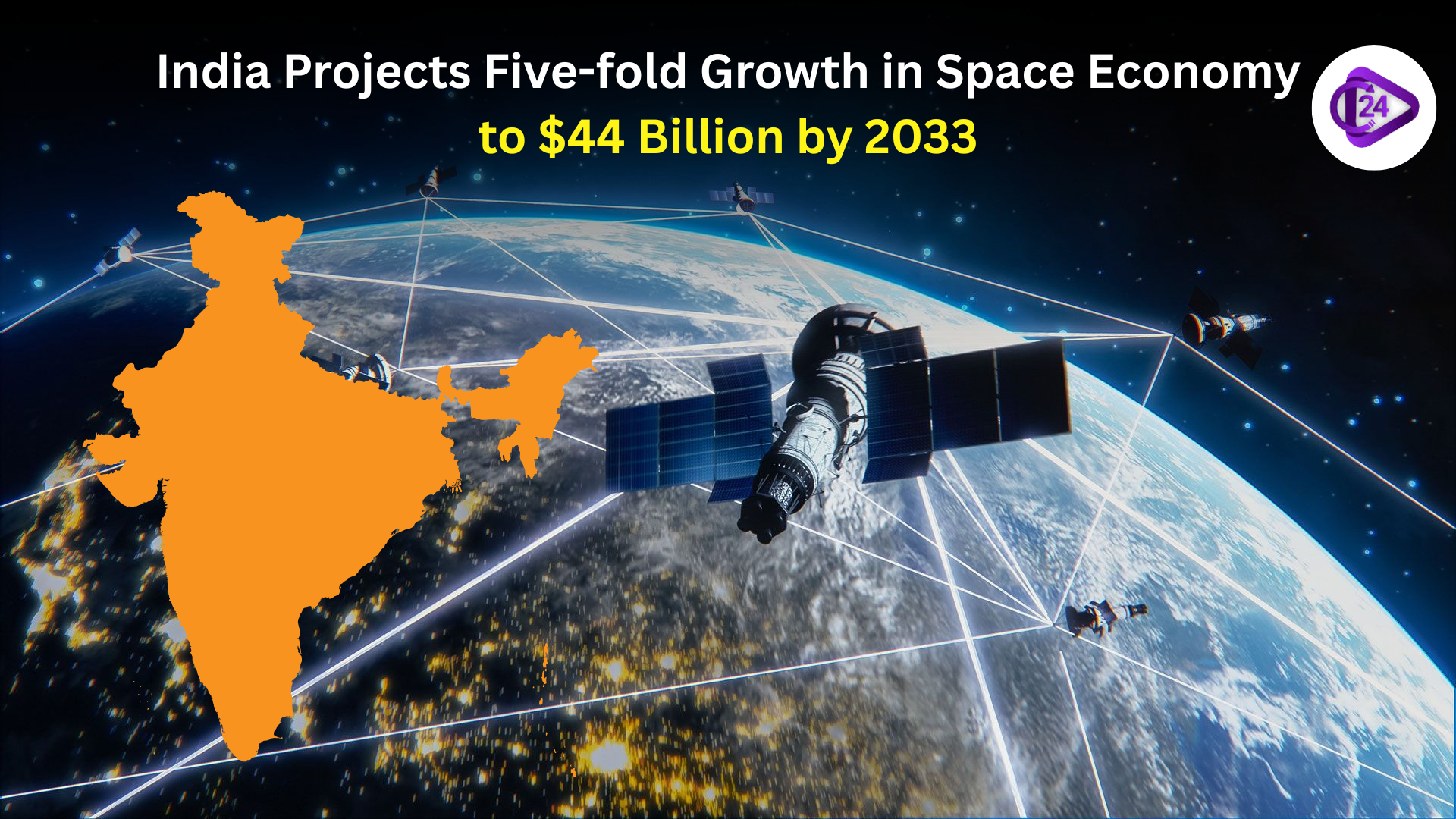
India’s space economy is projected to grow from approximately US8.4billionin2022toUS44 billion by 2033, according to the Decadal Vision and Strategy for the Indian Space Economy prepared by the Indian National Space Promotion and Authorisation Centre (IN-SPACe). The projection includes an ambition to capture around 8% of the global space market and generate approximately US$11 billion in exports.
India’s space sector is no longer limited to government-led satellite launches and scientific missions. It increasingly includes private rocket manufacturers, satellite companies, Earth-observation services, satellite communication, space-based data applications and other commercial activities. Government reforms, private investment, startup participation and commercialisation of space technology are expected to contribute to this expansion. However, the US$44 billion figure is a future projection, not the current value of India’s space economy.
Key Highlights of India’s Space Economy
| Indicator | Key Information |
| Space economy baseline | Approximately US$8.4 billion in 2022 |
| Projected value by 2033 | US$44 billion |
| Projected global market share | Around 8% by 2033 |
| Projected exports by 2033 | Approximately US$11 billion |
| Estimated space economy in August 2026 | Approximately US$9 billion, according to a government factsheet |
| Main space agency | Indian Space Research Organisation (ISRO) |
| Private-sector promotion and authorisation | IN-SPACe |
| Commercial arm of the Department of Space | NewSpace India Limited (NSIL) |
| Key policy framework | Indian Space Policy 2023 |
Sources: IN-SPACe Decadal Vision and Strategy, Department of Space and Government of India updates. The baseline, projections and later estimates refer to different dates and should not be treated as directly interchangeable.
What Is India’s Space Economy?
The space economy includes the activities, products and services that depend on space technology and its applications. It covers both the development of space infrastructure and the use of space-based systems to provide services on Earth.
India’s space economy can be broadly understood through three interconnected segments.
1. Upstream Segment
The upstream segment involves the development and production of space infrastructure. It includes launch vehicles, satellites, spacecraft components, propulsion systems and related technologies.Companies operating in this segment manufacture hardware and build systems that enable satellites and other spacecraft to reach and operate in space. The segment requires specialised engineering, testing facilities, research and substantial investment.
2. Midstream Segment
The midstream segment includes infrastructure and services that help operate space systems. Examples include ground stations, satellite control systems, data reception infrastructure and other supporting facilities.These services connect satellites and spacecraft with users on Earth. Reliable ground infrastructure is essential for operating satellites and managing the information they collect.
3. Downstream Segment
The downstream segment focuses on applications and services that use space-derived data or connectivity. It includes satellite communication, Earth observation, navigation services, weather applications and geospatial analytics.
This segment can serve a broad range of customers, including farmers, telecom operators, logistics companies, financial institutions, disaster-management authorities and government departments.The IN-SPACe vision identifies downstream applications as a major opportunity for expanding the commercial value generated by India’s space capabilities.
IN-SPACe Decadal Vision: The $44 Billion Roadmap
IN-SPACe’s Decadal Vision and Strategy outlines a roadmap to expand India’s space economy from US8.4billionin2022toUS44 billion by 2033.
The projected US44billionmarketincludesapproximatelyUS33 billion in domestic demand and US$11 billion in exports. The vision seeks to strengthen the entire industry rather than focusing only on rocket launches or satellite manufacturing.
Its major priorities include:
- Building commercially viable space platforms and services.
- Strengthening the domestic industrial ecosystem.
- Helping Indian companies expand production and operations.
- Increasing the adoption of satellite-based services.
- Improving international collaboration and exports.
- Encouraging cooperation among government institutions, startups, investors and established companies.
Achieving this projection will require more customers for space-enabled services, access to finance, dependable supply chains, skilled workers and greater participation in international markets.
Indian Space Policy 2023 and Private-Sector Participation
The Indian Space Policy 2023 is an important step in expanding private participation across India’s space sector. It provides a framework under which non-government entities can undertake a wide range of space activities, subject to applicable laws, authorisations and regulatory requirements.
Private companies can participate in areas such as satellite manufacturing, launch services, satellite operations, ground infrastructure and space-based applications.
The policy also clarifies the roles of key institutions.
ISRO
The Indian Space Research Organisation is India’s principal space research and development organisation. It develops space technologies and carries out scientific, exploration, launch and application missions.
IN-SPACe
The Indian National Space Promotion and Authorisation Centre promotes and authorises eligible non-government space activities. It helps facilitate private-sector participation and access to relevant space infrastructure and technology under the applicable framework.
NewSpace India Limited (NSIL)
NewSpace India Limited is the commercial arm of the Department of Space. It supports the commercialisation of Indian space capabilities, including launch services, satellite-related services and the transfer of space technologies to industry.
Together, these institutions support a model in which government research and infrastructure can coexist with private-sector manufacturing, investment and commercial services.
Growth of Private Space Companies and Startups
Private companies are becoming an increasingly important part of India’s space ecosystem. They are developing launch vehicles, satellite platforms, propulsion systems, communication technologies, Earth-observation services and software-based applications.
The government reported in January 2026 that approximately 1,050 private companies had provided their capabilities on the IN-SPACe Digital Platform for various space activities. This is a platform-based figure and should not automatically be interpreted as the number of fully operational space companies.
Private-sector participation can help expand the industry’s technical capabilities and create new commercial services. Startups can also test specialised technologies and develop products for customers in India and overseas.
However, companies face challenges such as high capital costs, long development cycles, demanding technical requirements, access to launch opportunities and uncertainty about future demand. Continued investment and reliable commercial contracts will be important for sustainable growth.
Major Applications Driving India’s Space Economy
1. Satellite Communication
Satellite communication supports television broadcasting, broadband connectivity, maritime communications and communication services in remote areas.
It can be especially useful where terrestrial networks are difficult or expensive to deploy. The commercial opportunity will depend on service affordability, network capacity, spectrum arrangements and demand from users.
2. Earth Observation and Remote Sensing
Earth-observation satellites collect information about the Earth’s surface and atmosphere. The data can support agriculture, crop assessment, water-resource management, urban planning, environmental monitoring and disaster response.
Businesses can create value by converting satellite imagery into useful information, forecasts and analytical services for customers.
3. Navigation Services
Satellite navigation supports positioning, navigation and timing applications. These services are useful in transport, logistics, mapping, surveying and several infrastructure-related activities.
India’s Navigation with Indian Constellation (NavIC) is an important component of its independent satellite-navigation capabilities.
4. Launch Services
Launch services enable satellites to be placed into orbit. India’s launch capabilities can serve domestic missions as well as international customers, subject to technical and commercial requirements.
A competitive launch industry needs reliable launch vehicles, predictable schedules, suitable infrastructure and effective cost management.
5. In-Orbit Services and Emerging Technologies
The wider space economy may also include satellite servicing, in-orbit operations and other emerging commercial activities. These areas require advanced technology, specialised expertise and a suitable regulatory environment.
As space systems become more complex, new opportunities may emerge for companies that develop reliable and cost-effective services.
Government Reforms and Investment Support
India opened its space sector to wider private participation through reforms introduced in 2020, followed by the Indian Space Policy 2023 and changes to foreign direct investment rules in 2024.
These reforms aim to improve opportunities for private investment and establish clearer pathways for eligible companies to undertake space activities.
Government support also includes initiatives to encourage startup development, technology transfer and access to funding. In 2026, the government highlighted targeted support measures such as the IN-SPACe Seed Fund Scheme, a ₹1,000 crore Venture Capital Fund and a ₹500 crore Technology Adoption Fund.
The objectives of these measures differ: seed funding supports early-stage innovation, venture capital helps finance company growth, and technology-adoption support is intended to encourage wider use of space technologies. Eligibility and disbursement depend on the relevant scheme rules.
Challenges to Achieving the $44 Billion Target
Despite the growth potential, several challenges could affect India’s progress.
- High development costs: Rockets, satellites and associated infrastructure require large investments.
- Access to capital: Space businesses may need long development periods before earning stable revenue.
- Global competition: Indian companies compete with established international providers in launch, satellite and data services.
- Market demand: Building technical capacity is not enough; businesses must attract paying customers.
- Technology and supply chains: Advanced components, testing facilities and skilled personnel are essential.
- Regulation and authorisation: Clear, predictable procedures help businesses plan investments and launch operations.
- Exports and international partnerships: Reaching the export ambition will require competitive services, international customer confidence and compliance with relevant rules.
The $44 billion projection is therefore an ambitious roadmap rather than a guaranteed outcome. Its realisation depends on both expanding technical capabilities and converting those capabilities into commercially sustainable products and services.
Important Facts for Competitive Examinations
- Targeted space economy size: US$44 billion by 2033.
- Baseline value: Approximately US$8.4 billion in 2022.
- Targeted global market share: Around 8% by 2033.
- Projected exports: Approximately US$11 billion by 2033.
- Projected domestic market: Approximately US$33 billion by 2033.
- Space policy: Indian Space Policy 2023.
- Space-sector promotion and authorisation: IN-SPACe.
- Commercial arm of the Department of Space: NSIL.
- Principal space research organisation: ISRO.
- Indian satellite-navigation system: NavIC.
- Government-reported platform figure: Approximately 1,050 private companies on the IN-SPACe Digital Platform as of January 2026.
Conclusion
India’s space economy is projected to grow from approximately US8.4billionin2022toUS44 billion by 2033, with a target of capturing around 8% of the global market and generating US$11 billion in exports.
Indian Space Policy 2023, IN-SPACe, NSIL and the expansion of private-sector participation are central to this strategy. Satellite communication, Earth observation, navigation, launch services and other space-enabled applications offer opportunities for commercial growth.
For India to achieve the projection, it will need sustained investment, wider adoption of space services, competitive domestic manufacturing, skilled talent and stronger international market access. For competitive examinations, remember the key figures, the roles of ISRO, IN-SPACe and NSIL, and the difference between the projected 2033 market size and the latest government estimate.