

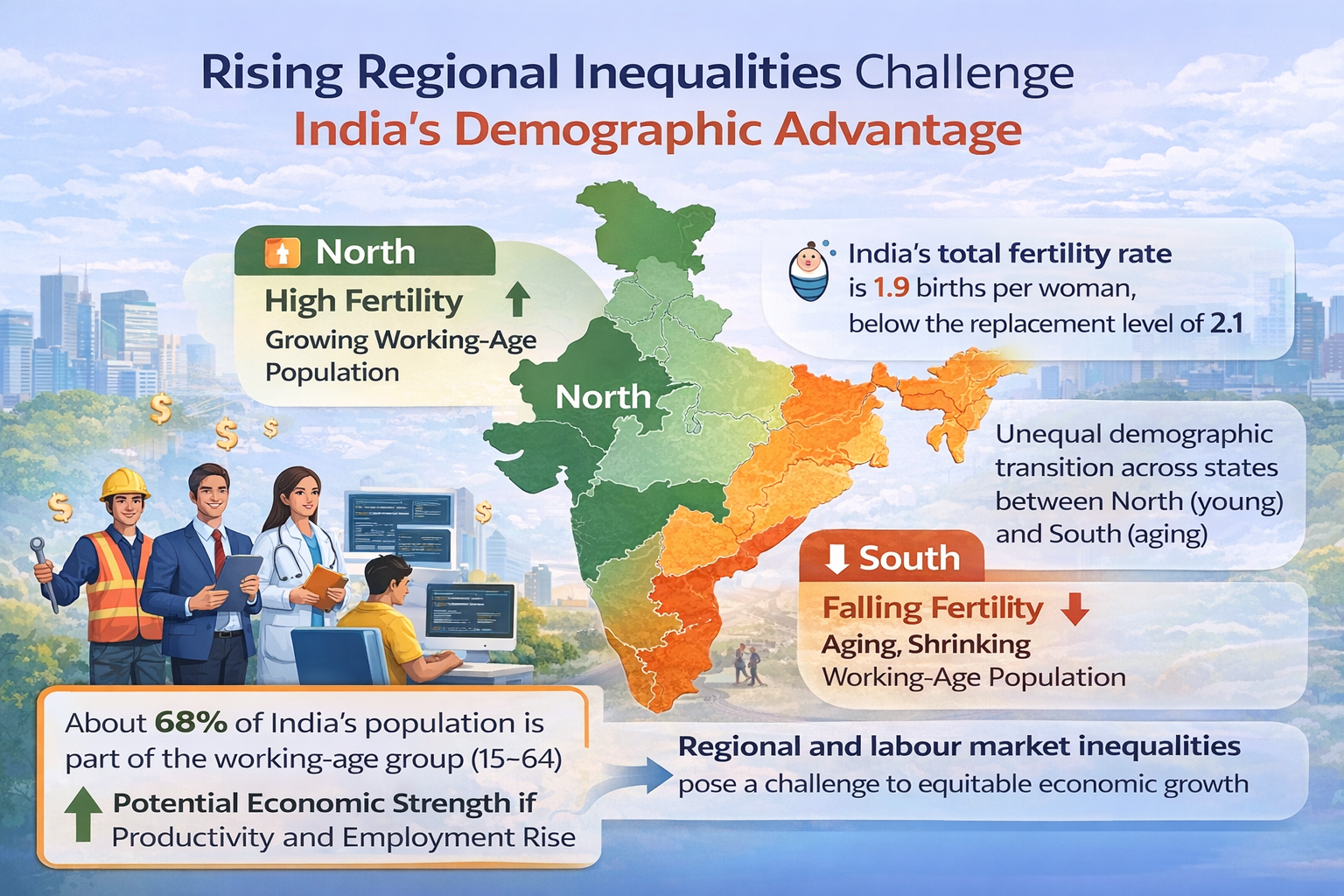
The demographic dividend long promised in India is starting to turn into a demographic divide, with regional and labour market inequalities increasing. A recent report demonstrates that although the national population can go up to about 1.59billion by 2051, the varying demographic transitions in different states are transforming the workforce in India. States in the north that have high fertility will provide a higher proportion of the working age group, and in the south, it is ageing with a falling fertility rate. This imbalance may transform federal relationships, pressurise the employment relations, and undermine fair economic development unless the employment, skills development, and regional inequalities are addressed through policy.
Rising Regional Inequalities Challenge India’s Demographic Advantage
-
Demographic transition is not uniform in nature since the total fertility rate (TFR) of India has been below the replacement level of 2.1 births per woman, and it currently stands at approximately 1.9, which is a nationwide demographic change.
-
The young labour force is still not minor -About 68 per cent of people in India are of working age (1564), which might be the economic strength in case the productivity and employment can keep up.
-
The difference in fertility in the regions remains high – states such as Bihar, Jharkhand or Uttar Pradesh still present a higher fertility rate, and states such as Delhi, Kerala and Tamil Nadu have significantly low rates, which is explained by the different socio-economic backgrounds and accessibility to education and healthcare.
-
The divergence between countries in terms of demographic trajectories can result in a two-fold problem: some will experience the risk of surpluses of labour, and others an ageing process that is not slowing down and an ageing population with fewer and fewer young people in the future.
-
Policy implications — These variances may make it difficult to plan at the national level, and this will influence resource allocation, job creation and fair growth among states.
-
Long-term perspective – In the absence of specific measures in skill development, education, and regional economic strategies, demographic benefits may transform into demographic separations.
Previous Year Questions of Demographic of India
| Exam & Year | Question | Correct Answer |
|---|---|---|
| UPSC Civil Services Prelims 2009 | Between Census 1951 and Census 2001, did population density increase more than three times, and did the annual growth rate double? | Neither (Both statements false) |
| SSC CGL 2024 Tier-II (Official) | Regarding the 2011 Census: (1) The population increased by more than 181 million from 2001–11; (2) The decadal growth rate saw the fastest post-independence decline. | Both statements are correct |
| SSC MTS 2024 (Official) | In which census was negative population growth recorded? | 1921 Census |
| RRB Technician (Geography) | As per the 2011 Census, what is India’s population density? | 382 persons/km² |
| SSC / RRB / State PYQs | The first synchronous census in India was conducted in which year? | 1881 |
| SSC / RRB / State Exams | The year 1921 in Indian census history is known as? | The Great Divide |
| SSC / RRB / State Questions | The Census Act in India was passed in which year? | 1948 |
Conclusion (India’s Demographic Dividend Turns into a Divide)
At a very crucial stage, India is facing a demographic advantage. The population imbalance between the southern states, geographical inequalities, and ageing will put the demographic dividend in jeopardy of becoming a divide. Employment, development of skills and equity in the region should have some strategic policies that would exploit the workforce to positively bring about inclusive and sustainable economic growth.