

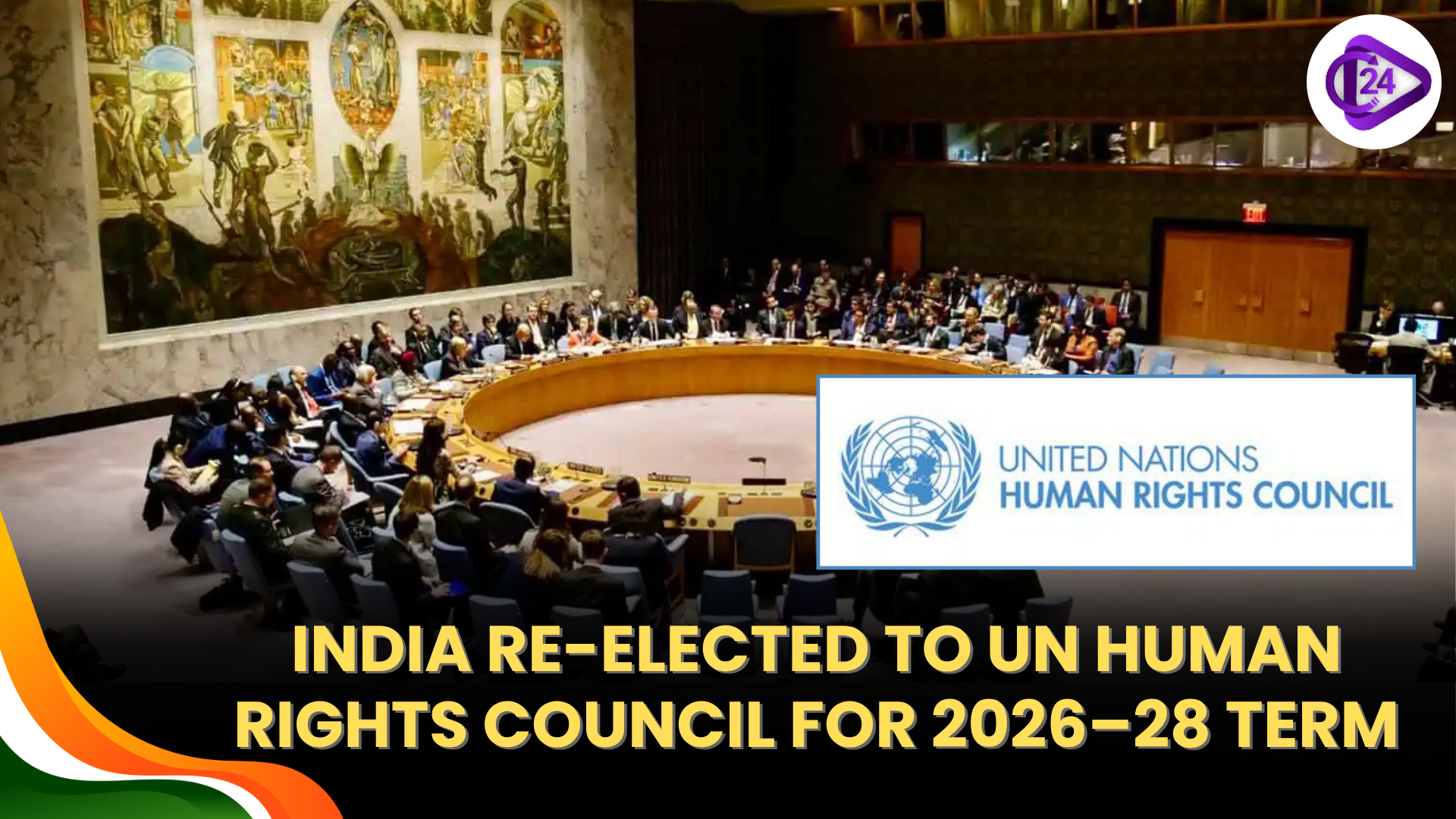
India was elected to the United Nations Human Rights Council (UNHRC) for the 2026–2028 term on 14 October 2025. The election took place during the 80th session of the United Nations General Assembly in New York. India was elected unopposed from the Asia-Pacific States group, and its three-year term began on 1 January 2026.
This was India’s seventh term on the Human Rights Council since the body was established in 2006. The election is an important international current affairs development because the Council works to promote and protect human rights worldwide, addresses human rights violations and provides a forum for dialogue and cooperation among countries.
For competitive-exam candidates, the key facts include the election date, the 2026–2028 term, the Council’s 47-member composition, its headquarters in Geneva, Switzerland, and its role within the United Nations system.
India Re-elected to UNHRC 2026-2028: Key Highlights
| Particular | Details |
| Country elected | India |
| Organisation | United Nations Human Rights Council |
| Election date | 14 October 2025 |
| Term | 2026–2028 |
| Term commencement | 1 January 2026 |
| Election body | United Nations General Assembly |
| Regional group | Asia-Pacific States |
| Election outcome | Elected unopposed |
| India’s membership | Seventh term |
| Total Council members | 47 countries |
| Headquarters | Geneva, Switzerland |
| Established | 15 March 2006 |
Source: United Nations General Assembly and official UN Human Rights Council election records.
What Is the United Nations Human Rights Council?
The United Nations Human Rights Council is an intergovernmental body within the United Nations system. It is responsible for promoting and protecting human rights around the world and addressing situations involving human rights violations.
The Council was established by the UN General Assembly on 15 March 2006 through Resolution 60/251. It replaced the former United Nations Commission on Human Rights.
The UNHRC provides a platform for countries to discuss human rights concerns, examine allegations of violations, adopt resolutions and recommend measures to improve the protection of fundamental rights and freedoms.
Its work covers a wide range of issues, including civil and political rights, economic and social rights, discrimination, freedom of expression and the protection of vulnerable groups.
Key Functions of the UNHRC
- Promoting human rights: Encourages respect for internationally recognised human rights and fundamental freedoms.
- Addressing violations: Discusses situations involving human rights violations and makes recommendations.
- Universal Periodic Review (UPR): Reviews the human rights records of all UN Member States through a peer-review process.
- Special procedures: Appoints independent experts and special rapporteurs to examine specific human rights themes or country situations.
- International cooperation: Provides a forum for dialogue, technical assistance and cooperation on human rights issues.
- Recommendations and resolutions: Adopts resolutions and recommends steps to strengthen human rights protection.
The Council is a subsidiary body of the UN General Assembly. It should not be confused with the Office of the UN High Commissioner for Human Rights (OHCHR), which supports human rights work across the UN system.
How Was India Elected to the UNHRC?
The United Nations General Assembly elected 14 countries to the Human Rights Council on 14 October 2025 for terms beginning on 1 January 2026. India was among the countries elected from the Asia-Pacific States group. Its election was unopposed, meaning the regional election did not involve a contested choice between India and competing candidates for its seat. The Council’s membership is based on equitable geographical distribution. Countries are elected individually by secret ballot in the General Assembly, and a candidate must receive the required majority of votes. India’s election for the 2026–2028 term marked its seventh term on the Council. Its previous terms included 2006–2007, 2008–2010, 2012–2014, 2015–2017, 2019–2021 and 2022–2024.
The membership rules do not permit a country to serve more than two consecutive terms. India therefore had a break before beginning its 2026–2028 term.
UNHRC Membership and Regional Seat Distribution
The United Nations Human Rights Council consists of 47 Member States elected by the General Assembly for three-year terms. Seats are distributed among five regional groups to support equitable geographical representation.
| Regional group | Number of seats |
| African States | 13 |
| Asia-Pacific States | 13 |
| Eastern European States | 6 |
| Latin American and Caribbean States | 8 |
| Western European and Other States | 7 |
| Total | 47 |
The distribution ensures that all five regional groups are represented on the Council. Elections take place annually to fill seats whose terms are ending. Members are expected to uphold high human rights standards and cooperate with the Council’s mechanisms. A state cannot be immediately re-elected after serving two consecutive terms.
India’s Role in the UN Human Rights Council
India’s election places it among the countries participating in the Council’s work during the 2026–2028 period. As a member, India can participate in discussions, contribute to negotiations, vote on resolutions and engage with international human rights initiatives.
The Council’s work involves balancing country-specific concerns with broader thematic issues. Its members discuss matters such as equality, non-discrimination, freedom of expression, access to justice and the protection of vulnerable communities.
Membership does not automatically mean that a country has received a separate assessment certifying its domestic human rights record. The election determines representation on the Council; the Council’s reviews and procedures are separate processes.
India’s participation also provides an opportunity to contribute to discussions on development, social inclusion, access to education and healthcare, and the relationship between human rights and public policy.
What Is the Universal Periodic Review (UPR)?
The Universal Periodic Review is one of the major mechanisms associated with the Human Rights Council. Under this process, the human rights record of every UN Member State is reviewed by other states on a periodic basis.
The review provides an opportunity for countries to present information about their human rights situation, discuss recommendations and report on measures taken to improve implementation.
The UPR is distinctive because it covers all UN Member States rather than only countries that are members of the Human Rights Council.
Recommendations emerging from the process can address legal reforms, institutional arrangements, public policy and the implementation of international human rights commitments.
For examinations, candidates should remember that the UPR is a mechanism of the UN Human Rights Council and is not a separate treaty organisation.
UNHRC vs. OHCHR: Important Difference
The UNHRC and the Office of the United Nations High Commissioner for Human Rights perform related but distinct roles.
| Feature | UN Human Rights Council | OHCHR |
| Nature | Intergovernmental body | UN office |
| Main role | Promotes and protects human rights through deliberation, reviews and resolutions | Supports human rights work and provides expertise and assistance |
| Membership | 47 elected Member States | Not a membership-based council |
| Location | Geneva, Switzerland | Headquarters in Geneva, Switzerland |
| Key activities | UPR, resolutions, special procedures and discussions | Monitoring, technical assistance, research and support for UN mechanisms |
This distinction is useful for competitive examinations because questions often test the difference between a UN body, an office and a specialised agency.
Why Is India’s UNHRC Election Important?
India’s election is significant from the perspective of international representation and multilateral diplomacy. Membership allows the country to take part in deliberations on global human rights issues and contribute to the development of resolutions and recommendations.
The Council also provides a platform for cooperation between countries on human rights challenges. Its activities can influence international discussions about legal safeguards, equality, accountability and institutional reform.
However, election to the Council should be understood as participation in an intergovernmental body, not as a final judgement on the human rights performance of any member country.
Important Facts for Competitive Exams
Candidates preparing for SSC, UPSC, RRB, banking and state-level competitive examinations should remember:
- India was elected to the UNHRC for the 2026–2028 term on 14 October 2025.
- India’s new term began on 1 January 2026.
- This was India’s seventh term on the Council.
- The UN Human Rights Council was established on 15 March 2006.
- The Council has 47 members.
- Its headquarters is in Geneva, Switzerland.
- Members are elected by the UN General Assembly for three-year terms.
- Seats are allocated among five regional groups.
- The Universal Periodic Review examines the human rights records of all UN Member States.
- OHCHR is a separate UN office that supports human rights activities.
Conclusion
India’s election to the United Nations Human Rights Council for the 2026–2028 term was announced on 14 October 2025, and its term began on 1 January 2026. The election marked India’s seventh term on the Council, which comprises 47 Member States elected by the UN General Assembly.
The UNHRC plays an important role in promoting human rights, conducting the Universal Periodic Review, addressing violations and encouraging international cooperation. Understanding its membership structure, regional seat distribution and major mechanisms is useful for candidates preparing for competitive examinations.
For current affairs preparation, the most important facts are India’s election date, term, membership count, headquarters, establishment year and the distinction between the UNHRC and OHCHR.
Previous Year Questions (PYQs) Based on the UNHRC
The following table includes questions reported in previous examination papers or memory-based paper compilations. The exact wording may vary by source.
| Exam Name | Year | Question | Correct Answer |
| CDS I | 2019 | In October 2018, India was elected as a member of the UN Human Rights Council for a period of how many years? | Three years |
| MPSC State Services Prelims | 2019 | India was elected to the UN Human Rights Council for a term beginning on 1 January 2019. Which statements about the election were correct? | Statements about the three-year term and India’s 188 votes were correct |
| UGC NET Political Science | 2019 | On which date did India’s 2019 UNHRC membership term begin? | 1 January 2019 |
| IBPS Clerk Mains (memory-based) | 2025 | For how long does a country serve on the UN Human Rights Council? | Three years |