

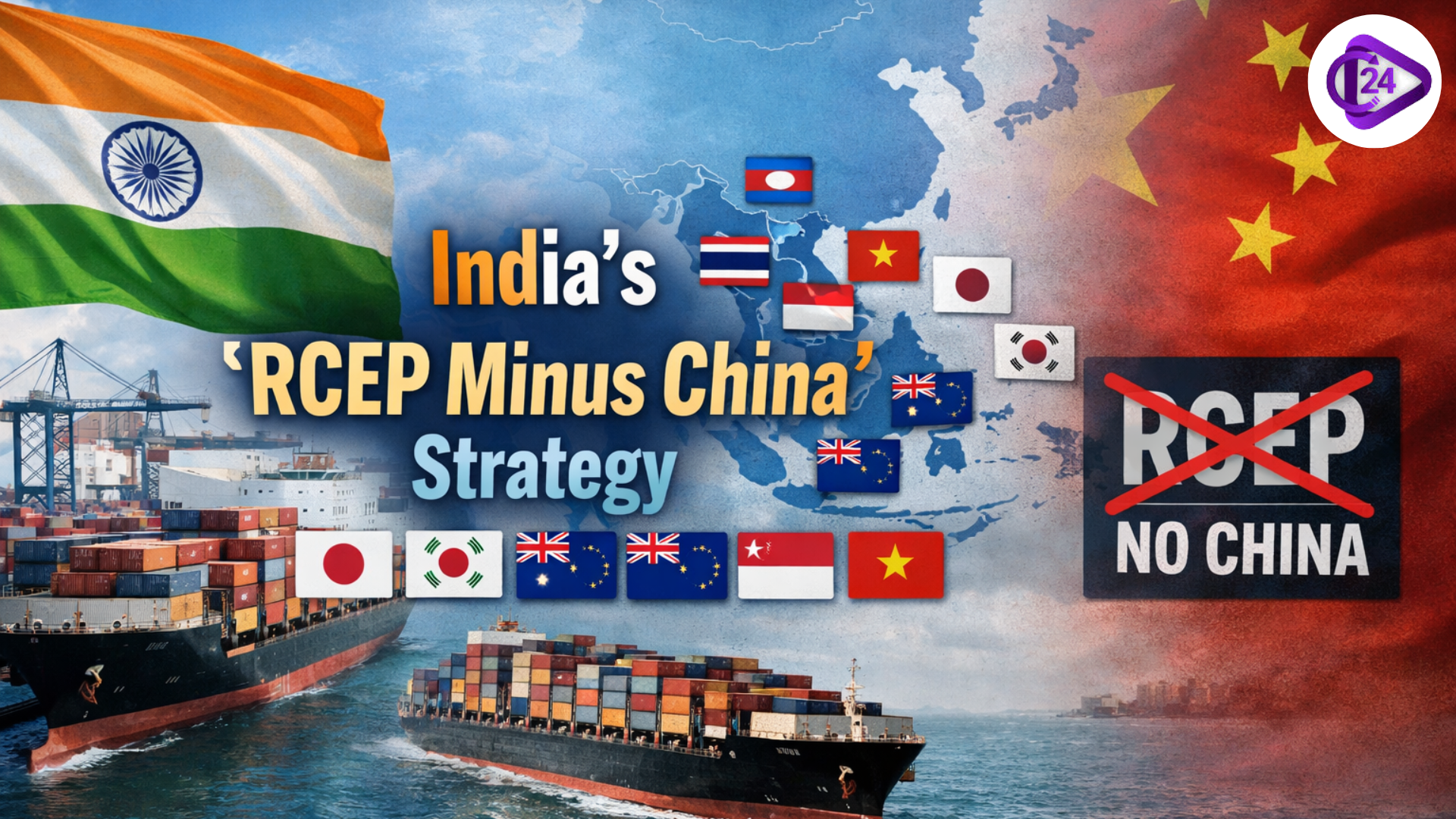
India's RCEP Minus China policy shows that New Delhi was cautious about regional trade following its decision not to join the Regional Comprehensive Economic Partnership (RCEP) in 2019. The government concluded that the current RCEP framework failed to protect India's sensitive sectors and would flood local industries with almost free Chinese imports. Rather than being part of the entire bloc, India has sought bilateral free trade agreements with all RCEP members except China, gaining market access without relinquishing its tariff autonomy and policy space. This policy is intended to restrain economic opportunities in line with national interests and reduce the vulnerability associated with China-centred trade integration.
What is RCEP and India’s ‘RCEP Minus China
-
The RCEP (Regional Comprehensive Economic Partnership) is a mega free trade agreement among countries in the Asia-Pacific region, aimed at reducing tariffs and facilitating trade integration.
-
It comprises 10 ASEAN nations, Japan, South Korea, Australia, and New Zealand, and is a major member of China.
-
RCEP accounts for approximately 30 percent of global GDP and population, making it the largest trade bloc in the world.
-
In 2019, India pulled out because of increasing trade deficits, particularly with China, as well as risks to domestic industries.
-
The RCEP Minus China strategy refers to India's approach of seeking bilateral trade agreements with other RCEP members, excluding China.
-
This will assist India in entering the market while safeguarding both strategic and economic interests.
Expected MCQs about RCEP
Q.1 With reference to the Regional Comprehensive Economic Partnership (RCEP), consider the following statements:
It is a free trade agreement among Asia-Pacific countries.
It aims to reduce tariffs and integrate regional supply chains.
India is a current member of RCEP.
Which of the statements given above is/are correct?
A) 1 and 2 only
B) 2 and 3 only
C) 1 and 3 only
D) 1, 2, and 3
Answer: A
Explanation: India is not a member of RCEP; it withdrew in 2019.
Q.2 What does India’s ‘RCEP Minus China’ strategy primarily refer to?
A) Forming a new trade bloc without China
B) Imposing tariffs only on Chinese goods
C) Signing trade agreements with RCEP members except China
D) Re-entering RCEP with special safeguards
Answer: C
Explanation: India is engaging bilaterally with RCEP countries excluding China.
Q.3 RCEP currently represents approximately what share of the global economy?
A) 15%
B) 20%
C) 30%
D) 45%
Answer: C
Explanation: RCEP accounts for about 30% of global GDP and population.
Q.4 How does the ‘RCEP Minus China’ strategy help India?
A) It isolates India from regional trade
B) It increases import protection only
C) It balances market access with strategic autonomy
D) It replaces WTO rules
Answer: C
Explanation: It allows engagement with Asia-Pacific economies without strategic vulnerability.
Q.5 RCEP consists of ASEAN countries and which of the following non-ASEAN countries?
A) India, Pakistan, Sri Lanka, Bangladesh
B) China, Japan, South Korea, Australia, New Zealand
C) Russia, China, Iran, Turkey
D) UK, France, Germany, Italy
Answer: B
Explanation: RCEP includes ASEAN + China, Japan, South Korea, Australia, and New Zealand.
Conclusion (India’s ‘RCEP Minus China’ Strategy)
The strategy of India, which is known as the RCEP minus China, is a measure of moderation between economic integration and strategic independence. In the process of interacting with the economies of Asia-Pacific and excluding China, India protects domestic industries, minimizes geopolitical risk, and enhances diversified supply chains in accordance with its long-term national and economic interests.