

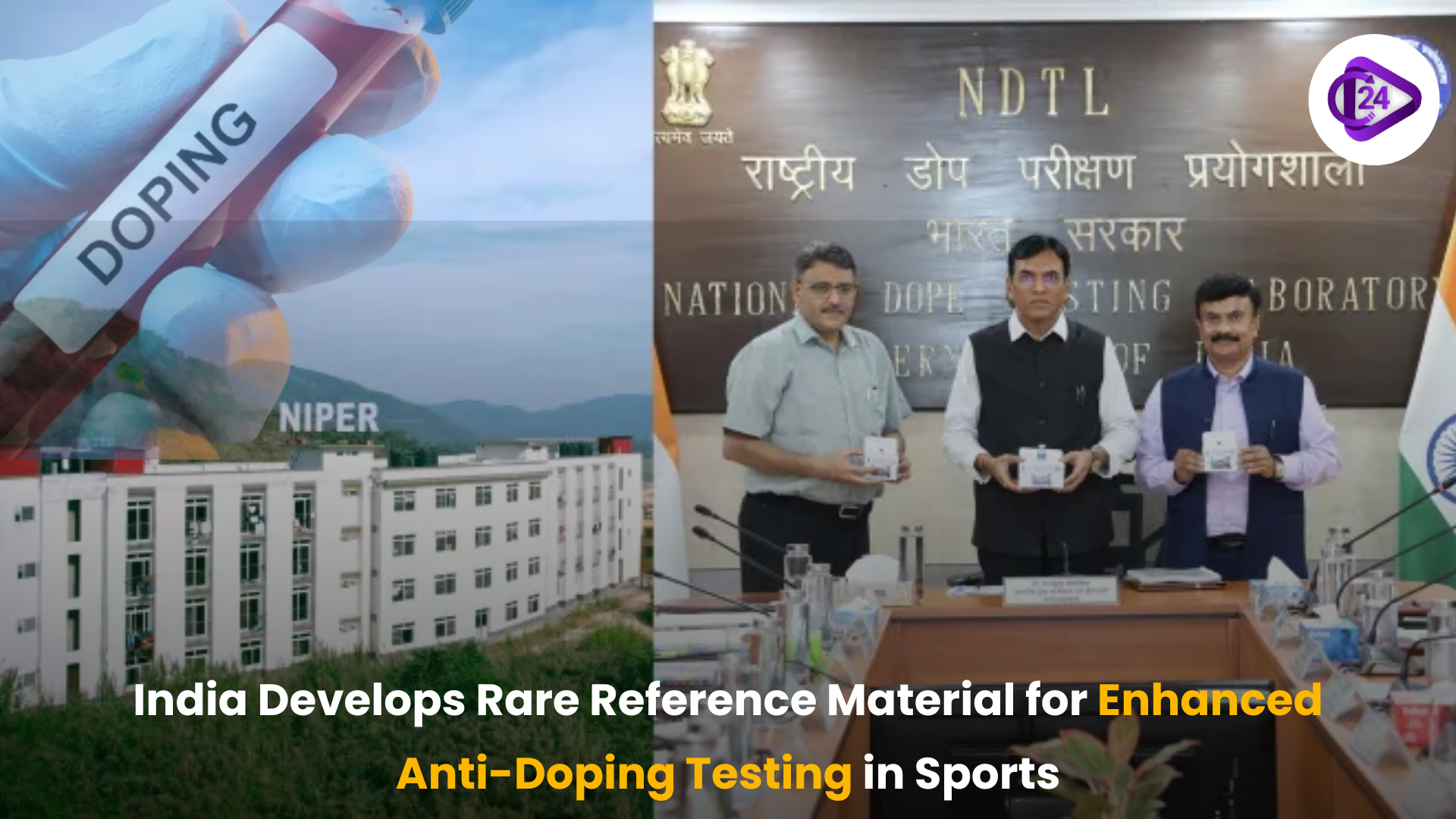
India has taken an important step towards strengthening anti-doping testing with the development of a rare chemical reference material by the National Institute of Pharmaceutical Education and Research (NIPER), Guwahati, in collaboration with the National Dope Testing Laboratory (NDTL), New Delhi. The development was announced on 4 September 2025 and marks a significant contribution to sports science and the global effort to protect clean athletes.
The newly developed material is known as Methandienone Long-Term Metabolite (LTM). It is designed to support the detection of methandienone, an anabolic steroid prohibited in competitive sports. The development of this specialised material can help anti-doping laboratories improve their testing capabilities and strengthen efforts to identify doping violations.
This achievement is important not only for India but also for the international sports community, as reliable laboratory testing is essential for maintaining fairness, transparency and integrity in sporting competitions.
Key Highlights of India’s Anti-Doping Reference Material
Here are the important facts about this development:
- Developed by: NIPER Guwahati in collaboration with NDTL, New Delhi.
- Reference material: Methandienone Long-Term Metabolite (LTM).
- Launch date: 4 September 2025.
- Launched by: Union Minister Dr. Mansukh Mandaviya.
- Launch occasion: The 22nd Governing Body Meeting of NDTL in New Delhi.
- Main objective: To strengthen anti-doping analysis and improve the detection of prohibited substances.
- Global significance: The material may be shared with WADA-accredited laboratories worldwide.
According to the Government of India’s announcement, this reference material was not commercially available globally at the time of its development. Its availability represents an important contribution to specialised anti-doping research.
What Is Anti-Doping Testing in Sports?
Anti-doping testing refers to the scientific process used to identify prohibited substances or methods that athletes may use to gain an unfair competitive advantage. It is an essential part of modern sports because doping can undermine fair competition and may pose health risks to athletes.
Anti-doping laboratories analyse samples, commonly urine and blood, using specialised scientific methods. These tests look for prohibited substances, their metabolites or other relevant markers that may indicate doping.
However, detecting a substance is not always straightforward. Some drugs are broken down by the body into different chemical compounds, known as metabolites. These compounds may remain detectable for a period after the original substance has been taken.
This is where India’s anti-doping reference material becomes important. A reliable chemical reference helps laboratories compare analytical findings with a well-characterised standard, supporting the identification of relevant substances in samples.
What Is Methandienone Long-Term Metabolite (LTM)?
Methandienone is an anabolic-androgenic steroid that has been prohibited in sport under anti-doping rules. It has been associated with attempts to increase muscle mass and improve physical performance.
When a substance enters the body, it may undergo metabolic changes. The resulting metabolites can provide useful evidence during anti-doping investigations. Some metabolites remain detectable for longer than the original substance or its primary breakdown products.
Methandienone Long-Term Metabolite (LTM) is a specialised chemical reference material associated with the long-term detection of methandienone use. Its importance lies in helping laboratories identify the relevant metabolite during analytical testing.
The availability of this material can support the development and validation of testing methods. It may also help laboratories recognise evidence of prohibited substance use even when testing takes place long after the original exposure.
The detection window varies according to the substance, individual metabolism, analytical method and other factors. Therefore, no single reference material guarantees that every instance of doping will be detected.
Role of NIPER Guwahati and NDTL in This Achievement
The collaboration between NIPER Guwahati and the National Dope Testing Laboratory highlights the role of scientific research in strengthening India’s sports infrastructure.
NIPER Guwahati is a national institute focused on pharmaceutical education and research. Its scientific expertise contributed to the synthesis of the specialised reference material.
National Dope Testing Laboratory (NDTL) is India’s national laboratory for dope testing. It carries out scientific analysis related to doping control and contributes to research and technical development in anti-doping science.
The two institutions have been working together to develop reference materials that are difficult to obtain commercially. The government’s announcement stated that 12 of 22 targeted reference materials had been synthesised by NIPER Guwahati and delivered to NDTL, with Methandienone LTM being the latest at the time.
This work can reduce dependence on limited international supplies and strengthen domestic scientific capabilities in an area where specialised materials are essential.
What Is a Reference Material in Dope Testing?
A reference material is a substance that has been sufficiently characterised for its intended analytical use. In anti-doping laboratories, such materials help scientists identify and measure target substances and check the performance of testing procedures.
For example, a laboratory investigating a sample may need to establish whether a chemical signal corresponds to a particular prohibited substance or metabolite. A suitable reference material provides a standard for comparison and supports the reliability of the analytical method.
Reference materials are also important for quality control, method validation and consistent laboratory performance. Their availability is especially valuable when the target compound is rare or difficult to source.
In this context, anti-doping reference material is not a drug for athletes or a treatment product. It is a scientific tool used by trained laboratory professionals to support accurate testing.
How Does This Development Help WADA-Accredited Laboratories?
The World Anti-Doping Agency (WADA) plays a central role in coordinating international anti-doping efforts and establishing the framework used to protect clean sport. WADA-accredited laboratories must meet strict technical and quality requirements.
The development of Methandienone LTM is relevant to these laboratories for several reasons:
- Improved analytical capability: A suitable reference material can support the identification of the target metabolite in laboratory samples.
- Long-term detection support: It can help scientists investigate evidence of methandienone use beyond the period when the original substance may be readily detectable.
- Quality assurance: Reference materials help laboratories assess whether their analytical procedures are performing as intended.
- International scientific cooperation: Sharing specialised materials can support research and testing capacity across different countries.
- Protection of clean athletes: More reliable analytical tools can strengthen the broader effort to discourage doping and uphold fair competition.
The Government of India stated that the material could be shared with all 30 WADA-accredited laboratories worldwide as part of international knowledge-sharing efforts. This was the reported scope of the initiative, rather than a confirmation that every laboratory had already received it.
Significance of the Development for India
The development of India’s anti-doping reference material has scientific, institutional and sporting significance.
First, it demonstrates the ability of Indian research institutions to contribute to specialised analytical science. Producing reference materials that are scarce internationally requires chemical expertise, careful characterisation and cooperation between research and testing laboratories.
Second, the initiative supports India’s efforts to strengthen its domestic anti-doping infrastructure. Greater local research capacity can help reduce dependence on limited international suppliers and support future work on other difficult-to-source reference materials.
Third, international sharing can extend the benefits of Indian research beyond national boundaries. Anti-doping is a global responsibility, and cooperation among laboratories is important because athletes compete across countries and sporting systems.
Finally, reliable testing supports the principles of fair play, equal opportunity and sporting integrity. Athletes who compete without prohibited performance-enhancing substances deserve confidence that doping-control systems are scientifically robust.
What Is the Difference Between a Reference Material and a Doping Test?
A reference material and a doping test are related, but they are not the same thing.
A reference material is a scientifically characterised substance used as a standard during laboratory analysis. A doping test is the broader process of collecting and analysing an athlete’s sample to look for evidence of prohibited substances or methods.
The reference material helps the laboratory perform its work; it does not independently determine whether an athlete has violated anti-doping rules. Results must be interpreted under the applicable testing standards and anti-doping procedures.
This distinction is important because the integrity of a doping-control system depends on validated methods, proper sample handling, quality assurance and appropriate interpretation of findings.
Conclusion
India’s development of Methandienone Long-Term Metabolite (LTM), through collaboration between NIPER Guwahati and NDTL, is a meaningful step in the advancement of anti-doping science. The material can support the identification of a long-term metabolite associated with methandienone and strengthen the scientific tools available to testing laboratories.
The initiative also highlights the value of indigenous research, institutional collaboration and international knowledge sharing. By improving access to specialised reference materials, India can contribute to global efforts to protect clean athletes and promote fair competition.
For students preparing for current affairs examinations, this development is important under sports science, government initiatives, pharmaceutical research and international anti-doping cooperation.