
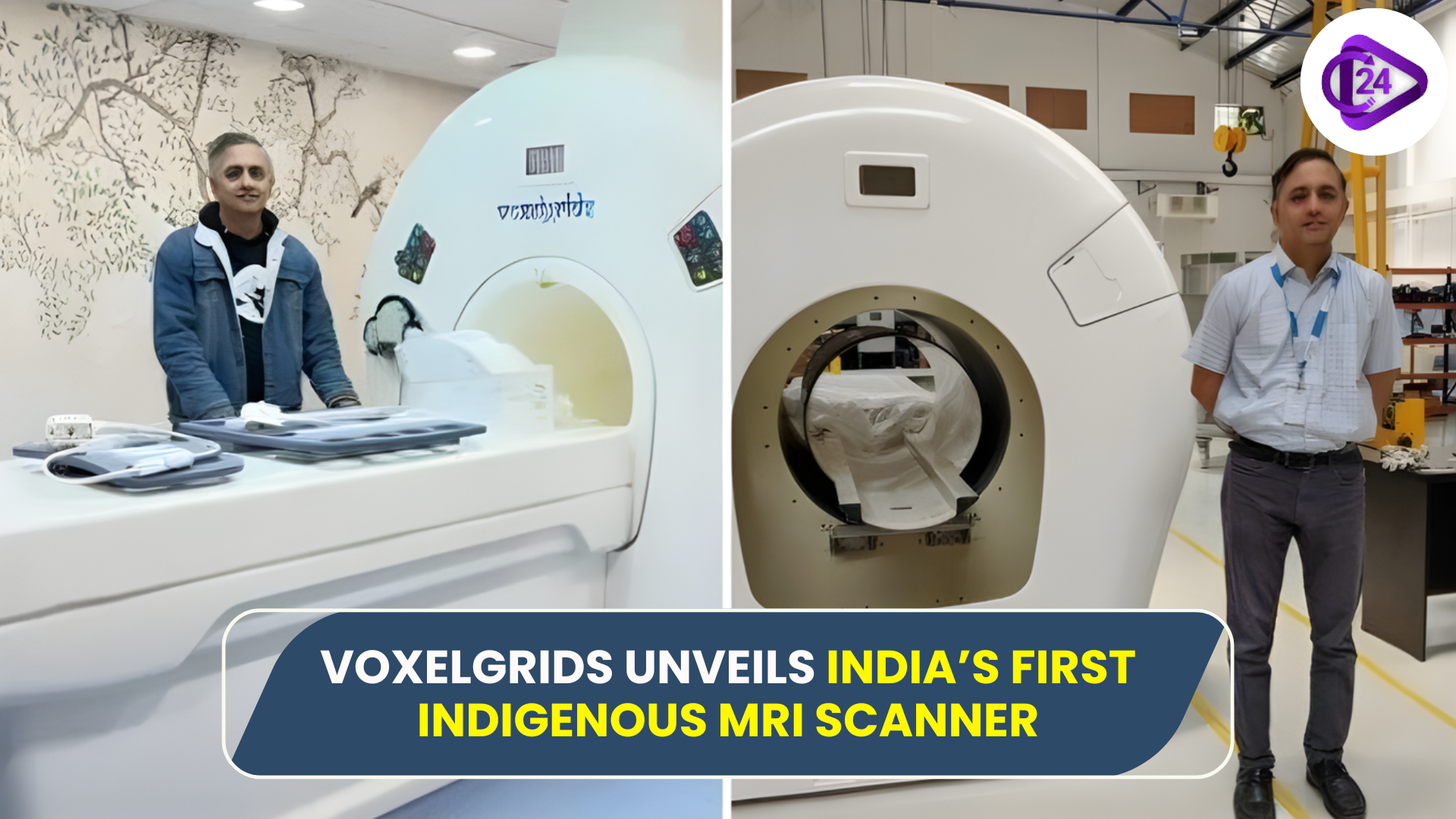
As the latest technology in healthcare, Magnetic Resonance Imaging (MRI) has seen a significant breakthrough in India, with the Bengaluru-based startup VoxelGrids launching the first fully indigenous MRI scanner, supported by Zoho Corporation. The 1.5 Tesla MRI scanner was developed over 12 years and launched on December 25, 2025. It is currently operating at the Chandrapur Cancer Care Foundation in Maharashtra, reducing dependence on imported diagnostic equipment. The system is locally engineered with a no-helium design, making it lighter, more energy-efficient, and approximately 40 per cent more affordable than traditional machines, thereby making high-quality medical imaging much more accessible to all Indians.
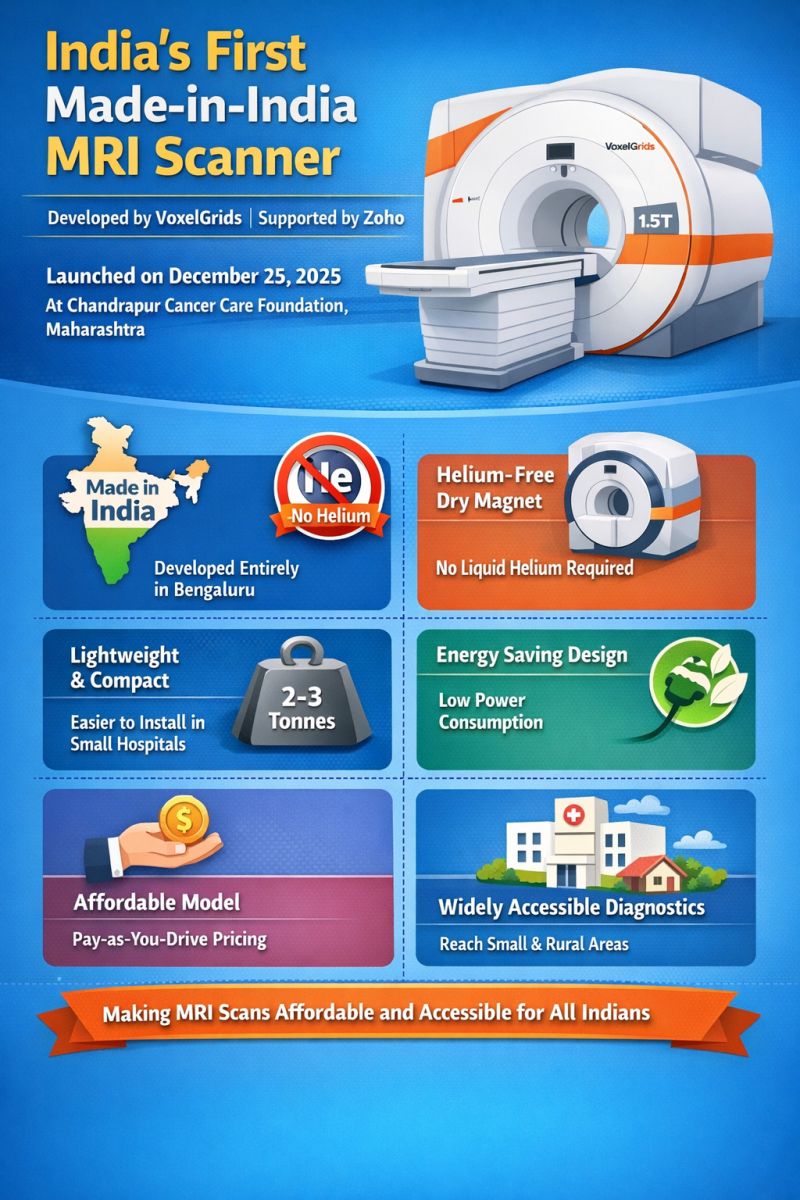
Key Features of India’s First Made-in-India MRI Scanner
-
Indigenous 1.5 Tesla MRI System: This is another milestone in the field of domestic medical technology, as it has been developed entirely in India by Bengaluru-based start-up VoxelGrids.
-
Helium-Free: Dry Magnet Design: Uses no costly and unavailable liquid helium, saving about 40 dollars in manufacturing and maintenance.
-
Lightweight and Compact: Only weighed around 2 to 3 tonnes, which is light compared to the normal weight of 6 tonnes of the regular MRI scanners, and thus, the device could be installed in smaller hospitals and rural centres.
-
Energy-Saving Operation: The design consumes less power and is thus suitable in the Indian clinical environment with fluctuating electrical supply.
-
Reduced initial expenditure: The pay-as-you-drive model lowers capital expenses incurred by healthcare providers.
-
Widely Accessible Diagnostics: To make MRI services widely accessible, this aims to increase the spread of MRI services outside large urban areas by reducing the cost and infrastructure barrier to access.
PYQs About MRI Asked So Far
| Exam Name | Year | Question | Answer |
|---|---|---|---|
| UPSC Civil Service Prelims | 2012 | What does MRI stand for? | Magnetic Resonance Imaging — MRI uses magnets and radio waves to image organs and tissues. |
| Bihar CET B.Ed | 2019 | MRI stands for: | Magnetic Resonance Imaging — the correct full form of the medical imaging technique. |
| RRB NTPC CBT-I | 2025 | India developed its first indigenous MRI machine, set to be installed at __________. | All India Institute of Medical Sciences (AIIMS), Delhi — as per official RRB NTPC question. |
| MPSC State Service Prelims | 2016 | Which of the following is correct? MRI generates thin-section images of any body part; a CT scan is superior to X-rays and MRI. | Only MRI generates detailed thin-section images (correct statement). |
Conclusion (India’s First Made-in-India MRI)
VoxelGrids India's first indigenous MRI scanner is a significant breakthrough in the history of medical technology as it provides cost-effective, energy saving, and helium free imaging. The result of this will increase the level of access to a high level of diagnostics, build self-sufficiency in healthcare, and make India a leader in local innovation in medical imaging.