

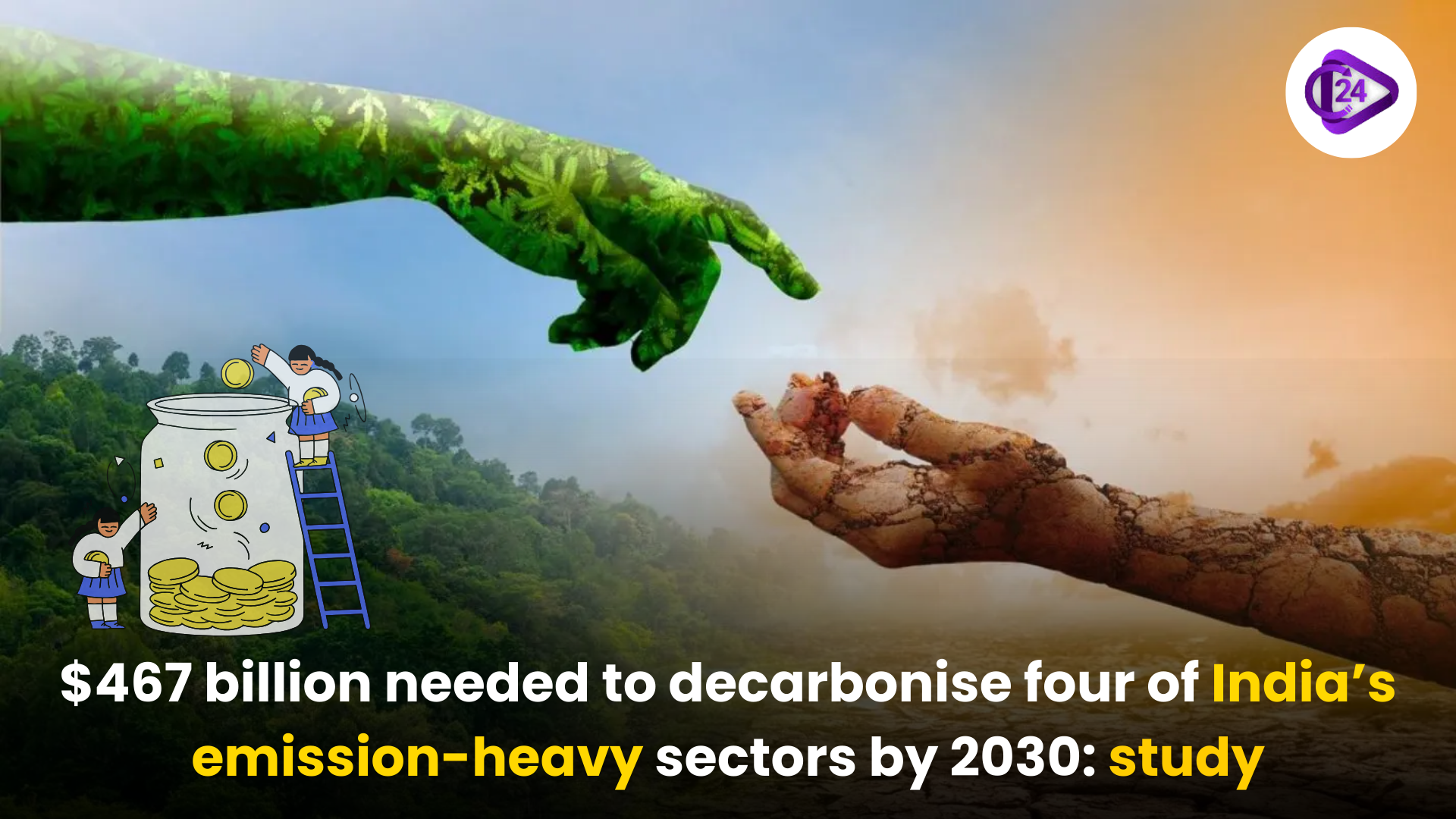
India’s transition towards a low-carbon economy will require substantial investment in cleaner technologies, industrial infrastructure and energy systems. A sector-specific study estimated that India would need approximately $467 billion in additional investment by 2030 to decarbonise four major sectors: steel, cement, power and road transport. These sectors are important to India’s economic development, but they also present significant challenges for reducing greenhouse gas emissions.
The investment estimate highlights a central challenge of climate action: India must continue expanding its economy while reducing the emissions associated with electricity generation, industrial production and transportation. Achieving this transition will require a combination of technological innovation, supportive policies, private-sector investment and access to climate finance.
For competitive examination aspirants, this development is relevant to current affairs, environmental studies, climate change, sustainable development and India’s commitments under the Paris Agreement.
What Is Decarbonisation?
Decarbonisation refers to reducing carbon dioxide emissions and other greenhouse gas emissions associated with economic activities. It involves changing the way electricity is generated, industries manufacture products, buildings use energy and vehicles operate.
For example, replacing coal-based electricity with renewable power can reduce emissions from the electricity sector. In steel production, low-carbon manufacturing technologies can reduce dependence on conventional coal-intensive processes. In transport, electric vehicles and cleaner fuels can help lower emissions when supported by cleaner electricity and suitable infrastructure.
Decarbonisation does not necessarily mean stopping industrial development. Instead, it aims to make economic growth less carbon-intensive through improved energy efficiency, cleaner technologies and changes in production systems.
India faces a particularly important challenge because steel, cement, electricity and transport are closely connected with infrastructure development, urbanisation and rising energy demand.
Why Does India Need $467 Billion in Additional Investment?
The estimated $467 billion requirement reflects the scale of investment needed to move four emission-intensive sectors towards lower-carbon pathways by 2030. The figure is an estimate from a sector-specific study, not a confirmed government expenditure allocation or a guarantee that the money will be raised. Decarbonising these sectors requires more than installing renewable energy capacity. Industries may need new production equipment, changes in fuel use, carbon capture technologies, electrification, energy storage and supporting infrastructure.
The transition also involves financial challenges. Cleaner technologies can have high initial costs, while existing industrial facilities may continue operating for decades. Companies must therefore evaluate investment decisions over long periods and consider the cost of upgrading or replacing existing assets. Mobilising finance from public institutions, private companies, banks and international sources can help bridge this investment gap. The appropriate financing model will differ by sector because the technologies, operating costs and emissions-reduction opportunities are not the same.
Sector-Wise Investment Required for Decarbonisation
The study identifies four major sectors and estimates their additional investment requirements as follows.
| Sector | Estimated additional investment | Main decarbonisation challenge |
| Steel | $251 billion | Reducing emissions from energy-intensive production |
| Cement | $141 billion | Lowering emissions from fuel use and chemical processes |
| Power | $47 billion | Expanding cleaner electricity and supporting the transition |
| Road transport | $18 billion | Electrification and cleaner mobility |
| Total | $457 billion | Combined sectoral transition |
Important data check: The sector figures above add up to $457 billion, not $467 billion. The original Class24 article reports a total of $467 billion, so the total and sector-wise figures must be reconciled against the original study before publication. Do not silently present inconsistent figures as though they match.
1. Steel Sector: The Largest Investment Requirement
The steel sector accounts for the largest investment estimate in the reported breakdown. Steel is essential for construction, railways, automobiles, machinery and infrastructure. However, conventional steelmaking can be highly emissions-intensive because it relies on carbon-intensive fuels and processes. One option is to increase the use of scrap steel in suitable production routes. Another is to develop direct reduced iron processes using lower-carbon energy sources, including green hydrogen where technically and economically feasible. Carbon capture and storage may also help reduce emissions from certain industrial processes.
The transition is difficult because steel plants require reliable energy supplies, specialised equipment and large capital investments. New technologies must also meet strict requirements for product quality, production capacity and cost competitiveness. For India, industrial decarbonisation must therefore balance emissions reduction with the need to supply affordable steel for economic development.
2. Cement Sector: Reducing Process Emissions
Cement production creates emissions through both energy consumption and the chemical transformation of limestone into clinker. This makes the sector challenging to decarbonise through renewable electricity alone. Potential measures include improving energy efficiency, reducing the clinker content of cement where standards permit, using alternative fuels and developing lower-carbon cement formulations. Carbon capture and storage may also be important for emissions that cannot easily be eliminated through fuel switching.
The cement sector is closely linked to housing, roads, bridges, dams and other infrastructure. Demand may rise as India urbanises and expands its built environment.
Consequently, decarbonisation strategies must improve production efficiency while ensuring that cement remains available at competitive prices and meets safety and performance standards.
3. Power Sector: Enabling Cleaner Electricity
Electricity is essential for households, industries, transport and digital infrastructure. Reducing emissions from power generation can therefore support decarbonisation across several other sectors. Renewable sources such as solar and wind can reduce dependence on fossil-fuel-based electricity. However, their variable output creates a need for stronger transmission networks, flexible generation, energy storage and better grid management.
Investment may be required in battery storage, pumped-storage hydropower, transmission lines and other technologies that help maintain reliable electricity supply. These systems are important because electricity demand must be met even when solar or wind generation is low. A cleaner power system can also increase the climate benefits of electrifying vehicles and industrial equipment. The extent of these benefits depends on how electricity is generated and how the power system evolves.
4. Road Transport: Cleaner Mobility
Road transport contributes to emissions through the consumption of petrol and diesel. Reducing these emissions requires changes in vehicle technology, fuel use and transport infrastructure. Electric vehicles can help reduce direct tailpipe emissions, particularly when their electricity comes from lower-carbon sources. Other measures include improving public transport, expanding charging infrastructure, increasing vehicle efficiency and encouraging suitable alternatives to private vehicle travel.
The transition also requires attention to battery manufacturing, mineral supply chains, charging access and electricity distribution networks. The reported investment estimate for road transport is smaller than the estimates for steel and cement. However, the actual emissions-reduction potential depends on how quickly cleaner vehicles are adopted, how they are used and the emissions associated with electricity and fuel production.
How Can India Finance the Low-Carbon Transition?
Mobilising capital is a major part of decarbonisation. Governments can support the transition through policy frameworks, infrastructure investment and incentives, while businesses can finance new plants, equipment and cleaner production methods.
Several financing approaches can contribute:
- Domestic public finance: Government spending and public financial institutions can support infrastructure and projects where private investment alone may be insufficient.
- Private-sector investment: Companies can finance cleaner production equipment, renewable electricity procurement, energy efficiency and low-carbon industrial technologies when projects are commercially viable.
- Green bonds and sustainable finance: These instruments can help raise capital for eligible projects that meet applicable environmental and financial requirements.
- International climate finance: Multilateral development banks, bilateral cooperation and other international mechanisms may provide loans, grants, guarantees or technical assistance, subject to their rules and eligibility criteria.
- Carbon markets and pricing mechanisms: Well-designed carbon market mechanisms may create incentives for emissions reduction. Their effectiveness depends on credible measurement, reporting, verification and market design.
No single source of finance will be sufficient for every project. The financing structure must reflect the project’s costs, risks, expected returns and emissions-reduction benefits.
Connection with India’s Climate Commitments
India’s decarbonisation efforts form part of its broader climate policy and international commitments. Under its updated Nationally Determined Contribution, India committed to reducing the emissions intensity of its GDP by 45% from the 2005 level by 2030 and achieving about 50% cumulative installed electric power capacity from non-fossil-fuel-based energy resources by 2030, subject to the stated conditions in its commitment. India has also announced a long-term target of achieving net-zero emissions by 2070.
These targets address different aspects of climate action. Emissions intensity measures emissions relative to economic output; it does not necessarily mean that total emissions will fall by the same percentage. Installed electricity capacity measures potential generation capacity, not the actual share of electricity generated at a particular time. Investment in industrial and transport decarbonisation can complement the expansion of non-fossil electricity. However, the extent of progress depends on technology deployment, financing, infrastructure, energy demand and policy implementation.
Challenges in Achieving Decarbonisation by 2030
India’s low-carbon transition faces several practical challenges. First, cleaner industrial technologies can require substantial upfront capital. Second, businesses need reliable access to electricity, suitable fuels and supporting infrastructure. Third, some industrial processes have emissions that are difficult to eliminate using currently commercial technologies.
There are also concerns about competitiveness. If domestic producers face significantly higher transition costs than competitors in other markets, they may require suitable policy support and access to affordable technologies. A further challenge is ensuring that the transition is inclusive. Workers, communities and smaller businesses connected with conventional energy and industrial sectors may need training, investment and support as technologies change.
Finally, the $467 billion estimate should be understood as a financing requirement reported by a particular study. It should not be interpreted as a final government budget, a confirmed funding commitment or the exact amount that will automatically be invested.
Key Facts for Competitive Examinations
| Question | Answer |
| What is decarbonisation? | Reducing carbon dioxide and other greenhouse gas emissions |
| What is the reported additional investment estimate? | Approximately $467 billion by 2030 |
| Which four sectors are covered? | Steel, cement, power and road transport |
| Which sector has the largest reported investment requirement? | Steel |
| What is India’s net-zero target year? | 2070 |
| What does emissions intensity measure? | Emissions relative to economic output |
| What is a major challenge for cement decarbonisation? | Process emissions from clinker production |
| Why is energy storage important? | It helps balance variable renewable electricity generation |
| What is climate finance? | Funding for mitigation, adaptation and related climate action |
Conclusion
India’s low-carbon transition requires significant investment across industrial production, electricity generation and road transport. The reported $467 billion estimate illustrates the scale of the financial challenge, particularly in the steel and cement sectors.
Progress will depend on cleaner technologies, access to affordable finance, infrastructure development and effective policy implementation. For competitive examinations, candidates should remember the four sectors covered by the estimate, the difference between decarbonisation and net zero, and India’s principal climate commitments.
Sources for verification: The original sector-specific study reporting the $467 billion estimate; the Government of India’s updated Nationally Determined Contribution; and official climate-policy information published by the Ministry of Environment, Forest and Climate Change.