


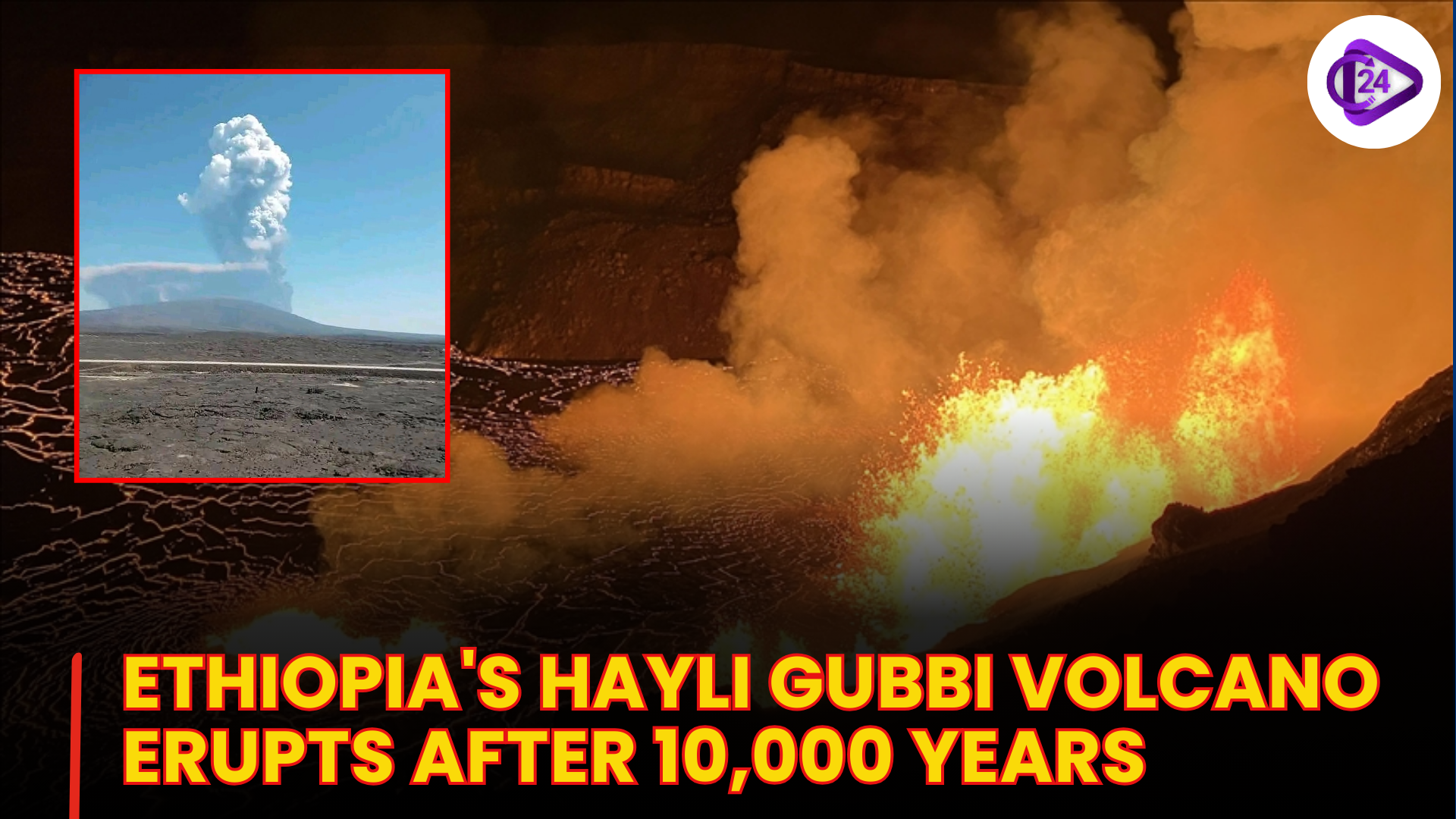
The Hayli Gubbi Volcano Eruption in Ethiopia on 23 November 2025 was a significant geological event in the East African Rift region. Located in the Afar region of northeastern Ethiopia, Hayli Gubbi produced a major explosive eruption that sent volcanic ash and gases high into the atmosphere. The ash plume travelled across the Arabian Peninsula and the Arabian Sea before reaching parts of India and moving further towards China.
The eruption attracted international scientific attention because it was the first historically documented explosive eruption of Hayli Gubbi. It also highlighted the importance of satellite-based volcano monitoring, particularly in remote volcanic regions where ground-based observation facilities are limited.
Key Highlights of Hayli Gubbi Volcano Eruption
| Particulars | Details |
| Volcano | Hayli Gubbi |
| Country | Ethiopia |
| Region | Afar |
| Eruption date | 23 November 2025 |
| Geological location | Danakil Depression |
| Volcanic system | East African Rift System |
| Volcanic province | Afar Rift Volcanic Province |
| Eruption type | Explosive |
| Volcanic Explosivity Index | VEI 4 |
| Ash plume height | Approximately 10–15 km |
| Nearby volcanic system | Erta Ale Range |
Where Is Hayli Gubbi Volcano Located?
Hayli Gubbi is located in the Afar region of northeastern Ethiopia, within the Danakil Depression. It is the southernmost volcano of the Erta Ale volcanic range, which forms part of the Afar Rift Volcanic Province.
The Afar region is situated near the meeting point of three major tectonic rift systems:
- Red Sea Rift
- Gulf of Aden Rift
- East African Rift
This region is geologically active because the African, Arabian and Somali tectonic plates are moving apart. Their movement causes crustal stretching, faulting and volcanic activity.
The Danakil Depression is also known for its extreme temperatures, salt deposits, active volcanoes and unique geological formations.
Why Was the Hayli Gubbi Eruption Significant?
The 23 November 2025 eruption was significant because it was the first historically documented explosive eruption of Hayli Gubbi.
The volcano had not been known for a major explosive event in recorded history. Its long period without a documented explosive eruption made the event particularly important for volcanologists.
However, describing the volcano as completely extinct would be scientifically inaccurate. Geological studies indicate that the volcano has older lava flows, while the exact dates of its prehistoric eruptive activity are not fully established.
The eruption also demonstrated that volcanic systems in the Afar region can remain capable of producing major activity even when no recent explosive eruption has been documented.
Type and Intensity of the Eruption
The Hayli Gubbi eruption was classified as an explosive volcanic event. According to the Smithsonian Institution’s Global Volcanism Program, the eruption was assigned Volcanic Explosivity Index (VEI) 4.
The Volcanic Explosivity Index is a scale used to describe the magnitude of explosive volcanic eruptions. It considers factors such as erupted material volume, eruption column height and other characteristics.
Important observations from the eruption include:
- The eruption began on 23 November 2025.
- A large ash and gas plume rose approximately 10–15 km into the atmosphere.
- The plume contained volcanic ash and sulphur dioxide.
- Satellite observations recorded significant atmospheric movement of the volcanic plume.
- The eruption created new craters in the summit area.
The eruption was relatively short-lived, with the main explosive activity subsiding by 25 November 2025.
Impact of Hayli Gubbi Volcanic Ash Plume on India
One of the important effects of the eruption was the movement of volcanic ash and gases towards India.
After the eruption, upper-level atmospheric winds carried the plume eastward across the Arabian Peninsula and the Arabian Sea.
According to the Indian Institute of Remote Sensing (IIRS), an institute of ISRO:
- The plume entered the western boundary of India on 24 November 2025 at approximately 5:50 PM IST.
- It travelled at estimated speeds of 100–120 km/h.
- The plume moved at altitudes of approximately 5–13 km.
- It cleared Indian skies by 25 November 2025 at approximately 10:30 PM IST.
The ash plume was also detected over northern India, including the Delhi region, before continuing towards China.
The event affected aviation operations, as volcanic ash can create serious risks for aircraft engines, visibility and flight safety. Reports also indicated flight disruptions in India.
What Is the East African Rift System?
The East African Rift System (EARS) is a major geological feature where the Earth’s crust is gradually pulling apart.
It extends through eastern Africa and includes several active volcanic and tectonic regions. The rift is associated with earthquakes, volcanic activity, deep valleys and the formation of new oceanic crust over geological time.
The movement of tectonic plates creates fractures in the Earth’s crust. Magma can rise through these fractures and produce volcanic eruptions.
Important features associated with the East African Rift System include:
- Active volcanic mountains and volcanic fields.
- Frequent tectonic and volcanic activity in certain regions.
- Large rift valleys and fault systems.
- Geothermal activity and hot springs.
- The gradual separation of the African and Somali plates.
Hayli Gubbi is part of the Afar Rift Volcanic Province, making its eruption important for understanding the geological processes operating in this region.
What Is the Volcanic Explosivity Index (VEI)?
The Volcanic Explosivity Index (VEI) is a scientific scale used to classify the explosiveness of volcanic eruptions.
It ranges from VEI 0 to VEI 8. Higher values generally represent more explosive eruptions and larger volumes of erupted material.
| VEI | General classification |
| VEI 0 | Non-explosive |
| VEI 1 | Small |
| VEI 2 | Moderate |
| VEI 3 | Moderate to large |
| VEI 4 | Large |
| VEI 5 | Very large |
| VEI 6 | Very large to colossal |
| VEI 7 | Colossal |
| VEI 8 | Mega-colossal |
The Hayli Gubbi eruption of 23 November 2025 was classified as VEI 4 by the Smithsonian Global Volcanism Program.
Importance of Satellite-Based Volcano Monitoring
The Hayli Gubbi eruption highlighted the importance of satellite observations in monitoring volcanic activity, especially in remote areas.
Satellites operated by organisations such as NASA, ESA and other space agencies can help scientists observe:
- Changes in volcanic ash and gas emissions.
- Sulphur dioxide concentrations in the atmosphere.
- Changes in the shape and temperature of volcanic surfaces.
- Movement and spread of volcanic plumes.
- Ground deformation associated with underground magma movement.
Satellite observations are particularly useful when ground-based monitoring stations are unavailable or difficult to maintain.
Conclusion
The Hayli Gubbi Volcano Eruption of 23 November 2025 was an important geological event in Ethiopia’s Afar region. Classified as a VEI 4 explosive eruption, it produced a large ash and gas plume that travelled across the Arabian Peninsula and reached India.
The event highlighted the active geological nature of the East African Rift System and the importance of monitoring volcanic activity in remote regions. It also demonstrated how volcanic eruptions in one part of the world can affect aviation and atmospheric conditions across distant countries.
For competitive examinations, the key facts to remember are the volcano’s location in Ethiopia’s Afar region, its eruption date of 23 November 2025, its VEI 4 classification and the movement of its ash plume towards India.