

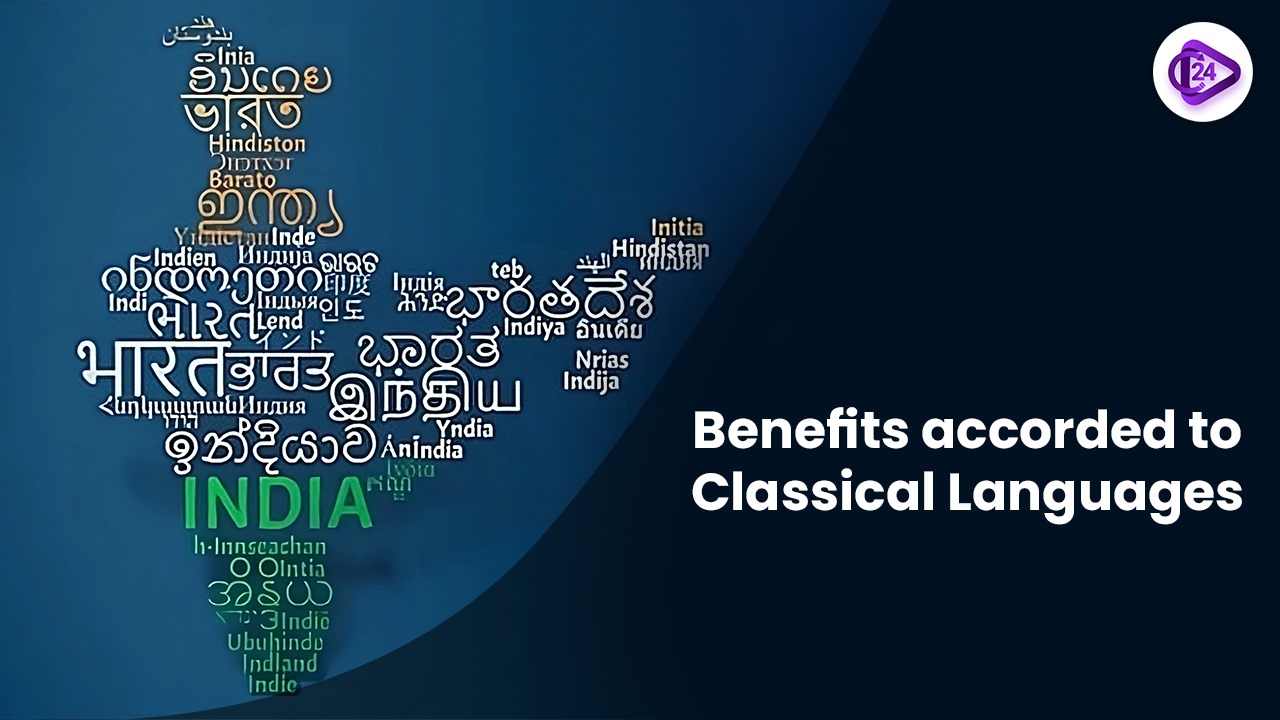
India has more than a thousand languages and dialects, and some of them are among the oldest living literary traditions in the world. The Government of India has been giving special attention to these languages through the “Classical Language” status. After the recent expansion of the list, the number of classical languages has gone from six to eleven, and the government has also widened the support it gives for their research, teaching and preservation.
What Is a Classical Language?
A classical language is not just an old language. It is one with a very long, independent and rich literary history, whose early texts are still read and valued today. The government introduced the category in 2004, when Tamil became the first language to receive the status.
The broad conditions a language has to meet are:
- Its early texts and recorded history go back 1,500 to 2,000 years.
- It has a body of ancient literature that its speakers consider a valuable heritage.
- Its literary tradition is original and was not borrowed from another speech community.
- The classical form is distinct from the modern form, so there may be a gap between the old language and its later versions.
The Six Languages Recognised Earlier
Before the latest additions, six languages held the status. Here they are in order of recognition:
| Language | Year of recognition |
| Tamil | 2004 |
| Sanskrit | 2005 |
| Telugu | 2008 |
| Kannada | 2008 |
| Malayalam | 2013 |
| Odia | 2014 |
The New Additions
In October 2024, the Union Cabinet approved classical language status for five more languages: Marathi, Pali, Prakrit, Assamese and Bengali. This brought the total to eleven, and it was the first time in about a decade that the list had grown.
The choice of languages is interesting because it covers two kinds of tradition. Pali and Prakrit are ancient languages tied to early Buddhist and Jain literature, and they carry a lot of India’s philosophical and religious history. Marathi, Assamese and Bengali are living languages spoken by millions of people today, and each has a long written tradition of its own. Giving them the status recognises both the old roots and the modern vitality of Indian languages.
What Support Does the Government Provide?
The Ministry of Education runs research and development programmes for the recognised languages. In simple terms, the support works in three ways.
- Awards for scholars. Each year, the government gives awards to people who have made outstanding contributions to the study of classical languages. This helps bring respect and visibility to a field that often does not get much attention.
- Centres of Excellence. These are institutions set up to carry out serious research, collect and study old manuscripts, run training programmes and publish work in and about the language.
- Professional chairs in central universities. Special chairs are created so that universities can teach these languages properly and train a new generation of scholars. Without such posts, many ancient languages risk running out of teachers and students.
Together, these steps are meant to stop classical languages from becoming something only a few people know, and to keep them part of active academic life.
Institutions Working for Classical Languages
Each language has its own institution or set of institutions:
- Tamil: Central Institute of Classical Tamil (CICT), Chennai, working since 2008.
- Sanskrit: promoted through the Central Sanskrit University (New Delhi), the Shri Lal Bahadur Shastri National Sanskrit University (New Delhi) and the National Sanskrit University (Tirupati).
- Telugu: Centre of Excellence for Classical Telugu, Nellore, Andhra Pradesh.
- Kannada: Centre of Excellence for Classical Kannada, Mysuru, Karnataka.
- Malayalam: Centre of Excellence for Classical Malayalam, Tirur, Kerala.
- Odia: Centre of Excellence for Classical Odia, Bhubaneswar, Odisha.
Mysuru is also home to the Central Institute of Indian Languages (CIIL), which has supported much of the national work on Indian languages.
Why This Matters
Language is more than a way to talk. It stores a community’s stories, laws, science, medicine, poetry and ways of thinking. When a language fades, much of that goes with it. Classical status gives a language national and international recognition and, more practically, brings funding and institutional backing.
The step also fits with the wider push in recent years to promote Indian languages in education, including the focus on mother-tongue learning in the National Education Policy 2020. For students and researchers, it opens up more scholarships, research posts and study programmes in these languages.
There are fair questions as well. Some people ask whether a “classical” label alone saves a language, or whether more needs to be done in schools, publishing and technology. A language also needs everyday users and good teaching to stay alive, beyond research centres. These concerns are worth keeping in mind when thinking about how effective the policy will be.
Quick Revision Points for Exams
- India now has 11 classical languages.
- The first language to get the status was Tamil (2004); the second was Sanskrit (2005).
- Telugu and Kannada were both recognised in 2008.
- Malayalam in 2013 and Odia in 2014.
- The five new languages are Marathi, Pali, Prakrit, Assamese and Bengali.
- Support includes awards, Centres of Excellence and professional chairs in central universities.
- The Central Institute of Classical Tamil is in Chennai.
Conclusion
The expansion of classical language status shows how seriously the government is taking the country’s linguistic heritage. By adding five more languages and continuing awards, centres and university chairs, it hopes to keep both ancient and living traditions in active study. For aspirants, the main points to remember are the list of languages, the years of recognition and the type of support given. For everyone else, it is a reminder that India’s languages are an important part of its history and identity.