
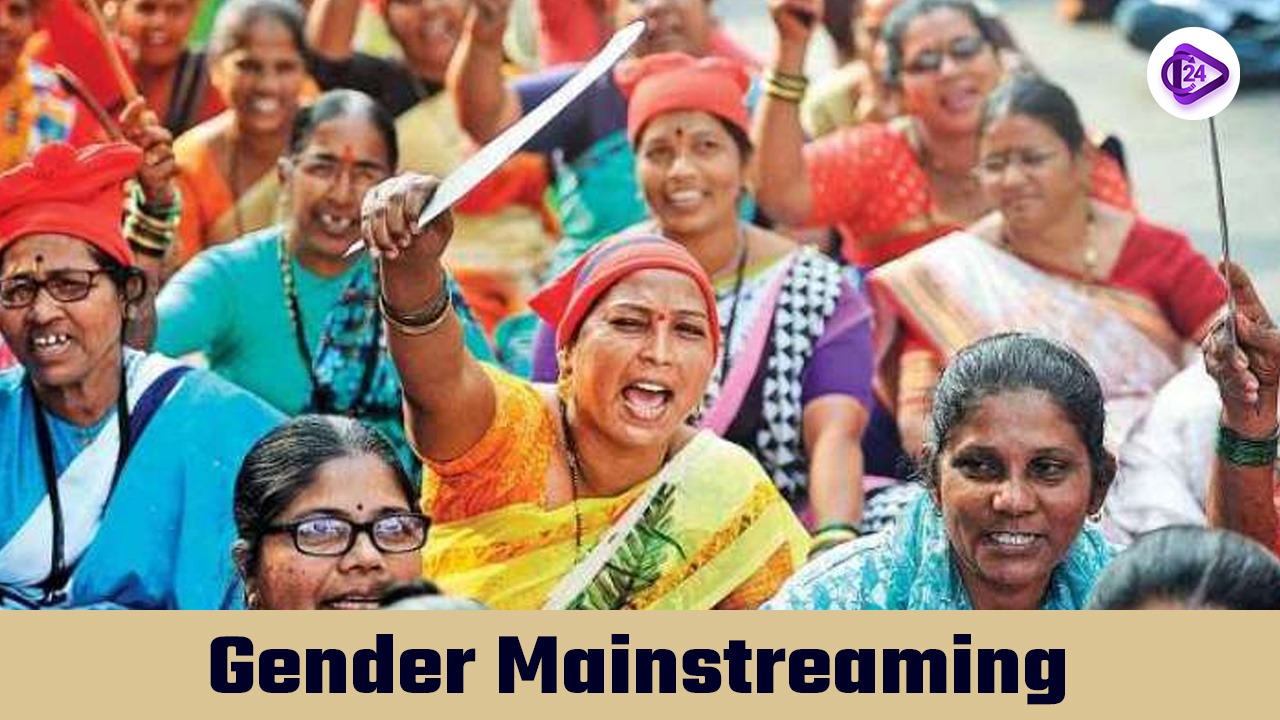
Feminism in India functions as an active movement that fights for equal opportunities for women throughout all social fields, economic structures, and political institutions. The Indian feminist movement has developed into its present form through time during which it changed according to Indian historical, cultural, and social environments. The feminist movement in India started under male leadership because its origins came from men fighting for social change as opposed to Western feminism which began as a men's struggle for women to gain political rights. The movement grew through time to embrace additional concerns involving caste alongside class, religious groups, and rights for LGBTQ+ persons which diversified its focus.
Throughout different historical periods, the feminist movement in India has experienced substantial changes by transitioning from a reform-based orientation to adopting a modern intersectional and inclusive framework. Feminism in India developed its direction based on the characteristics of social change alongside political and economic developments. At the beginning of its feminist movement, India focused on social reforms instead of the Western pattern which centered on civil and political rights.
Evolution of Feminism in India: A Historical Perspective
The feminist movement of India developed through four distinct historical periods which brought separate socio-political patterns during each stage.
First Phase (19th Century – Early 20th Century): Social Reforms
The movement for social reform in India was initiated by male leaders including Raja Ram Mohan Roy and Ishwar Chandra Vidyasagar together with Jyotirao Phule.
Focus Areas:
-
Abolition of Sati and child marriage.
-
Promotion of widow remarriage (Vidyasagar).
-
Advocacy for women’s education (Savitribai Phule, Fatima Sheikh).
-
Affluent Hindu women of higher castes became the sole recipients of positive impacts during this phase.
Challenges:
-
Lacked a strong women-led movement.
-
The introduced social reforms failed to address how family and marriage structure depended on patriarchy.
-
The notion of intersectionality failed to consider how lower-caste and tribal women were missing from its discussions.
Second Phase (1915–1947): Political Participation & Nationalist Movement
The political sphere gained new significance when women transferred their social reformer efforts into active participation in struggles for change.
Key Developments:
-
Formation of All India Women’s Conference (AIWC), Women’s India Association (WIA), and National Federation of Indian Women (NFIW).
-
Mahatma Gandhi’s influence: Encouraged women’s participation in the freedom movement (Non-Cooperation & Civil Disobedience Movements).
-
Sarojini Naidu alongside Aruna Asaf Ali and Kasturba Gandhi became influential leaders during this time.
Limitations:
-
The nationalist movement considered women's rights less important than the dedication to nationalistic objectives.
-
Women occupied their conventional role in society where they fulfilled duties as mothers and caregivers.
-
The main distribution of political activities occurred in urban areas while being driven by upper-caste groups.
Third Phase (Post-1947 – 1990s): Women’s Rights & Legal Reforms
The transfer of power from the British colonial government to state control resulted in modern gender equality policy development.
Key Developments:
-
Constitutional provisions for gender equality (Articles 14, 15, 16).
-
Legal reforms: Hindu Code Bill (1955-56), Dowry Prohibition Act (1961), Equal Remuneration Act (1976).
-
The Committee on the Status of Women in India produced Towards Equality (1974) to expose gender inequalities in the nation.
-
Mathura Rape Case (1972) → Led to amendments in rape laws, the emergence of women’s activism.
Challenges:
-
Patriarchy within the legal system: Implementation gaps in laws.
-
The workplace treats women as supplementary staff to be called in when needed.
-
Upper-caste and urban feminists tend to ignore the problems faced by rural and Dalit women so their issues receive minimal attention.
Fourth Phase (1990s-Present): Intersectionality & Digital Feminism
Acceptance of diverse characteristics by the justice system which includes caste together with class, sexual orientation, and gender identities.
Key Developments:
-
Vishaka Judgment (1997): Framework for workplace sexual harassment laws.
-
Bhanwari Devi case: Highlighted caste and gender-based violence.
-
Rise of Dalit feminism, Adivasi feminism, Queer feminism.
-
Digital movements through #MeToo, Pinjra Tod, and Internet advocacy for making marital rape punishable and LGBTQ+ rights defense have become increasingly prominent.
New Challenges:
-
Rural women face the challenge of experiencing harassment in the online world and encounter cyberbullying while being systematically excluded online.
-
Deep-rooted cultural biases against feminism.
Key Issues in Indian Feminism
A. Intersectionality & Inclusion
-
The traditional feminist movement mainly served members who belonged to upper castes and resided in urban areas while holding middle-class status.
-
Female members of Dalit, Adivasi, and Muslim groups face a compound system of societal discrimination.
-
The proposed remedy features this solution which recognizes that different groups require unique policy patterns.
B. Legal Framework vs. Implementation
-
The nation has several progressive statutes including the Pocso Act, the Dowry Act, and Domestic Violence Act yet their implementation remains ineffective.
-
National Crime Records Bureau statistics indicate that domestic violence and rape convictions remain exceptionally low according to official reports.
-
Relief for elections alongside stronger local government representation should be implemented through the Panchayati Raj model.
Feminism & State Policy in India
Constitutional Provisions
-
Article 14: Equality before the law.
-
Article 15(3): Special provisions for women & children.
-
Article 16: Equal opportunities in public employment.
-
Article 39(d): Equal pay for equal work.
-
Article 42: Maternity relief.
Government Initiatives
-
Beti Bachao Beti Padhao: Addresses declining Child Sex Ratio (CSR).
-
The Maternity Benefit (Amendment) Act of 2017 grants workers and women employees 26 weeks of paid maternity leave.
-
One Stop Centre Scheme: Provides support to survivors of violence.
-
SHe-Box (Sexual Harassment Electronic Box): Online complaint portal for workplace harassment.
Future Directions: The Way Forward
A. Strengthening Intersectionality
-
Relevant action must be taken to address women who live in rural areas along with service provision for Dalit, Muslim, and LGBTQ+ communities.
-
The economy must include provisions to minimize exclusion based on caste and gender differences within its frameworks.
B. Law & Policy Reform
-
Step one should involve the criminalization of marital rape while improving services that support survivors.
-
Strict implementation of workplace harassment laws.
C. Economic & Political Empowerment
-
Women should join the workforce in greater numbers through the implementation of accommodating employment policies.
-
Pass the Women’s Reservation Bill.
D. Role of Technology & Digital Activism
-
Remote groups of women should get safe access to digital platforms.
-
The control of cyber harassment together with deepfakes and gendered misinformation must receive regulation.
Conclusion
India has undergone a fundamental shift in its feminist movement since the 19th century social reform period transitioning into the current 21st century practice of intersectional advocacy. The existing constitutional provisions with laws have not overcome their enforcement difficulties. Indian feminist movements of the future need to prioritize both inclusivity through representation and economic empowerment and digital security for women to achieve complete gender equality.