

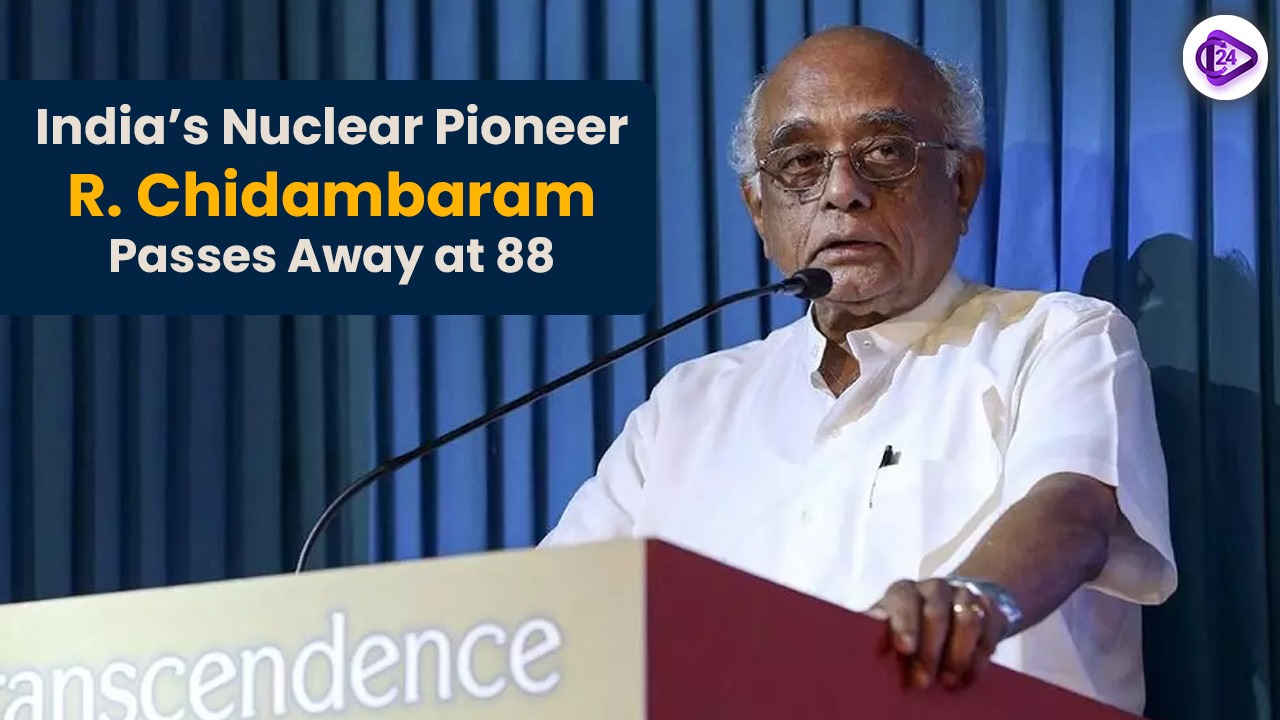
Dr. R. Chidambaram (Dr. Rajagopala Chidambaram), one of the most respected scientists in modern India, passed away on 4 January 2025 at Jaslok Hospital in Mumbai. He was 88. A physicist by training, he played a leading role in both the 1974 Pokhran-I test and the 1998 Pokhran-II tests, and he later spent about sixteen years as the principal scientific adviser to the government of India. His death marked the end of an era for India’s nuclear and scientific community.
This article explains who Dr. Chidambaram was, what he achieved, and why he matters in simple language for students and current affairs readers.
Early Life and Education
Chidambaram was born on 11 November 1936 in Madras, now Chennai, Tamil Nadu. He studied at the University of Madras and then completed his postgraduate studies at the Indian Institute of Science in Bengaluru. He started his career in 1962 at the Atomic Energy Establishment, Trombay, which was later renamed the Bhabha Atomic Research Centre (BARC) in Mumbai.
His early research was in experimental physics, especially neutron diffraction and high-pressure physics. These fields study how materials behave under extreme conditions, and they later became very useful for understanding nuclear materials. Because of this work, he was also recognised internationally as a crystallographer and served as an office-bearer of the International Union of Crystallography during the 1990s.
Role in Pokhran-I (1974): Operation Smiling Buddha
On 18 May 1974, India carried out its first nuclear test at Pokhran in Rajasthan. The test was officially described as a “peaceful nuclear explosion” and was code-named Smiling Buddha. Chidambaram was a young scientist in the team at that time. He is known for his work on the physics of plutonium, including its equation of state, which describes how the material behaves under very high pressure. Reports also say that he personally helped move the plutonium from Mumbai to Pokhran.
After the 1974 test, he set up an open research program in high-pressure physics at BARC. This work later grew into a strong materials science program that is still important in India today.
Key Positions He Held
- Director, BARC (1990 to 1993): He led India’s largest nuclear research center. During this time, BARC began work on supercomputers.
- Chairman, Atomic Energy Commission and Secretary, Department of Atomic Energy (1993 to 2000): He headed the country’s nuclear program during one of its most important periods.
- Principal Scientific Adviser to the Government of India (2001 to 2018): He was the second person to hold this post, after Dr. A.P.J. Abdul Kalam. Some sources give 2002 as the starting year, so it is best to write “around 16 to 17 years” in exams and articles.
- Other roles: He also served in international nuclear bodies, including a leadership role on the board of the International Atomic Energy Agency in the mid-1990s.
Role in Pokhran-II (1998): Operation Shakti
In May 1998, India conducted a series of nuclear tests at Pokhran under the code name Operation Shakti. At that time, Chidambaram was the Chairman of the Atomic Energy Commission. He and Dr. A.P.J. Abdul Kalam, who headed the Defence Research and Development Organisation (DRDO), were the project coordinators. Together they led the scientific and technical teams from the Department of Atomic Energy and DRDO.
The tests made India an openly declared nuclear weapon state. India said that the tests included a thermonuclear device, although some outside experts later questioned the exact yield. After the tests, India faced economic sanctions from several countries, but it also announced a policy of credible minimum deterrence and a voluntary moratorium on further testing.
Students should remember that Pokhran-II was a government and scientific effort involving many people. Chidambaram was one of its main leaders, but the success belonged to a large team.
As Principal Scientific Adviser
After leaving the Atomic Energy Commission in 2000, Chidambaram became the Principal Scientific Adviser. He served under three prime ministers: Atal Bihari Vajpayee, Dr. Manmohan Singh, and Narendra Modi. In this role, he did much more than advise on nuclear policy. His work covered many areas of science and technology, including:
- National Knowledge Network: He helped conceptualize a high-speed network to connect about 1,500 universities and research institutions across India.
- Rural Technology Action Groups (RuTAGs): These groups were created to bring science and technology solutions to villages.
- Core Advisory Group for R&D in the Automotive Sector: This was set up to improve cooperation between industry and academic institutions.
- Energy and healthcare: He promoted research in clean energy and affordable health technologies.
He also took part in discussions on India’s nuclear diplomacy during the period when India worked to end its isolation from the global nuclear trade. As a senior scientific voice, he helped explain the technical side of these matters to policymakers.
Awards and Honours
- Padma Shri (1975)
- Padma Vibhushan (1999)
- Honorary doctorates from several universities
- Fellowships of major Indian and international science academies
He also wrote an autobiography titled India Rising, in which he described his experiences in the nuclear program.
Tributes After His Death
The Department of Atomic Energy confirmed his death on 4 January 2025. Prime Minister Narendra Modi and leaders from across the political spectrum expressed their condolences. They described him as a brilliant scientist whose work strengthened India’s security and scientific base. Scientists and former colleagues remembered him not only for the Pokhran tests but also for encouraging open research, young talent, and cooperation between science and society.
Why His Legacy Matters
- Strategic security: His work helped India become a nuclear weapon state with a credible deterrent.
- Science beyond weapons: He supported research in materials science, supercomputing, and digital connectivity for education.
- Policy bridge: As Principal Scientific Adviser, he linked scientists with decision makers and helped shape science policy for nearly two decades.
- Inspiration for students: His path from a student in Madras to a top scientific leader shows how curiosity and hard work can shape a nation’s future.
Quick Facts for Exams
- Full name: Rajagopala Chidambaram
- Born: 11 November 1936, Madras (now Chennai)
- Died: 4 January 2025, Mumbai, aged 88
- Director of BARC: 1990 to 1993
- Chairman of AEC and Secretary of DAE: 1993 to 2000
- Principal Scientific Adviser: 2001 to 2018 (some sources say 2002)
- Pokhran-I: 18 May 1974, code name Smiling Buddha
- Pokhran-II: May 1998, code name Operation Shakti; project coordinators were Chidambaram and A.P.J. Abdul Kalam
- Honors: Padma Shri (1975), Padma Vibhushan (1999)
- Autobiography: India Rising
Conclusion
Dr. R. Chidambaram’s life shows how science and national strategy can work together. He helped build India’s nuclear capability, but he also pushed for research that benefits everyday life, from advanced materials to digital networks and rural technology. His passing is a great loss, yet his work continues through the institutions he led and the scientists he inspired. For students, he remains an example of how deep scientific knowledge, discipline, and service to the country can create lasting change.