


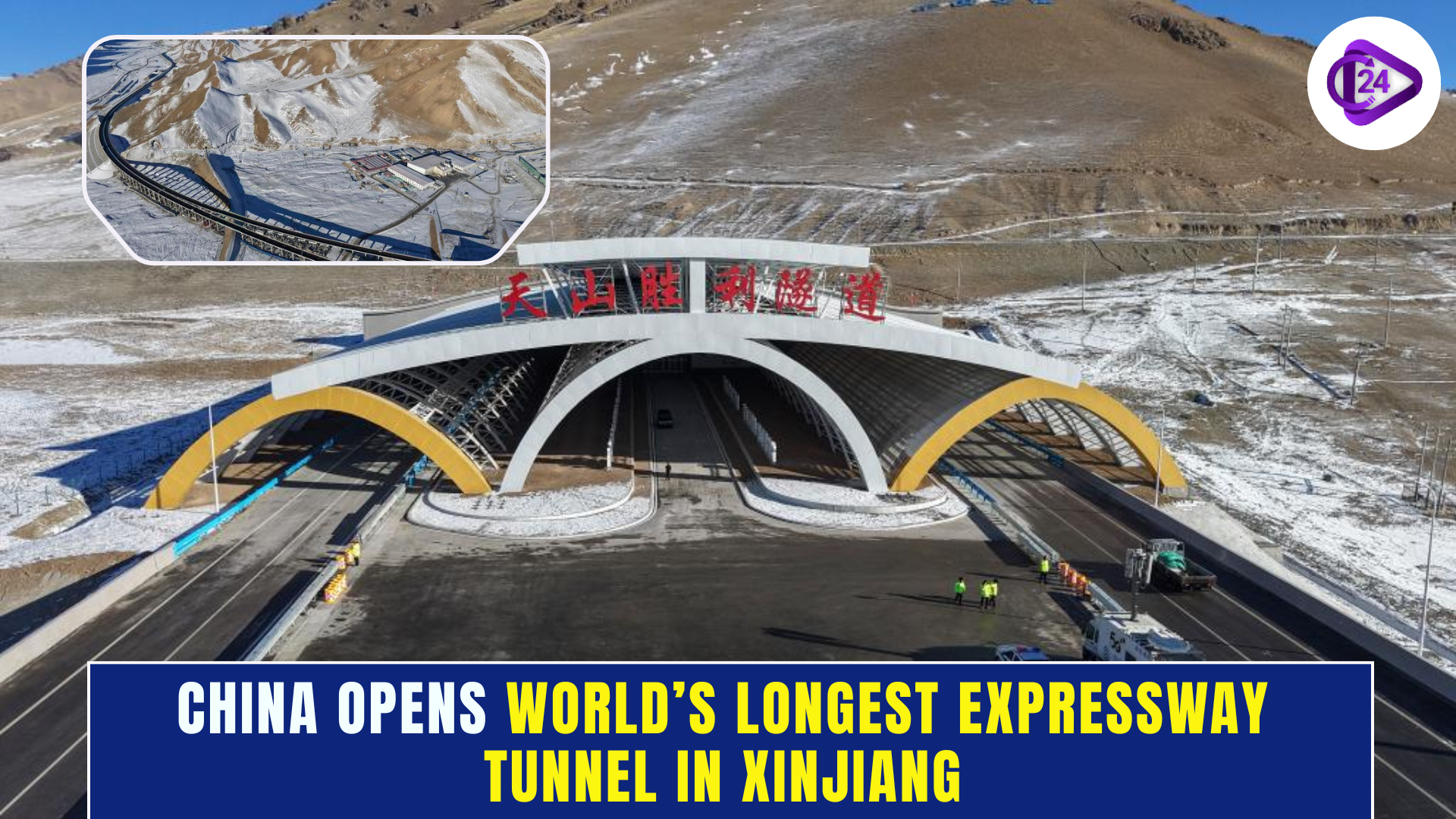
China opened the Tianshan Shengli Tunnel, the world’s longest expressway tunnel, to traffic on 26 December 2025 in the Xinjiang Uygur Autonomous Region. Measuring 22.13 kilometres, the tunnel passes through the central section of the Tianshan Mountains and forms a major part of the G0711 Urumqi-Yuli Expressway.
The tunnel has reduced the time required to cross the mountainous region from several hours to approximately 20 minutes. It has also improved connectivity between northern and southern Xinjiang by reducing the journey between Urumqi and Korla from around seven hours to approximately three to three-and-a-half hours.
The project is an important infrastructure and engineering achievement because it involved construction through difficult mountainous terrain, high geological stress, extreme cold and multiple fault zones.
Key Highlights of Tianshan Shengli Tunnel
| Particulars | Details |
| Tunnel name | Tianshan Shengli Tunnel |
| Country | China |
| Region | Xinjiang Uygur Autonomous Region |
| Length | 22.13 km |
| Record | World’s longest expressway tunnel |
| Expressway | G0711 Urumqi-Yuli Expressway |
| Opening to traffic | 26 December 2025 |
| Construction began | April 2020 |
| Mountains crossed | Tianshan Mountains |
| Time to cross the mountains | Approximately 20 minutes |
| Geological fault zones | 16 |
| Maximum burial depth | 1,112.2 metres |
Where Is the Tianshan Shengli Tunnel Located?
The Tianshan Shengli Tunnel is located in the Xinjiang Uygur Autonomous Region in northwestern China. It passes through the central section of the Tianshan Mountains and is a key component of the G0711 Urumqi-Yuli Expressway.
The tunnel connects transport routes between northern and southern Xinjiang.
Its route is particularly important for improving connectivity between:
- Urumqi: The capital of the Xinjiang Uygur Autonomous Region.
- Korla: A major city in southern Xinjiang.
- Yuli County: Located in the Bayingolin Mongolian Autonomous Prefecture.
The Tianshan Mountains form a major geographical barrier across Xinjiang. Before the tunnel became operational, travellers often had to use winding mountain roads that could be affected by severe winter conditions.
The new tunnel provides a much faster route through this mountainous region.
World’s Longest Expressway Tunnel: Major Features
The Tianshan Shengli Tunnel has achieved international recognition because of its length and complex engineering design.
Its important features include:
- Length of 22.13 Kilometres
The tunnel extends for 22.13 kilometres, making it the world’s longest expressway tunnel.
- Maximum Burial Depth of 1,112.2 Metres
The tunnel passes deep beneath the mountainous terrain. Its maximum burial depth reaches approximately 1,112.2 metres.
- Crossing 16 Geological Fault Zones
During construction, engineers had to deal with 16 geological fault zones. These areas presented significant challenges because of unstable rock conditions and geological stress.
- Faster Travel Across the Tianshan Mountains
The tunnel has reduced the time required to cross the central Tianshan Mountains from several hours to approximately 20 minutes.
- Advanced Construction Technology
The project used a combination of tunnel excavation techniques, ventilation systems, monitoring technologies and specialised construction equipment to deal with difficult geological conditions.
Engineering Challenges During Construction
Construction of the Tianshan Shengli Tunnel began in April 2020 and continued for more than five years.
The project involved several major engineering challenges:
- High Ground Stress: Deep underground construction created significant pressure on the surrounding rock.
- Seismic Activity: The region’s geological conditions required careful engineering and safety planning.
- Multiple Fault Zones: The tunnel crossed 16 geological fault zones.
- Extreme Cold: Low temperatures created difficulties for construction activities and equipment.
- High Altitude: The mountainous environment increased the complexity of construction and logistics.
- Environmental Protection: Construction activities required measures to minimise damage to the surrounding mountain ecosystem.
The project also used a three-tunnel and four-vertical-shaft construction arrangement. A tunnel boring machine (TBM) was used for the service tunnel, helping improve construction efficiency and safety.
How Does the Tunnel Improve Connectivity in Xinjiang?
The Tianshan Shengli Tunnel is the key project of the G0711 Urumqi-Yuli Expressway, which connects important areas of northern and southern Xinjiang.
Before the expressway opened, travelling between Urumqi and Korla could take approximately seven hours. With the new route, the journey has been reduced to around three to three-and-a-half hours.
The tunnel provides several benefits:
- Reduced Travel Time
The tunnel allows vehicles to cross the Tianshan Mountains in approximately 20 minutes.
- Improved Trade and Transportation
Faster road connectivity can support the movement of agricultural products, industrial goods and other commodities between northern and southern Xinjiang.
- Tourism Development
Improved road access can make travel between different parts of Xinjiang easier and support regional tourism.
- Better Regional Integration
The expressway strengthens transport links between the Urumqi metropolitan area, northern Xinjiang’s urban centres and southern Xinjiang’s urban clusters.
- More Reliable Transport
The new route provides an alternative to difficult mountain roads that can experience severe winter weather and transportation disruptions.
About the Tianshan Mountains
The Tianshan Mountains are a major mountain range in Central Asia. They extend across several countries, including China, Kazakhstan and Kyrgyzstan.
The mountain system is known for its high peaks, glaciers, valleys and diverse natural landscapes.
Important geographical facts about the Tianshan Mountains include:
- They are located in Central Asia.
- They extend across China and neighbouring Central Asian countries.
- They form an important geographical feature of the Xinjiang region.
- They contain glaciers, high mountain peaks and alpine ecosystems.
- They create a major geographical divide between northern and southern parts of Xinjiang.
The Tianshan Shengli Tunnel passes through this mountain system and provides an important road connection across its central section.
Why Is the Tianshan Shengli Tunnel Important?
The opening of the Tianshan Shengli Tunnel is significant for China’s infrastructure and transportation network.
It demonstrates the use of advanced engineering techniques to construct a long road tunnel through a challenging mountain environment.
The project is expected to support:
- Improved north-south connectivity in Xinjiang.
- Faster movement of passengers and freight.
- Better access to regional markets.
- Growth in tourism and commercial activities.
- Greater integration of transportation networks across the region.
It also provides an example of how long tunnels can overcome geographical barriers and improve connectivity in mountainous areas.
Conclusion
The Tianshan Shengli Tunnel in China’s Xinjiang Uygur Autonomous Region is the world’s longest expressway tunnel, with a length of 22.13 kilometres. Opened to traffic on 26 December 2025, it forms a key part of the G0711 Urumqi-Yuli Expressway.
The tunnel has reduced the time required to cross the Tianshan Mountains to approximately 20 minutes and shortened travel between Urumqi and Korla from around seven hours to approximately three to three-and-a-half hours.
Its construction through 16 geological fault zones and challenging mountain conditions makes it an important engineering achievement. The project is expected to improve regional connectivity, transportation, trade and tourism in Xinjiang.
For competitive examinations, remember the tunnel’s name, its location in Xinjiang, its length of 22.13 km, its association with the G0711 Urumqi-Yuli Expressway and its status as the world’s longest expressway tunnel.