


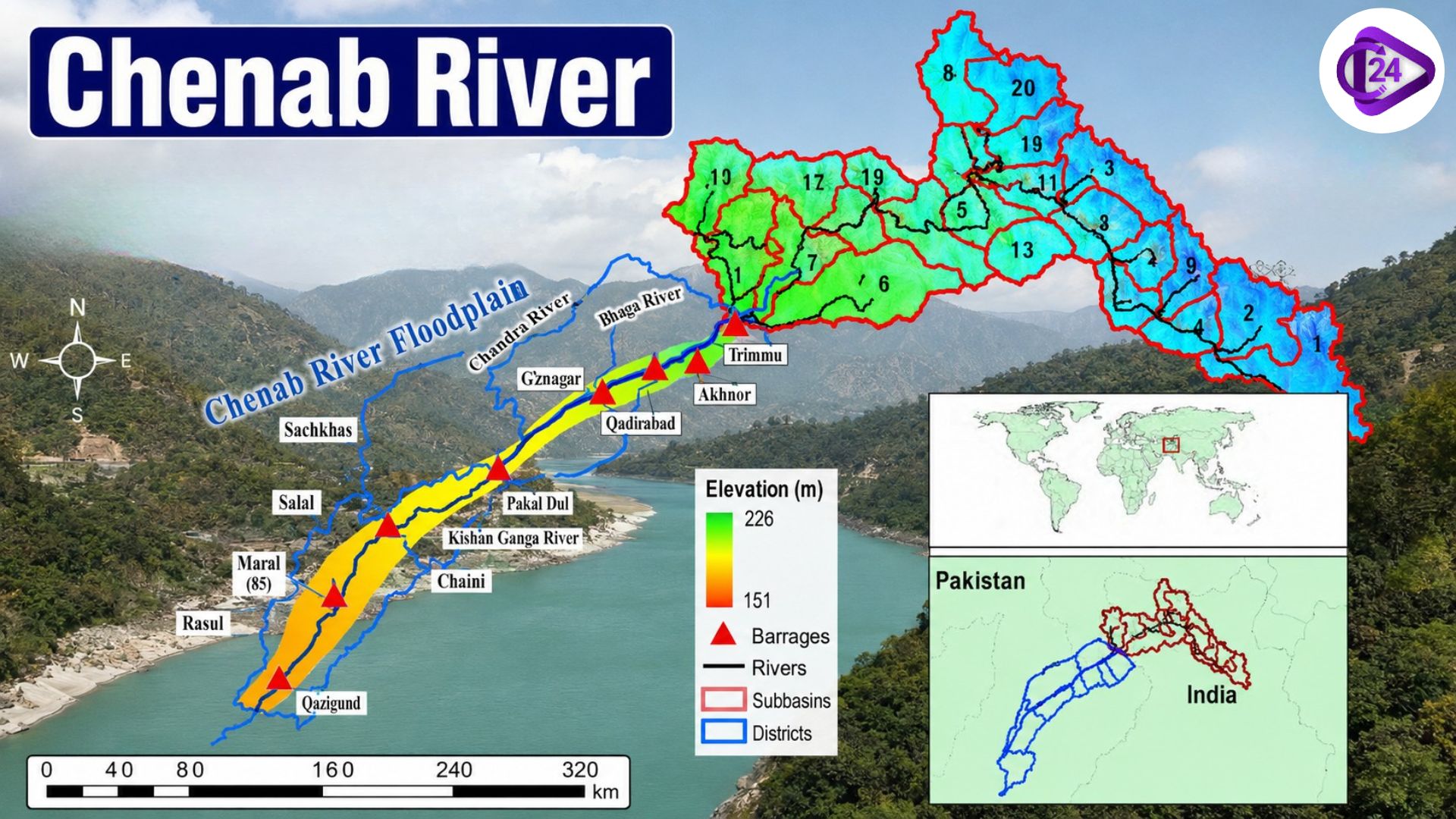
The Chenab River is one of the biggest western tributaries of the Indus River system and contributes to an important part of India-Pakistan water resources. The river was referred to as Chandrabhaga in ancient texts and Asikni in the Rigveda, and is formed by the merging of Chandra and Bhaga rivers at Tandi in Lahaul and Spiti district of Himachal Pradesh. The Chenab has its source in the glaciers around Baralacha La Pass in the Himalayas, travels through Himachal Pradesh and Jammu and Kashmir before joining the river Indus across Pakistani territory. The river itself is about 1,200 kilometres long.
Chenab River Origin & Course
Originally referred to as Chandrabhaga in early Indian texts, the Chenab is also known as Asikni in the Rigveda and is formed from rivulets that originate in the upper reaches of Himachal Pradesh. It is formed at Tandi, where Chandra and Bhaga Rivers meet (Tandi is in the Lahaul and Spiti district). The Chandrabhaga River has two headstreams: the Chandra River, which flows out of the Surya Taal Lake near Baralacha La Pass on one side and the Bhaga River from glacial lakes nearby on the other side.
The Chenab rises from Tandi and flows northwards through the deep gorges of Lahaul, entering the Union Territory of Jammu and Kashmir where it traverses the districts of Kishtwar, Doda, Ramban, Reasi and Jammu. It flows through the Punjab plains, then flows into Pakistan and then at last joins the Sutlej, being a tributary of the Panjnad River (of RB) before draining into the Indus River.
Major Tributaries of the Chenab River
| Tributary | Bank | Origin | Key Features | Confluence |
| Chandra River | Headstream | Samudra Tapu Glacier, near Baralacha La Pass, Himachal Pradesh | One of the two source rivers of the Chenab; flows through the Lahaul Valley. | Meets the Bhaga River at Tandi, Himachal Pradesh. |
| Bhaga River | Headstream | Surya Taal Lake, near Baralacha La Pass, Himachal Pradesh | Glacier-fed river flowing through the Lahaul region; forms the Chenab with the Chandra River. | Meets the Chandra River at Tandi, Himachal Pradesh. |
| Marusudar River | Left Bank | Kishtwar Himalayas, Jammu & Kashmir | Largest tributary of the Chenab in India; major hydropower potential. | Joins the Chenab near Kishtwar. |
| Thirot River | Left Bank | Pir Panjal Range, Jammu & Kashmir | Mountain stream contributing snowmelt to the Chenab basin. | Merges with the Chenab in Doda district. |
| Bichleri River | Right Bank | Kishtwar district, Jammu & Kashmir | Seasonal tributary draining the middle Himalayan region. | Joins the Chenab in Kishtwar district. |
| Tawi River | Right Bank | Kailash Kund Glacier, Bhaderwah region, Jammu & Kashmir | Important river of the Jammu region; flows through Jammu city. | Merges with the Chenab near Trimmu, Pakistan. |
| Munar Tawi River | Right Bank | Doda district, Jammu & Kashmir | Significant mountain tributary of the upper Chenab basin. | Joins the Chenab near Doda. |
| Poonch River | Left Bank | Pir Panjal Range, Jammu & Kashmir | Transboundary river flowing through the Poonch region. | Meets the Chenab in Pakistan. |
| Jhelum River | Right Bank | Verinag Spring, Jammu & Kashmir | Major tributary of the Indus system; historically known as Vitasta. | Joins the Chenab at Trimmu, Punjab, Pakistan. |
| Ravi River | Right Bank | Near Rohtang Pass, Himachal Pradesh | One of the five rivers of Punjab. | Joins the Chenab through the Panjnad system in Pakistan. |
Major Dams and Hydropower Projects on the Chenab River
| Project/Dam | River | Location | Installed Capacity | Type | Status/Key Features |
| Salal Hydroelectric Project | Chenab River | Reasi district, Jammu & Kashmir, India | 690 MW | Run-of-the-river | Commissioned in phases between 1987 and 1995; operated by NHPC. |
| Dulhasti Hydroelectric Project | Chenab River | Kishtwar district, Jammu & Kashmir, India | 390 MW | Run-of-the-river | Commissioned in 2007; developed by NHPC. |
| Baglihar Hydroelectric Project (Stage I & II) | Chenab River | Ramban district, Jammu & Kashmir, India | 900 MW | Run-of-the-river | Major hydropower project developed in two stages; subject to discussions under the Indus Waters Treaty. |
| Ratle Hydroelectric Project | Chenab River | Kishtwar district, Jammu & Kashmir, India | 850 MW | Run-of-the-river | Under construction; developed on the lower Chenab. |
| Pakal Dul Hydroelectric Project | Marusudar River* | Kishtwar district, Jammu & Kashmir, India | 1,000 MW | Storage project | Under construction; located on the Chenab’s largest tributary. |
| Kiru Hydroelectric Project | Chenab River | Kishtwar district, Jammu & Kashmir, India | 624 MW | Run-of-the-river | Under construction; designed to utilise the Chenab’s steep gradient. |
| Kwar Hydroelectric Project | Chenab River | Kishtwar district, Jammu & Kashmir, India | 540 MW | Run-of-the-river | Under construction; part of the Chenab cascade development plan. |
| Sawalkote Hydroelectric Project | Chenab River | Ramban and Udhampur districts, Jammu & Kashmir, India | 1,856 MW | Run-of-the-river | Proposed; expected to be one of India’s largest hydropower projects. |
| Marala Headworks | Chenab River | Punjab, Pakistan | — | Barrage | Diverts water for irrigation through the Upper Chenab Canal system. |
| Trimmu Barrage | Chenab River | Jhang district, Punjab, Pakistan | — | Barrage | Located near the confluence of the Jhelum and Chenab rivers; supports irrigation and flood control. |
Also Read
| Yamuna River System | Son River |
| Ganga River System | Jhelum River System |
| Indus River System | Godavari River System |
| Brahmaputra River System | Indian River Systems |
Significance of the Chenab River
- The Chenab River is one of the major western tributaries of the Indus River System.
- At Tandi in Himachal Pradesh, it is formed by the confluence of the Chandra and Bhaga rivers.
- The river irrigates lands in Jammu and Kashmir, but also Punjab province of Pakistan, supporting agriculture.
- The perennial flow is maintained from the glaciers and snowmelt from the Himalayan ranges.
- Chenab has a massive hydel power generation potential — projects like Salal, Baglihar, Dulhasti and Ratle have come up on it.
- It supplies drinking water and livelihoods to millions of people.
- The river supports unique mountain habitats and biodiversity.
- It was called Chandrabhaga and Asikni in the ancient texts of India.
- Chenab is one of the Western Rivers which fall under the Indus Waters Treaty (1960).
- Hence, it is very important for regional water security and economic development.