


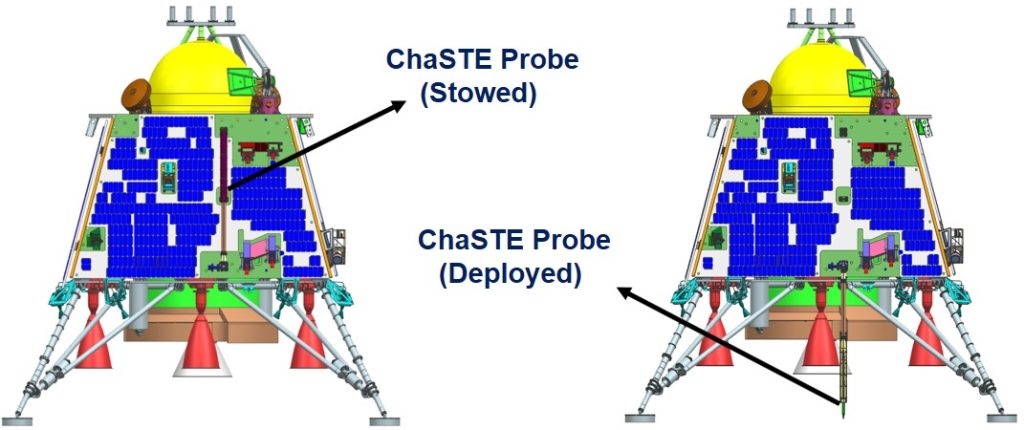
India’s Chandrayaan-3 mission achieved an important milestone in lunar science through the Chandra’s Surface Thermophysical Experiment (ChaSTE). Installed on the Vikram lander, ChaSTE measured the temperature profile of the lunar soil near the Moon’s south polar region for the first time at this high-latitude location.
The experiment recorded temperatures from the lunar surface down to a depth of approximately 10 centimetres. At the Shiv Shakti landing site, the peak surface temperature reached 355 Kelvin (82°C). These measurements provided valuable information about the thermal properties of lunar soil, also known as lunar regolith.
The findings are important for understanding the Moon’s near-surface environment, studying the possible stability of water ice and planning future lunar exploration missions.
Key Highlights of the ChaSTE Experiment
| Particulars | Details |
| Full form | Chandra’s Surface Thermophysical Experiment |
| Mission | Chandrayaan-3 |
| Space agency | Indian Space Research Organisation (ISRO) |
| Installed on | Vikram lander |
| Landing location | Shiv Shakti Point |
| Region | Moon’s southern high-latitude region |
| Latitude | Approximately 69.37° South |
| Measurements | Temperature and thermal properties of lunar soil |
| Number of temperature sensors | 10 |
| Measurement depth | Up to 10 cm |
| Peak surface temperature | 355 K (approximately 82°C) |
| Measurement period | 24 August to 2 September 2023 |
What Is ChaSTE?
ChaSTE stands for Chandra’s Surface Thermophysical Experiment. It is a scientific instrument carried by the Vikram lander of India’s Chandrayaan-3 mission.
The instrument was designed to investigate the thermal properties of lunar regolith near the Moon’s south polar region.
Its main objectives included:
- Measuring the temperature of lunar soil at different depths.
- Studying the vertical temperature profile of the lunar surface.
- Understanding the thermal conductivity of lunar regolith.
- Investigating how solar heat moves through the upper layers of lunar soil.
- Providing scientific data useful for future lunar exploration and resource utilisation.
ChaSTE was jointly developed with contributions from the Physical Research Laboratory (PRL), Ahmedabad, and the Space Physics Laboratory (SPL) of the Vikram Sarabhai Space Centre (VSSC), ISRO.
How Did the ChaSTE Experiment Work?
ChaSTE used a thermal probe equipped with 10 temperature sensors to measure the temperature of lunar soil at different depths.
The probe was inserted into the lunar regolith through a controlled deployment mechanism operated using commands from Earth.
Its working process involved the following steps:
- The thermal probe was deployed from its stowed position on the Vikram lander.
- A rotation-based mechanism helped the probe penetrate the lunar soil.
- Ten temperature sensors mounted along the probe measured temperatures at different depths.
- The measurements were used to prepare a vertical temperature profile of the lunar regolith.
- A heating experiment was also conducted to estimate the thermal conductivity of the soil.
The probe reached a final measurement depth of approximately 10 cm. Its observations provided information about the thermal behaviour of the Moon’s uppermost soil layer.
Important Features of the ChaSTE Thermal Probe
The ChaSTE instrument had several important technical features:
| Feature | Description |
| Temperature sensors | 10 |
| Sensor type | Platinum Resistance Temperature Detectors (Pt-1000) |
| Sensor arrangement | Mounted at different positions along the probe |
| Measurement depth | Surface to approximately 10 cm |
| Insertion mechanism | Controlled, rotation-based deployment |
| Heating element | Used for thermal conductivity experiments |
| Data collection | Temperature measurements at approximately one-second intervals |
The sensors were positioned at different depths to help scientists understand how the lunar soil temperature changes from the surface downwards.
Major Findings of the ChaSTE Experiment
The ChaSTE observations provided important information about the thermal environment of the Moon’s southern high-latitude region.
1. Peak Surface Temperature of 355 K
One of the most important findings was the measurement of a peak surface temperature of 355 K (approximately 82°C) at the Shiv Shakti landing site.
This was higher than the approximately 330 K temperature predicted by earlier orbital observations.
However, scientists explained that the difference was related to the local topography. The ChaSTE probe was deployed on a sun-facing slope of approximately 6 degrees, which received more direct solar heating.
An independent temperature measurement on a relatively flat surface about one metre away recorded approximately 332 K. This was consistent with earlier orbital estimates.
2. Significant Temperature Variation Over Short Distances
ChaSTE observations revealed that lunar surface temperatures can vary considerably even over distances of approximately one metre.
The difference between the sloping probe location and the nearby flat surface highlighted the influence of local terrain and solar illumination.
This finding is particularly important for future lunar missions because the selection of a landing site can affect the thermal conditions experienced by landers, instruments and equipment.
3. Temperature Changes Below the Lunar Surface
The probe measured temperature variations at different depths within the lunar soil.
The observations showed that the temperature changes with depth and that the subsurface reaches its warmest temperature later than the surface.
This time delay provides information about how heat travels through lunar regolith.
4. Thermal Conductivity of Lunar Soil
ChaSTE also conducted heating experiments to study the thermal conductivity of lunar soil.
Thermal conductivity describes how easily heat passes through a material.
The results indicated that the upper lunar regolith has poor thermal conductivity. This property is important for understanding the Moon’s extreme temperature variations and designing future lunar habitats and equipment.
Connection Between ChaSTE and Water Ice on the Moon
One of the important scientific implications of ChaSTE observations is their relevance to the possible presence of water ice near the lunar poles.
The Moon’s polar regions contain permanently shadowed areas where temperatures can remain extremely low. Under suitable conditions, water ice may remain trapped in these regions for very long periods.
ChaSTE’s temperature measurements help scientists understand the thermal environment of the lunar subsurface and assess where water ice could potentially remain stable.
However, it is important to understand that ChaSTE did not directly detect or confirm water ice. Its primary purpose was to measure temperature and thermal properties of lunar soil.
The findings provide useful thermal information for future missions that aim to investigate lunar water resources.
Why Is the ChaSTE Experiment Important?
The ChaSTE experiment is important for several scientific and technological reasons.
- Understanding Lunar Soil
It provides direct measurements of the temperature profile within the upper 10 cm of lunar soil at a southern high-latitude location.
- Planning Future Lunar Missions
The data can help scientists select suitable landing sites and design instruments that can operate under extreme lunar temperature conditions.
- Studying Lunar Water Ice
Temperature measurements provide important information for understanding the possible stability of water ice in the Moon’s polar regions.
- Development of Lunar Habitats
Understanding the thermal behaviour of lunar soil can support research into insulation, thermal protection and future human habitation systems.
- Advancement of India’s Space Research
The experiment demonstrates India’s ability to develop and operate scientific instruments for in-situ exploration of the lunar surface.
Conclusion
The ChaSTE experiment aboard Chandrayaan-3’s Vikram lander marked an important achievement in lunar science by providing the first in-situ temperature profiles of the upper lunar soil at a southern high-latitude location.
Using 10 temperature sensors, the instrument measured temperatures up to a depth of approximately 10 cm and recorded a peak surface temperature of 355 K at the Shiv Shakti landing site.
The observations improved scientific understanding of lunar soil, local temperature variations and thermal conductivity. They also provide useful information for studying the possible stability of water ice and planning future robotic and human exploration of the Moon.
For competitive examinations, remember the full form of ChaSTE, its association with Chandrayaan-3, its installation on the Vikram lander, the 10 temperature sensors and the peak surface temperature of 355 K.