


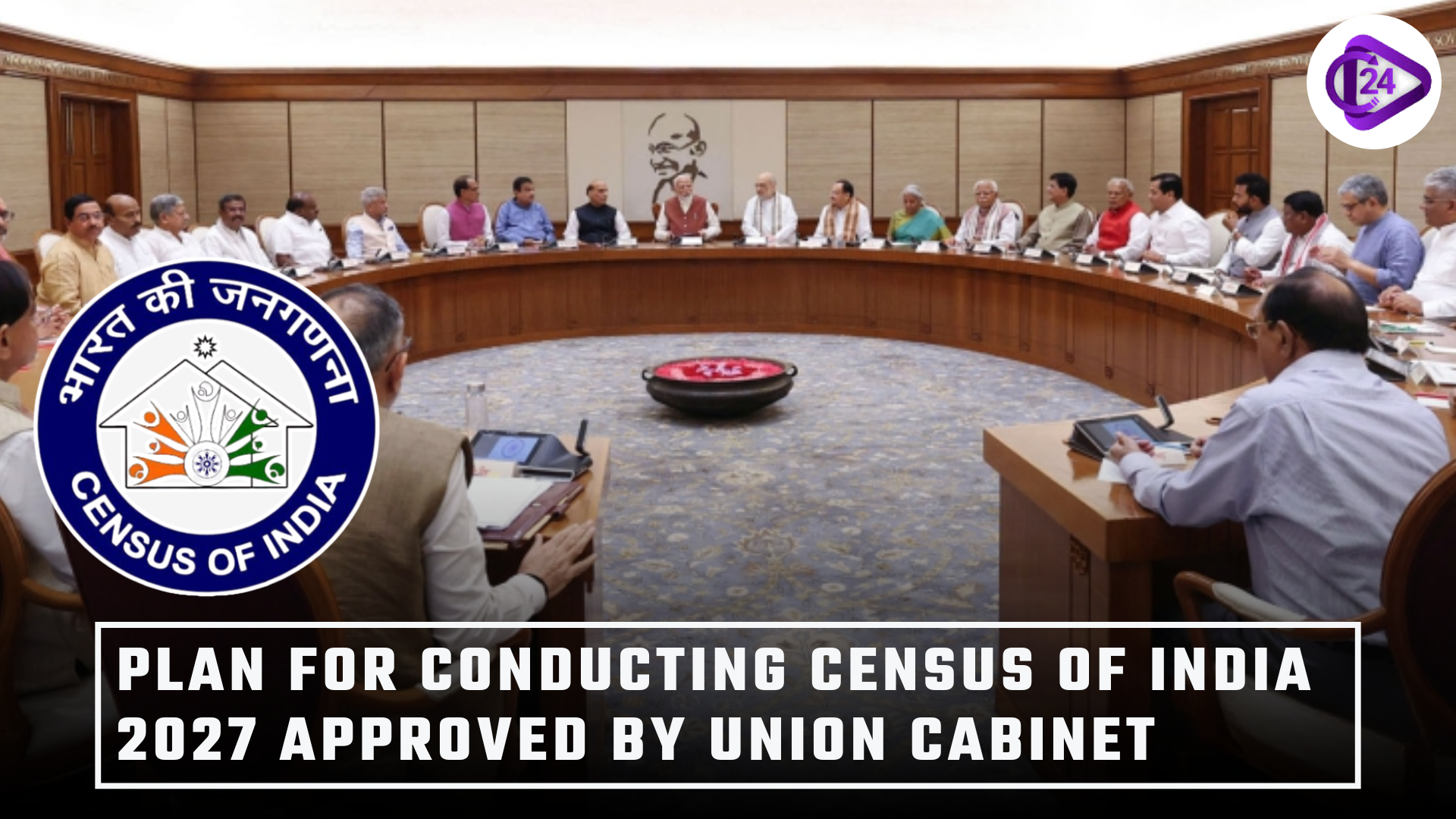
The Union Cabinet has approved the scheme for conducting the Census of India 2027 with a budget of ₹11,718.24 crore. The upcoming census is a major administrative exercise because it will be India’s first census conducted digitally, introducing mobile-based data collection and an online self-enumeration facility for eligible households.
Census 2027 will be conducted in two phases: the Houselisting and Housing Census, followed by Population Enumeration. The first phase is scheduled across state-specific 30-day periods between April and September 2026, while the second phase is scheduled for February 2027 in most parts of the country. Specified snow-bound areas follow a separate schedule.
The government has also announced that caste-related information will be collected during the population enumeration phase. These changes are intended to support systematic data collection and improve the availability of demographic information for public administration, welfare planning and policy development.
Census of India 2027: Key Highlights
| Particular | Details |
|---|---|
| Census name | Census of India 2027 |
| Conducting authority | Office of the Registrar General and Census Commissioner, India |
| Administrative ministry | Ministry of Home Affairs |
| Approved budget | ₹11,718.24 crore |
| Census frequency | Normally every 10 years |
| Previous completed census | Census 2011 |
| Total census series | 16th Census of India |
| Census since Independence | 8th |
| Data collection method | Digital tools and mobile applications |
| Special facility | Self-enumeration |
| Number of phases | Two |
| Phase 1 | Houselisting and Housing Census |
| Phase 2 | Population Enumeration |
| Caste-related information | Included in Phase 2 |
The Union Cabinet approved the census scheme in December 2025. The government subsequently announced the digital tools and operational arrangements for the exercise.
What Is the Census of India?
The Census of India is a nationwide population-counting and data-collection exercise conducted by the government. It provides information about population size, distribution, demographic characteristics, housing conditions and other relevant social and economic indicators.
Census data helps governments understand where people live and how population patterns change over time. It supports planning for schools, hospitals, housing, transport, sanitation, public infrastructure and welfare programmes.The census is conducted under the Census Act, 1948, and the applicable rules. The Office of the Registrar General and Census Commissioner, India, functions under the Ministry of Home Affairs and is responsible for administering the census.
India’s previous completed census was conducted in 2011. The next census was originally expected in 2021, but the exercise was postponed. Census 2027 is therefore particularly important for updating India’s official population information after a longer-than-usual interval.
Census of India 2027 Budget: ₹11,718.24 Crore
The Union Cabinet approved an expenditure of ₹11,718.24 crore for conducting Census 2027.
The budget supports the extensive logistical and administrative requirements of a nationwide exercise. Census operations involve planning, training, digital infrastructure, field staff, monitoring, data processing and coordination between central and state-level authorities.
Key expenditure-related requirements include:
- Recruiting and deploying enumerators, supervisors and other census officials.
- Developing and operating digital data-collection platforms.
- Providing training and technical support to field personnel.
- Organising houselisting and population enumeration operations.
- Monitoring progress and maintaining data quality.
- Processing and compiling census information for official use.
The government expects more than 30 lakh enumerators, supervisors and other census functionaries to be involved in the exercise.
The budget is an approved allocation for conducting Census 2027. It should not be confused with the cost of every separate government programme that may subsequently use census data.
Why Is Census 2027 India’s First Digital Census?
One of the most significant features of Census 2027 is the use of digital tools for collecting and managing census information.
In earlier census exercises, paper-based schedules played a major role in field data collection. Census 2027 introduces mobile applications and digital platforms to support enumeration, data transmission and administrative monitoring.
The digital approach is designed to improve operational efficiency and reduce dependence on paper-based processes. It also provides a structured system for monitoring fieldwork and managing information across different administrative levels.
Important features include:
- Mobile applications for authorized enumerators.
- Digital collection and uploading of household information.
- Offline data collection capabilities in the Houselisting and Housing Census application.
- A self-enumeration portal for eligible respondents.
- Digital monitoring of census activities.
- Centralized management and tracking of field operations.
Digital collection does not mean that every household must independently complete an online form. The government will also conduct door-to-door enumeration to ensure coverage.
Four Digital Tools for Census 2027
The government introduced four digital platforms to facilitate census operations. These tools were developed by the Centre for Development of Advanced Computing (C-DAC).
| Digital tool | Purpose |
|---|---|
| Houselisting Block Creator (HLBC) Web Application | Helps officials create standardized houselisting blocks using digital maps and satellite imagery |
| HLO Mobile Application | Allows authorized enumerators to collect and upload houselisting information |
| Self-Enumeration Portal | Enables eligible household respondents to submit information online before field enumeration |
| Census Management and Monitoring System (CMMS) Portal | Supports planning, monitoring and management of census operations |
1. Houselisting Block Creator Web Application
The Houselisting Block Creator application is a mapping tool used by authorized officials to create and organize houselisting blocks.
Digital maps and satellite imagery help officials define the geographic areas to be covered by enumerators. Standardized blocks support systematic fieldwork and reduce the risk of geographical gaps.
2. HLO Mobile Application
The Houselisting and Housing Census mobile application is designed for registered enumerators. It supports digital collection and uploading of housing and household information.
According to the official announcement, the application supports offline data collection and is compatible with Android and iOS devices. It can be operated in 16 regional languages and is accessible to authorized enumerators through the official system.
3. Self-Enumeration Portal
Self-enumeration is a new facility introduced for Census 2027. It allows eligible respondents to submit their household information online before the scheduled door-to-door enumeration period. After successful submission, the system generates a unique Self-Enumeration ID. The respondent can share this ID with the enumerator so that the submitted information can be verified during the field visit.
Self-enumeration is an option within the census process. It does not replace the government’s responsibility to ensure complete coverage through the prescribed enumeration arrangements.
4. Census Management and Monitoring System
The Census Management and Monitoring System, or CMMS, is a centralized digital platform for managing census operations.
Officials at different administrative levels can use the platform to track operational readiness, field performance and enumeration progress. The system is intended to improve coordination, monitoring and the management of census activities.
Census 2027: Two Phases of Enumeration
Census 2027 will be conducted in two principal phases. Each phase collects a different type of information.
| Phase | Name | Main focus | Broad schedule |
|---|---|---|---|
| Phase 1 | Houselisting and Housing Census | Housing conditions and household amenities | April–September 2026 |
| Phase 2 | Population Enumeration | Demographic, social and economic particulars of individuals | February 2027 in most areas |
The dates shown are the broad national schedule announced for the exercise. State- and Union Territory-specific notifications determine the actual fieldwork periods.
Phase 1: Houselisting and Housing Census
The first phase focuses on housing characteristics and household amenities. It records information required to understand housing conditions and the facilities available to households. Houselisting operations are scheduled during a 30-day continuous period notified by each state or Union Territory between 1 April and 30 September 2026. A 15-day self-enumeration window is scheduled immediately before the relevant state’s or Union Territory’s house-to-house listing period.
The information gathered during this phase provides an overview of housing conditions and household facilities across the country.
Phase 2: Population Enumeration
The second phase focuses on individual-level demographic, social and economic information. Population Enumeration is scheduled for February 2027 across most of India. Specified snow-bound and non-synchronous areas follow a separate schedule. The reference date for most states and Union Territories is 00:00 hours on 1 March 2027. For Ladakh and the specified snow-bound non-synchronous areas of Jammu and Kashmir, Himachal Pradesh and Uttarakhand, the reference date is 00:00 hours on 1 October 2026.
Caste-related information is also scheduled to be collected during the second phase.
Caste Enumeration in Census 2027
The inclusion of caste-related questions is another important feature of Census 2027. The government announced that caste-related information would be collected during Population Enumeration. The collection of this information is relevant to demographic research, social policy and understanding the composition of the population.
It is important to distinguish caste enumeration from the general population count. The census collects a wide range of information, and caste-related questions form one part of the broader enumeration process.
Why Is Census Data Important for India?
Census data supports evidence-based planning and helps governments understand the characteristics and needs of the population.
- Public policy and welfare: Population data can help authorities plan and evaluate programmes for different sections of society.
- Education and healthcare: Information about population distribution helps in planning schools, hospitals and other public services.
- Housing and infrastructure: Household and housing information supports planning for sanitation, water supply, transport and other facilities.
- Demographic research: Census data helps researchers examine population growth, age structure, migration and other demographic patterns.
- Administrative planning: Reliable population information supports a wide range of government planning and administrative functions.
- Resource allocation: Census information can serve as an input in planning public expenditure and assessing service requirements. Specific allocation decisions, however, depend on the applicable laws, policies and other data sources.
Important Facts for Competitive Exams
Candidates preparing for SSC, RRB, UPSC, banking and state-level examinations should remember the following:
- Census 2027 is India’s first digital census.
- The Union Cabinet approved an expenditure of ₹11,718.24 crore.
- The previous completed census was Census 2011.
- Census 2027 is the 16th Census of India and the eighth since Independence.
- The Ministry of Home Affairs is the administrative ministry.
- The Office of the Registrar General and Census Commissioner, India, administers the census.
- The Centre for Development of Advanced Computing developed the four digital tools.
- The four tools are HLBC, HLO Mobile Application, Self-Enumeration Portal and CMMS Portal.
- Census 2027 has two phases: Houselisting and Housing Census, followed by Population Enumeration.
- Caste-related information is scheduled to be collected in Phase 2.
- The normal reference date is 00:00 hours on 1 March 2027.
- Specified snow-bound areas use a reference date of 1 October 2026.
Conclusion
Census of India 2027 represents a major modernization of the country’s population data-collection process. With an approved budget of ₹11,718.24 crore, digital tools, self-enumeration and a two-phase structure, the exercise is designed to collect comprehensive information about India’s population and households. The introduction of mobile-based data collection and digital monitoring is an important change in the way census operations are managed. At the same time, door-to-door enumeration remains essential to achieving complete coverage.
All Important Questions Based on the Census of India (PYQs)
| Exam Name | Year | Question | Correct Answer |
|---|---|---|---|
| SSC CGL | 2019 | Which Ministry is responsible for conducting the Census of India? | Ministry of Home Affairs |
| SSC CHSL | 2020 | Under which Act is the Census of India conducted? | Census Act, 1948 |
| UPSC Prelims | 2018 | Who is the Registrar General and Census Commissioner of India? | An officer under the Ministry of Home Affairs |
| SSC GD | 2021 | How often is the Census conducted in India? | Every 10 years |
| State PCS | 2017 | When was the first Census conducted in India? | 1872 |
| UPSC Prelims | 2021 | Which was the first synchronous census in India? | Census of 1881 |
| SSC CPO | 2022 | Census data is primarily used for which purpose? | Policy planning and governance |
| RRB NTPC | 2020 | Which Census was the last fully completed Census of India? | Census 2011 |
| SSC MTS | 2023 | The Census of India includes which type of data? | Population, housing, socio-economic data |