


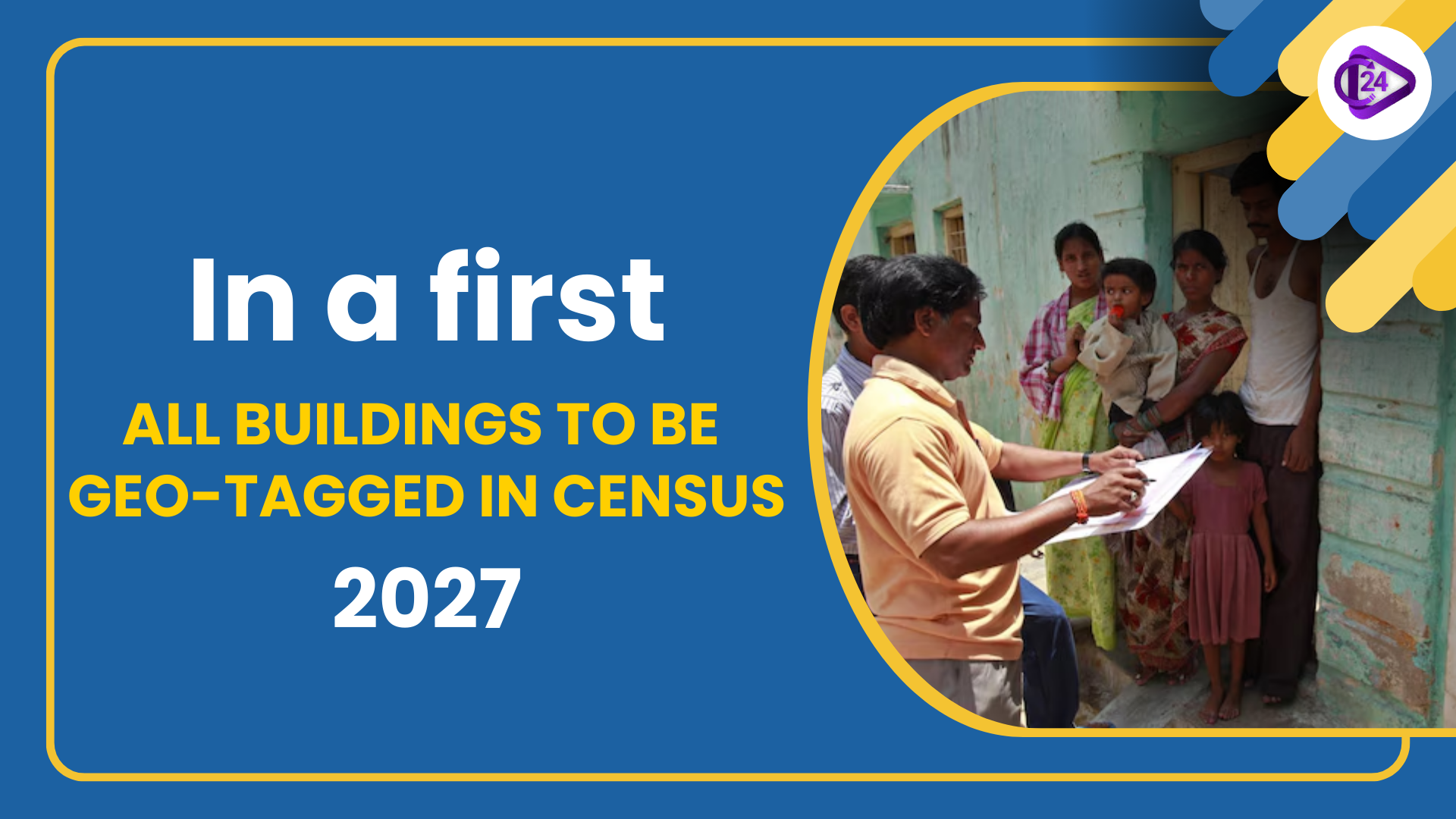
Census 2027 will mark a major transformation in India’s population enumeration process. For the first time, India is moving towards digital data collection using mobile applications, online self-enumeration and technology-enabled monitoring systems. The exercise will also include caste enumeration during the Population Enumeration phase, making it an important topic for SSC, Railway, Banking, UPSC and State Government examinations.
The Census 2027 will be conducted in two phases: Houselisting and Housing Census, followed by Population Enumeration. Digital tools such as the Houselisting Block Creator (HLBC) and Census Management and Monitoring System (CMMS) are designed to improve geographic coverage, coordination and monitoring. The government has also introduced a self-enumeration facility through which eligible household respondents can submit their information online before the field visit.
What Is Census 2027?
A census is the systematic process of collecting, compiling, analysing and publishing information about a country’s population and households. It provides essential data about demographic characteristics, housing conditions, household facilities and socio-economic indicators.
India’s Census 2027 is the next decennial census after the 2011 Census, which was the last completed national census. The census originally expected in 2021 was delayed during the COVID-19 period. Census 2027 will therefore be the 16th Census of India overall and the eighth since Independence, according to the Government of India’s official explanation.
- The exercise is conducted under the Census Act, 1948, and the Census Rules, 1990. Census is a Union subject under the Seventh Schedule of the Constitution of India.
- The government has approved an outlay of ₹11,718.24 crore for Census 2027. Its purpose is not merely to count people but also to create reliable statistical information for public administration, development planning and evidence-based policymaking.
Important Dates and Phases of Census 2027
Census 2027 will be carried out in two major phases. Each phase has a different purpose, and candidates should understand the distinction for competitive examinations.
| Particulars | Officially announced details |
| Houselisting and Housing Census | April–September 2026 |
| Fieldwork duration for Phase I | A 30-day continuous period notified by each State/UT |
| Optional self-enumeration | A 15-day period before the house-to-house Houselisting operation |
| Population Enumeration | February 2027 across most of India |
| Reference date for most States/UTs | 1 March 2027 at 00:00 hours |
| Reference date for specified snow-bound areas | 1 October 2026 at 00:00 hours |
| Digital approach | Mobile-based data collection and online self-enumeration |
The Houselisting and Housing Census phase was scheduled between April and September 2026. Its precise fieldwork dates vary according to the schedule notified for individual States and Union Territories. Population Enumeration is scheduled for February 2027 across most of the country.
For Ladakh and the specified snow-bound areas of Jammu and Kashmir, Himachal Pradesh and Uttarakhand, the Population Enumeration schedule is different. These areas have a reference date of 1 October 2026, whereas the reference date for the rest of the country is 1 March 2027. The reference date, sometimes called the Census Moment, determines the point in time against which population information is assessed. It should not be confused with the date on which enumerators physically visit a household.
Phase I: Houselisting and Housing Census
The first phase focuses on houses, housing conditions and household-level facilities. It helps establish the framework required for the subsequent population count. During this phase, enumerators collect information related to housing characteristics, available amenities and household assets covered by the notified questionnaire. The information helps authorities understand housing patterns and the distribution of basic facilities.
The phase also uses digital tools to organise geographic areas and improve the allocation of fieldwork. Properly defined houselisting blocks help officials plan their visits and reduce the risk of leaving areas uncovered or counting the same area more than once. An optional self-enumeration period is provided before the house-to-house survey. After a respondent successfully submits information, a unique Self-Enumeration ID is generated. The enumerator can use this ID during the field visit to retrieve and verify the submitted details.
Phase II: Population Enumeration
Population Enumeration is the second phase of Census 2027. It focuses on collecting information about individuals and their demographic and socio-economic characteristics. The official framework identifies February 2027 as the scheduled Population Enumeration period for most of India. The exact operational dates and questionnaire details are subject to official notifications.
An important feature of this phase is caste enumeration. Following the decision of the Cabinet Committee on Political Affairs dated 30 April 2025, caste enumeration will be undertaken during Census 2027. This is a significant change in the scope of the national census. Population Enumeration provides data that can support planning in areas such as education, healthcare, housing, employment, public services and social development. Its value depends on complete coverage, accurate responses and consistent application of census procedures.
Digital Census: What Makes Census 2027 Different?
Census 2027 represents a significant shift towards technology-enabled enumeration. Earlier census operations relied heavily on paper-based processes, whereas the new approach uses mobile applications and online systems for important parts of data collection and administration.
The digital model is intended to reduce manual paperwork, improve the movement of information from field staff to official systems and support faster monitoring. It does not eliminate the need for field verification. Enumerators will still visit households to ensure that information is collected and checked appropriately.
1. Houselisting and Housing Census Mobile Application
The Houselisting and Housing Census mobile application is designed for authorised enumerators. According to the government, it is a secure application that supports offline data collection and uploading, and is available for Android and iOS devices.
Access is restricted to registered census functionaries through the designated system. The application supports field-to-server data transmission, reducing dependence on traditional paper records. The official announcement states that the application supports 16 languages. The use of mobile devices can make data entry more systematic, but data quality still depends on proper training, accurate responses and the verification process.
2. Houselisting Block Creator (HLBC) Web Mapping Application
The Houselisting Block Creator is a web-based mapping application intended for Charge Officers. It supports the digital creation of houselisting blocks using satellite imagery.
A houselisting block is a defined geographic area assigned for census-related fieldwork. Digital mapping helps officials identify the boundaries and coverage of these areas more systematically. Geographic information systems and satellite imagery can help improve planning and reduce the likelihood of geographic omissions or duplication. However, the existence of digital mapping tools should not automatically be interpreted as proof that every individual building in India has already been geo-tagged. Candidates should distinguish the officially described mapping process from broader claims that may appear in secondary reports.
3. Self-Enumeration Portal
Self-enumeration allows eligible respondents to enter their household information online before the enumerator’s visit. It is one of the major citizen-facing changes introduced for Census 2027.
The official portal is available at https://se.census.gov.in/. After successful submission, a unique Self-Enumeration ID is generated. The respondent can share this ID with the enumerator, who can retrieve the submitted information and verify it during the field visit.
The government has announced support for 16 languages. The facility is intended to make the process more convenient for eligible households while maintaining verification through the official enumeration system.
Self-enumeration does not mean that every household is exempt from field visits. The census process includes verification and completion by authorised enumerators.
4. Census Management and Monitoring System (CMMS)
The Census Management and Monitoring System is a centralised web-based platform for planning, coordinating and monitoring census operations.
It provides administrative officers with tools to track fieldwork progress, work allocation, training, logistics and operational readiness. The government describes the platform as supporting near-real-time monitoring across administrative levels.
The system can help officials identify delays and operational problems more quickly. It also provides a common framework for coordinating census activities across districts, States and the national level.
Data Security and Confidentiality
Census information includes personal and household details, so data protection is an essential part of the exercise. The government has described measures that include encryption, secure data centres and security audits for the digital systems used in Census 2027.
The Census Act, 1948, provides a legal framework for protecting census information. Section 15 establishes confidentiality protections for individual census records. The official government explanation states that such information cannot be made public under the Right to Information Act, used as evidence in court or shared with institutions in the manner described by the law.
Digital collection can improve administrative efficiency, but it also makes secure access, data transmission, storage and system monitoring important. Respondents should use official channels for census-related activities and avoid sharing personal information through unverified links or unofficial applications.
Why Is Census 2027 Important?
Census information is widely used for public planning and resource allocation. Reliable population and household data help governments understand where services are needed and how demographic patterns differ across regions.
For example, information about housing conditions and household facilities can contribute to planning for infrastructure and basic services. Population statistics can support the assessment of education, healthcare and welfare needs. Demographic information can also help researchers analyse migration, population distribution and changes in household composition.
Census data is particularly valuable because it provides a broad statistical picture of the country rather than relying only on selected surveys. The digital transition aims to improve the process of collection, monitoring and dissemination. The actual quality and usefulness of the results will depend on complete enumeration, reliable responses, verification and careful data processing.
Census 2027: Important Facts for Competitive Exams
Candidates preparing for SSC CGL, SSC CHSL, RRB NTPC, RRB Group D, UPSC and State-level examinations should revise the following facts:
| Question area | Key fact |
| Census 2027 | India’s first census using digital means |
| Previous completed national census | Census 2011 |
| Census 2027 overall sequence | 16th Census of India |
| Census since Independence | Eighth |
| Legal framework | Census Act, 1948 and Census Rules, 1990 |
| Phase I | Houselisting and Housing Census |
| Phase II | Population Enumeration |
| Mobile data collection | HLO mobile application |
| Digital block mapping | Houselisting Block Creator |
| Monitoring platform | Census Management and Monitoring System |
| Self-enumeration | Optional online submission before fieldwork |
| Caste enumeration | Included in Census 2027 |
| Reference date for most States/UTs | 1 March 2027 |
| Reference date for specified snow-bound areas | 1 October 2026 |
| Approved financial outlay | ₹11,718.24 crore |
Candidates should also remember that the Houselisting and Housing Census collects information about housing and household facilities, whereas Population Enumeration focuses on individual-level demographic and socio-economic information.
Conclusion
Census 2027 is an important development in India’s statistical and administrative system. Its digital approach combines mobile-based data collection, self-enumeration, geographic mapping and centralised monitoring. The inclusion of caste enumeration is another major feature of the exercise.
For competitive examination aspirants, the most important areas are the two census phases, their schedules, the reference dates, the HLBC and CMMS platforms, self-enumeration, data confidentiality and the legal framework. Candidates should rely on official government notifications for operational dates and any subsequent changes.