


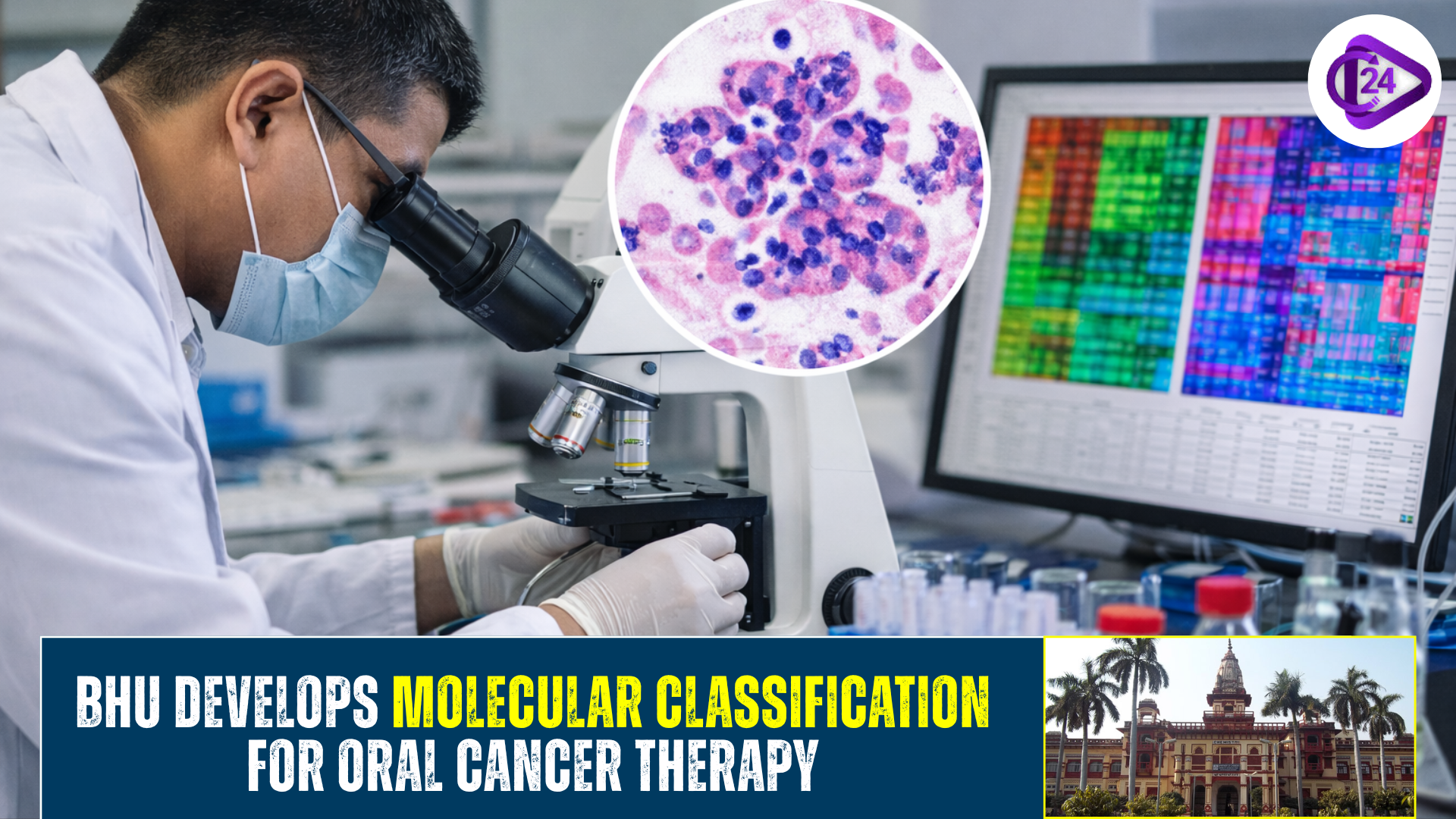
Researchers from Banaras Hindu University (BHU) have proposed a systematic molecular classification of oral cancer that could support the development of more personalized treatment approaches. The research identifies five major molecular pathways involved in oral cancer development and explains how different genetic alterations may contribute to the disease.
The study, titled “Unveiling oral cancer’s molecular blueprint: A novel classification to guide precision therapy,” was published online on 25 December 2025 in the journal Mutation Research/Reviews in Mutation Research. It presents a framework based on genomic research and scientific literature, offering a new way to understand the biological diversity of oral cancer.
The classification is particularly relevant to India, where oral cancer is a major public health concern associated with tobacco use, smokeless tobacco products, and areca nut or betel quid consumption.
What is the molecular classification of oral cancer?
Traditionally, oral cancer diagnosis and classification have relied heavily on the appearance and microscopic structure of tumour tissue. These methods remain important, but they may not fully explain the molecular differences between individual tumors.
Molecular classification examines the genetic alterations, biological processes, and signalling pathways involved in cancer development.
The BHU research proposes grouping oral cancer-related genes into five major molecular categories. This approach may help researchers understand why tumors behave differently and identify possible targets for future therapies.
The researchers reviewed 8,176 scientific articles related to oral cancer genomics and identified 48 coding genes associated with oral carcinogenesis. They used gene-function analysis, cluster analysis, and protein-protein interaction networks to develop the proposed classification.
Five Molecular Pathways Identified by BHU Researchers
The study identifies five major biological groups associated with oral cancer development.
1. Cell-Cycle Dysregulation (CCD)
Cell-cycle dysregulation occurs when the normal mechanisms controlling cell growth and division stop functioning properly.
Normally, cells grow, divide, and die through carefully regulated biological processes. When genes controlling these processes become altered, cells may multiply uncontrollably and contribute to tumor formation.
The study further divides this category into
- Growth Activation (GA): Involves the activation of growth-promoting genes and signalling pathways.
- Apoptotic Dysregulation (AD): Involves disruptions in apoptosis, the natural process through which damaged or abnormal cells are eliminated.
The research identifies cell-cycle dysregulation as the most frequently studied category, with alterations in this group reported in more than 60% of the cases discussed. TP53 was identified as the most common alteration.
2. Immune-Mediated (IM) Pathway
The immune system plays an important role in identifying and controlling abnormal cells. However, cancer cells can develop mechanisms that help them escape immune surveillance.
The immune-mediated pathway focuses on how interactions between cancer cells and the immune system may influence tumor development and progression.
Understanding this pathway could help researchers explore immunotherapy and other treatment approaches that target the tumor’s interaction with the immune system.
3. Xenobiotic Metabolism-Associated (XMA) Pathway
Xenobiotics are chemical substances that are foreign to the human body. These include various environmental chemicals and compounds introduced through tobacco and other exposures.
The xenobiotic metabolism-associated pathway examines how the body processes such substances and how related biological mechanisms may contribute to oral carcinogenesis.
This pathway is particularly relevant for studying oral cancer in populations exposed to tobacco and other harmful substances. The researchers highlight it as an area that needs further investigation.
4. Inflammatory Pathway Activation (IPA)
Chronic inflammation can influence several stages of cancer development, including cell growth, survival, and interactions within the tumor environment.
The inflammatory pathway activation category examines biological processes through which inflammation may contribute to oral cancer.
Understanding these mechanisms may help researchers investigate the relationship between persistent inflammatory responses and tumor progression, as well as possible therapeutic targets.
5. Viral Protein Activation (VPA)
Certain viral proteins can interact with human cellular mechanisms and influence processes associated with cancer development.
The viral protein activation category focuses on how viral proteins may affect cellular regulation and contribute to carcinogenic processes.
This classification provides a framework for investigating the role of viral mechanisms in oral cancer. However, it does not mean that every oral cancer case is caused by a viral infection.
Key Findings of the BHU Oral Cancer Research
| Research aspect | Key finding |
| Institution | Banaras Hindu University |
| Journal | Mutation Research/Reviews in Mutation Research |
| Online publication date | 25 December 2025 |
| Research type | Review and molecular classification framework |
| Scientific literature reviewed | 8,176 articles |
| Genes identified | 48 coding genes |
| Molecular categories | 5 |
| Most frequently studied category | Cell-Cycle Dysregulation |
| Common alteration highlighted | TP53 |
| Research objective | Support understanding of oral cancer biology and future precision therapy |
How Can This Research Support Precision Cancer Treatment?
Precision medicine aims to understand the biological characteristics of a disease in an individual patient and use that information to guide treatment decisions.
Different oral cancer tumors may contain different genetic alterations and biological mechanisms. Therefore, a treatment approach that works for one tumor may not produce the same response in another.
The molecular classification proposed by BHU could contribute to future research in several ways:
- Identification of molecular targets: Researchers may investigate genes and pathways that contribute to tumor development.
- Better understanding of tumor differences: The classification highlights that oral cancer involves multiple biological mechanisms.
- Development of targeted therapies: The identified pathways may help guide research into treatments directed at specific molecular processes.
- Further investigation of underexplored pathways: Xenobiotic metabolism and inflammatory mechanisms may offer additional research opportunities.
- Support for personalized medicine: Future studies may examine whether molecular information can help predict treatment responses.
However, the classification is a proposed research framework. It has not established a clinically validated system for assigning individual patients to specific treatments. Further laboratory studies, clinical validation, and treatment-outcome research will be required before it can be used as a routine clinical decision-making tool.
Why is This Research Important for India?
India faces a significant burden of oral cancer. According to information published by the ICMR-National Institute of Cancer Prevention and Research, India accounts for a substantial share of global oral cancer cases.
Major risk factors include
- Smoking and smokeless tobacco consumption
- Gutkha, khaini, and other tobacco-containing products
- Betel quid and areca nut consumption
- Alcohol consumption
- Certain viral infections, including high-risk HPV in relevant head and neck cancer sites
The National Cancer Registry Programme’s estimates for 2022 recorded approximately 1.98 lakh cases of oral cavity and pharynx cancer in India. This figure includes both oral cavity and pharyngeal cancers, so it should not be interpreted as oral cavity cancer alone.
The BHU framework is relevant because it highlights molecular processes that researchers can investigate in populations with different exposure patterns. In particular, the xenobiotic metabolism-associated and inflammatory pathway categories may help stimulate further research into the biological effects of tobacco-related exposures.
About Banaras Hindu University (BHU)
Banaras Hindu University is a central university located in Varanasi, Uttar Pradesh. Established in 1916, it is one of India’s major institutions of higher education and research.
The oral cancer classification research involved researchers associated with BHU’s Institute of Medical Sciences and Department of Surgical Oncology, along with other collaborators.
The research team included Manoj Pandey, Pooja Singh, Mridula Shukla, Monika Rajput and Ruhi Dixit.
Conclusion
The molecular classification proposed by Banaras Hindu University researchers offers a structured way to understand the biological mechanisms involved in oral cancer. By analyzing 48 genes and grouping them into five major molecular categories, the study provides a framework for future research into tumor biology and precision cancer therapy.
Its relevance is particularly important for India, where tobacco and betel quid-related exposures contribute to the burden of oral cancer. However, the framework should be viewed as a research development rather than an already established treatment system. Further clinical studies will determine how effectively these molecular categories can support personalized treatment decisions.