

The Dramatic Performances Act, 1876: A Colonial Tool of Suppression

The British government through the Dramatic Performances Act of 1876 obtained special powers to ban public performances considered seditious and defamatory and obscene. India experienced the Act as a tool to silence nationalist feelings across the nation. The court declared it unconstitutional in 1956 but the Allahabad High Court allowed...

The Dramatic Performances Act, 1876: A Colonial Tool of Suppression

The British government through the Dramatic Performances Act of 1876 obtained special powers to ban public performances considered seditious and defamatory and obscene. India experienced the Act as a tool to silence nationalist feelings across the nation. The court declared it unconstitutional in 1956 but the Allahabad High Court allowed the continuing presence of this law until the Modi administration eliminated it during their campaign to remove outdated legislation in the year 2017.
Context

  • On March 1, 2025 PM Modi expressed puzzlement about the survival of Dramatic Performances Act, 1876 which enabled the arrest of public dancers and forbidden specific performances even though India had gained independence 75 years ago.

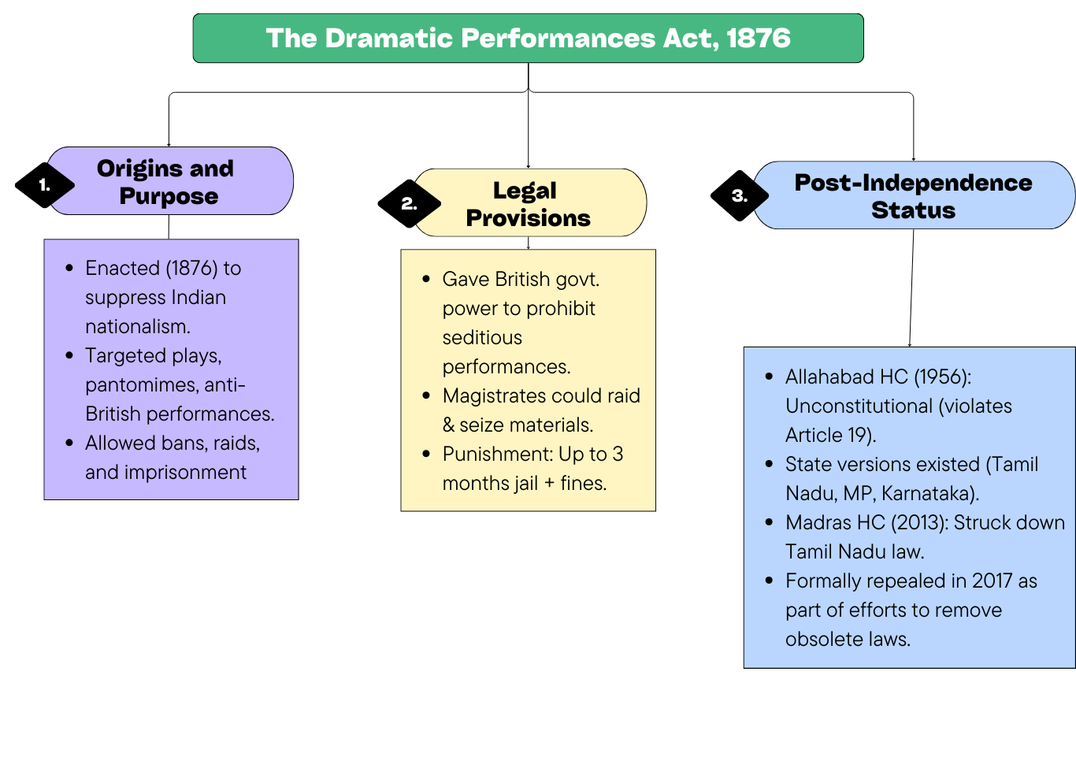
Origins and Purpose

  • The law received its initial enactment in 1876 with the aim to limit Indian discontent against foreign occupation.

  • Targeted plays, pantomimes, and other performances critical of British rule.

  • The law contained provisions for performance bans along with search authorization and imprisonment penalties.

Legal Provisions

  • The law granted extensive authorities to the government for banning entertaining shows considered either scandalous or seditious.

  • Magistrates received authorization to manage intercepting theater materials while acting on their own behalf.

  • Persons who violated the Act faced a maximum three-month imprisonment term with associated financial penalties.

Post-Independence Status

  • The Allahabad High Court declared this law unconstitutional on grounds of violating Article 19 which protects freedom of speech (1956).

  • Particular state variations of this law persisted in Tamil Nadu and were also active in Madhya Pradesh and Karnataka even after the Censorship Act expired.

  • Courts in Madras dismissed the Tamil Nadu version of the act during 2013.

Repeal Under Modi Government

  • A formal act in 2017 removed the law when the government conducted efforts to delete outdated regulations.

  • The Modi administration has eliminated over 2,000 outdated laws which improved the functioning of governance.

  • Although the government removed some outdated colonial laws from the books it kept the sediment law as well as made alternative modifications to remaining legal code.

Other Colonial Laws of the Era

1. Vernacular Press Act, 1878

  • British Indian Viceroy Lord Lytton introduced this piece of legislation.

  • The British government designed this legislation to prevent Indian-language newspapers from attacking their colonial control regime.

  • The government acquired control over printing machines together with authority to stop the distribution of publications which were deemed seditious.

  • The English-language newspapers had unrestricted freedom and faced no restrictions while vernacular newspapers (local Indian language) became specific targets for government censorship.

  • Indian intellectuals together with journalists staged protests until the British Viceroy Lord Ripon abolished the legislation in 1882.

2. Sedition Law, 1870

  • British authorities incorporated the Sedition Law into the Indian Penal Code through its Section 124A.

  • Through this law the government implemented penalties for speech and writing materials which instigated hatred and disaffection or rebellion against British governance.

  • Authorities employed this law to suppress the activities of Indian freedom fighters including Bal Gangadhar Tilak and Mahatma Gandhi as well as Bhagat Singh.

  • The law enforced sentences of life imprisonment together with other extreme punishments.

  • Since independence the legal code has persisted in India but opponents have disputed its implementation against those who raise dissent.

Conclusion

As a colonial leftover the Dramatic Performances Act 1876 emerged from British rule to suppress artistic and political activities. When the constitutional court declared this law unconstitutional in 1956 the Indian government continued to work toward eliminating obsolete legislation which finally resulted in its official repeal in 2017. Current discussions aim to resolve whether India should maintain the remaining colonial laws beyond the Dramatic Performances Act.


Bengaluru Records Highest Number of Cybercrime Cases in India
Shashi Shekhar Vempati Appointed New CBFC Chairman
India to Host First IBCA Summit in June 2026
Cabinet approves Emergency Credit Line Guarantee Scheme 5.0
Cabinet Approves Increase in Supreme Court Judge Strength to 37
Union Cabinet Approves Mission for Cotton Productivity in India
08 May 2026
07 May 2026
06 May 2026
05 May 2026
04 May 2026
02 May 2026
01 May 2026
30 April 2026
29 April 2026
18 April 2026

Start Learning Today with Class24

Buy a course

SSC

Railway

Banking

Teaching Exams

Rajasthan Exams

K12 Courses

Class24 Mobile Application

Class24 also has a mobile application so that it becomes easily accessible and convenient. This can be downloaded on an Android device. Users have appreciated this app and the content provided as 4.1 out of 5 is its rating in the App Store. People loved it because Class24 is giving content which is extremely rich in every sense. The app comprises a wide variety of features for smooth learning:

  • User-Friendly Interface: The app is categorized into various sections so that students can navigate and access various resources with ease.
  • Offline Access: The study materials can be downloaded and the student can access them even when not connected to the internet.
  • Inbuilt eBook Reader: There is a lightning-fast reader for eBooks within the app, so reading is seamless.
  • Progress Tracking: The app tracks student’s progress in preparation and keeps them organized and focused.

Courses and Subjects Offered

The total syllabus will be covered, and there are in-depth practice materials so as to give deep preparation in the courses designed to each one of them. All the subjects come under the aegis of courses offered by Class24 to meet different needs of various aspirants such as:

Preparation Tips for All Exams

Preparation tips for all exams mentioned below:

  • Previous Year Papers: Try to attempt at least 5-10 years of question papers to know the pattern of questions, how much difficulty one would face while answering, and how many frequently asked topics were in the examination.
  • Take Mock Tests: Attempt Mock Tests regularly in order to time and accuracy. You may analyze the performance and make an improvement for weak areas.
  • Focus on Time Management: Solve questions in the given time to make a habit of having speed and efficiency. Allocate time sensibly between Paper 1 and Paper 2, while appearing in the examination.
  • Current Affairs: For Current Affairs and TET exams, be updated about current affairs, teaching aptitude, and general awareness.
  • Regular Revision: Spend your daily and weekly time for revisions to not forget concepts and formulas. Use flashcards or do self-summary notes for quick revisions.
  • Understand the Exam Pattern and Syllabus: Understand the pattern of your exam paper and syllabus very well. Both Current Affairs and CSIR NET examinations are two-tier ones and involve both Paper 1, which consists of general aptitude and Paper 2 that involves specific aptitude subjects.
  • Make a Study Plan: Divide the preparation time into three phases of concept building, revision, and mock tests. Allocate more time to weaker areas while maintaining equilibrium with stronger sections.
  • Online Coaching or Study Groups: Enroll in online coaching programs like Class24 to get proper guidance and a structured approach to the study. Study groups will be useful to discuss doubts and share resources.
  • Stay Consistent and Motivated: Maintain a steady study schedule. Stay motivated by making small achievable goals.
  • Use Quality Study Materials: Suggested study material refers to a textbook, a set of previously published question papers, and web sources such as Class24.

Conclusion

Class24 is a one stop solution for aspirants preparing for Current Affairs, CSIR NET, SET, UP PGT English, UP TGT PGT, UPHESC Assistant Professor, TET, IGNOU B.Ed and other competitive exams. There are structured courses, live classes, mock tests along with the guidance of experts to assist candidates in achieving success in their respective fields.

Get success in your hand. Start study anytime anywhere.

The journey becomes simple and enjoyable when you start taking interest in it. And through our app “Class24”, we will be your trusted partners in developing that interest.

Daily Quizzes
Mock Tests
Ongoing

No ongoing tests right now.