

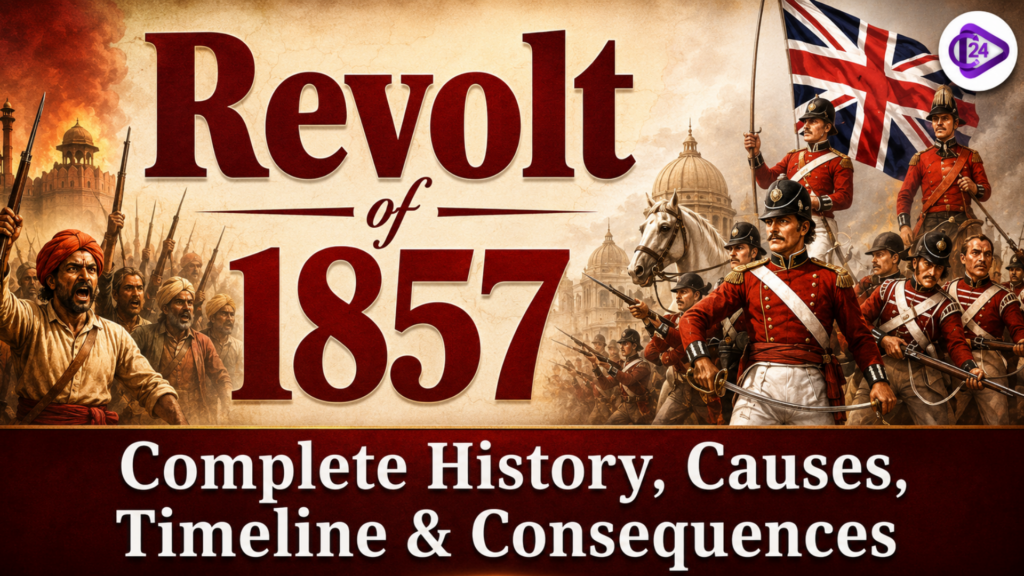
The Revolt of 1857 was the first war for independence against the establishment of the British East India Company and hence one of the turning points in Indian history. The uprising started on 10 May 1857 at Meerut and in no time extended to Delhi, Kanpur, Lucknow, Jhansi, Bareilly and beyond. With significant leaders like Rani Lakshmibai, Bahadur Shah Zafar, Nana Sahib, Tantia Tope and Bhadar Hazrat Mahal, it had a political, economic, military, and social agenda behind it.
While the revolt was finally quelled, it brought about an end to Company rule and transferred the administration of India directly to the British Crown under the Government of India Act, 1858; its effects complement and inform portions of India’s ongoing nationalist movement.
Major Causes of the Revolt of 1857
The Revolt of 1857 was triggered by various factors, political, economic, military, social and religious. Anger had been fanned by the annexation of Indian states through the Doctrine of Lapse, heavy taxation and exploitative policies against peasants and artisans along with collapsing traditional industries. Sepoys also endured discrimination in pay, promotions and service conditions. The immediate cause was the introduction of the greased cartridges used for Enfield rifles, and it was alleged that these were smeared with cow and pig fat which offended both Hindu and Muslim troops. Such widespread grievances finally culminated in the emergence of the Revolt of 1857, when on 10 May 1857 at Meerut it gave way.
How British Expansion Triggered the Revolt of 1857?
- In 1600, the East India Company received a royal charter from Queen Elizabeth I to trade in the East Indies.
- The Company started with trade by establishing factories at Surat, Madras, and Calcutta.
- The political domination of the Company started after Plassey (1757), when Robert Clive defeated Siraj-ud-Daulah and conquered Bengal.
- The British had gone on to win the Battle of Buxar (1764) against the combined forces of Mir Qasim, Shuja-ud-Daulah and Shah Alam II, cementing their power.
- In 1765, the Company acquired the Diwani Rights of Bengal, Bihar, and Odisha, which also enabled it to directly collect revenues.
- Provinces under the Company expanded through the Subsidiary Alliance of Lord Wellesley, which kept many Indian states in British hands.
- Lord Dalhousie then implemented the Doctrine of Lapse to ensure that states were annexed into British territories when rulers with no natural heirs died.
- Notable examples of the states annexed due to this policy include Satara, Jhansi, Nagpur and Sambalpur.
- The annexation of the Kingdom of Awadh(Oudh) in 1856 for alleged maladministration was resented widely.
- Peasants all over India faced aggressive land revenue demands, and exploitive economic policies impacted traditional industries and artisans.
- This swift process of territorial incrimination diminished the power of local Indian rulers, nobles and zamindars and led to a political crisis.
- Such expansionist policies became one of the chief reasons for the Revolt of 1857, since they brought in large-scale resentment against the East India Company.
Economic Causes of the Revolt of 1857
- The Exploitative Economic Causes of the Revolt of 1857 were Based on the Policies of the British East India Company. The revolt was an outburst against these exploitative policies.
- Land revenue settlements like the Permanent Settlement, Ryotwari and Mahalwari systems forced elaborate taxation on cultivators.
- With revenues extracted even during periods of crop failure, lands became mortgaged with large loans, and the peasants fell into debt.
- The industry was disrupted by cheap machine-made imports from Britain, and the market for traditional Indian handicrafts and cottage industries began to shrink.
- It ruined the Indian artisans, especially weavers, who lost their livelihoods due to British-made goods.
- India became more and more a land of raw materials, cotton, indigo, silk and opium that Britain imported to make finished goods.
- The regime of British trade incentivised an unequal economic system suctioning profits out of Indian producers to the benefit of British industries.
- The zamindars and taluqdars (landholders) lost a good portion of their estates due to harsher revenue collection policies for zamindari, changing land laws.
- Annexation of states like Awadh (1856) broke into the income estates of nobles, soldiers, officials and court dependents.
- Royal courts were also reverted causing a reduction in employment for scholars, artists, musicians and craftsmen.
- Increasing poverty, unemployment and rural distress bred dislike for British rule among other classes.
- These economic hardships combined peasants, artisans, landlords and dispossessed rulers, hence the emergence of economic exploitation being one of the major reasons for Revolt of 1857.
Major Centres of the Revolt of 1857
- Indian sepoys working for the British East India Company revolted against the company, starting on 10 May 1857 in Meerut, sparking the Revolt of 1857.
- The rise of Meerut led the rebels to march towards Delhi and to crown Bahadur Shah Zafar II as the figurehead Emperor of India.
- Bahadur Shah Zafar made Delhi the political seat of the revolt, with military assistance from Bakht Khan.
- Under the leadership of Nana Sahib, Kanpur (Cawnpore) became one of its most significant centres with support from Tantia Tope and Azimullah Khan.
- After the annexation of Awadh, fierce opposition was offered against British rule in Lucknow under Begum Hazrat Mahal.
- Under Rani Lakshmibai, Jhansi emerged as one of the more potent centres of the rebellion and her leadership in this regard was exceptionally exemplary.
- The rebel forces of Rani Lakshmibai and Tantia Tope laid siege to Gwalior, but it was retaken by the British.
- Khan Bahadur Khan led the resistance at Bareilly and organised uprisings across the Rohilkhand region.
- Under the oldest and one of the most respected leaders of the revolt, Kunwar Singh, Bihar (Jagdishpur) also emerged as an important centre.
- At Faizabad, under the leadership of Maulvi Ahmadullah Shah, brave resistance was organised, and people came forward to join this moment.
- The revolt was not nationwide, and even at its height, the British still retained central control of most of India, including Punjab, Bengal, Bombay and Madras.
- Because of the mass level involvement of soldiers, nobles, peasants, and common civilians alike in these centres, they became an integral part of the history of the Revolt of 1857.
Suppression of the Revolt of 1857
The British East India Company brought reinforcements from Britain, Punjab, and Nepal to gradually crush the Revolt of 1857. One by one, the centres of the commotion were taken back militarily. By the middle of 1858, most of the revolt had been suppressed, and British rule over northern and central India was reestablished. The end of the Company rule spelt the end of the revolt and ushered in direct British Crown administration through the Government of India Act, 1858.
| Centre | Leader(s) | British Official(s) | British Action | Outcome |
| Meerut | Revolting Sepoys | Major General William Hewitt | British troops regained control shortly after the uprising. | Revolt suppressed; British authority restored. |
| Delhi | Bahadur Shah Zafar II, Bakht Khan | General Archdale Wilson, John Nicholson, William Hodson | Delhi was recaptured in September 1857 after a prolonged siege. | Bahadur Shah Zafar was exiled to Rangoon; Delhi came under British control. |
| Kanpur (Cawnpore) | Nana Sahib, Tantia Tope | Sir Colin Campbell, Henry Havelock | British forces recaptured Kanpur after heavy fighting. | Nana Sahib disappeared; British reoccupied the city. |
| Lucknow | Begum Hazrat Mahal | Sir Colin Campbell, James Outram, Henry Havelock | British launched a prolonged campaign and recaptured Lucknow in 1858. | Rebel resistance ended; Awadh returned to British control. |
| Jhansi | Rani Lakshmibai | Sir Hugh Rose | Sir Hugh Rose captured Jhansi after fierce fighting. | Rani Lakshmibai died in battle in June 1858. |
| Gwalior | Rani Lakshmibai, Tantia Tope | Sir Hugh Rose | British troops recaptured Gwalior from the rebels. | Tantia Tope escaped temporarily; British restored control. |
| Bareilly | Khan Bahadur Khan | Sir Colin Campbell | British forces defeated rebel troops and regained the city. | Rebel leadership collapsed in Rohilkhand. |
| Jagdishpur (Bihar) | Kunwar Singh | Brigadier Douglas, Sir Edward Lugard | The British pursued rebel forces and gradually regained control of the region. | Kunwar Singh died in 1858; the rebellion was eventually suppressed. |
Lodhi Dynasty (1451–1526): History, Rulers, Administration, Art & Architecture
Causes of the Failure of the Revolt of 1857
- The Revolt of 1857 was unsuccessful since there was no national movement or a common organisation to lead one across India.
- Most of it was limited to North and Central India, and large areas of Punjab, Bengal, Bombay, Madras, and Southern India were just unaffected.
- The rebels had no unified goal, as various factions battled for political and regional interests.
- It had no leadership, which made coordinating between the different centres of power challenging.
- So, rather than with the rebels, many Indian rulers (Patiala, Hyderabad, Gwalior (Scindia); Kashmir, Nepal) lent their support to the British.
- The British had a more professional and well-organised army, with skilled generals to command them.
- The use of the more advanced artillery and military technology gave the British force a considerable advantage against the rebels.
- Assistance was provided by the British through effective use of railways, telegraph and postal communications to transport troops efficiently as well as to coordinate military operations.
- Rebels struggled with chronic shortages of arms, ammunition, food and money in drawn-out battles.
- Not all elements of the peasantry, not all merchants and certainly not some educated Indians took part uniformly across the country.
- British reinforcements poured in from Britain, Punjab and Nepal.
- The rebel assumed suffered from internal divisions, bad planning and no long-term leadership.
- The Uprising was defeated by the British in 1858, who were able to recover control of all major centres of the revolt.