

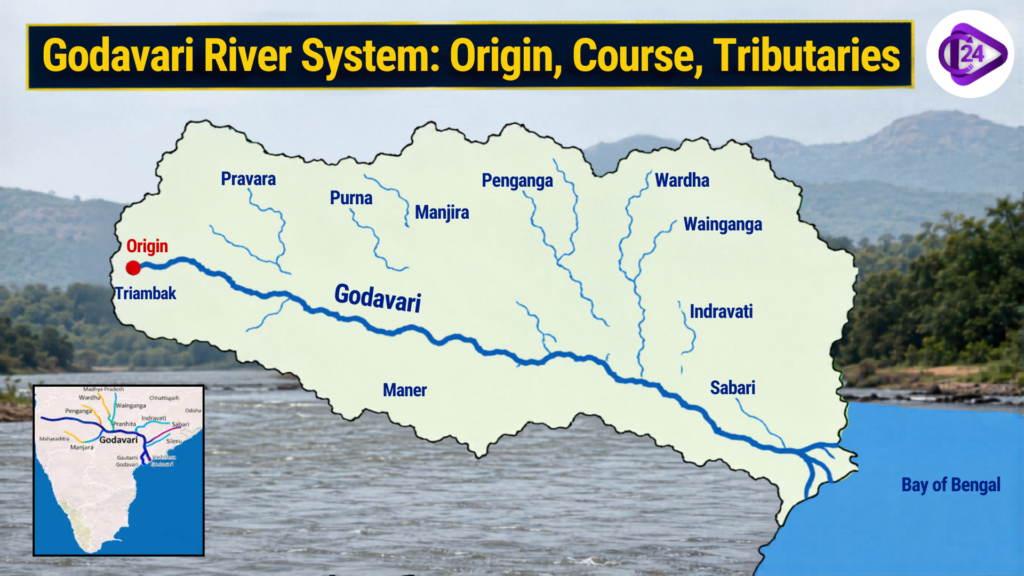
The Godavari River System, popularly known as the “Dakshina Ganga” or “Southern Ganges”, is the second-longest river in India, covering a distance of nearly 1,465 km. The river originates from Trimbakeshwar in the Western Ghats of Maharashtra and flows eastward across the Deccan Plateau before draining into the Bay of Bengal. Near Rajahmundry, the Godavari forms a large and fertile delta with several distributaries that support extensive agriculture and irrigation activities. The river holds great religious significance in Hinduism and is associated with many pilgrimage centres. Festivals such as the Pushkaram attract thousands of devotees who take holy dips in the river for spiritual purification.
About Godavari River System
The Godavari River System is the second-longest river system in India after the Ganga and forms one of the country’s largest drainage basins, covering around 10% of India’s total geographical area. It flows for about 1,465 km in an eastward direction. The river passes through several states, including Maharashtra (about 48.7%), Andhra Pradesh (around 23.7%), Chhattisgarh (12.4%), Odisha (5.7%), Madhya Pradesh (7.8%), Karnataka (1.4%), and a very small portion of the Union Territory of Puducherry (0.01%).
Origin of Godavari River
The Godavari River System originates in the Western Ghats of Maharashtra, near the Brahmagiri Hills in Trimbakeshwar, close to Nashik. From its source, the river travels across peninsular India and ultimately drains into the Bay of Bengal through a wide network of distributaries, forming a large delta.
Its drainage basin is one of the largest in India, covering about 312,812 square kilometres. Only the basins of the Ganga and Indus rivers are larger in the Indian subcontinent.
The basin is naturally enclosed by several geographical features. To the north lie the Mahadeo and Satmala Hills, while the Ajanta Range forms the northwestern boundary. The Western Ghats (North Sahyadri range) define its western edge. On the eastern and southeastern sides, the Eastern Ghats act as a natural boundary, and the Balaghat Range lies to the south.
The interior region of the basin is mainly part of the Maharashtra Plateau, which generally ranges between 300 and 600 metres in elevation and slopes gently towards the east. In the eastern portion, the landscape is dominated by the Dandakaranya region, while the Eastern Ghats form the prominent eastern boundary of the peninsula.
Course of Godavari River System
The Godavari Basin, also known as Vridha Ganga (Old Ganga), extends across Maharashtra, Andhra Pradesh, Chhattisgarh, and Odisha, along with parts of Madhya Pradesh, Karnataka, and the Union Territory of Puducherry (Yanam).
The basin is naturally bounded by:
- North: Satmala Hills, Ajanta Range, and Mahadeo Hills
- West: Western Ghats
- East and South: Eastern Ghats
Rajahmundry is the largest city located on the banks of the Godavari River.
The Sri Ram Sagar Project (1964–69) is built on this river and supports irrigation in districts such as:
- Adilabad
- Nizamabad
- Karimnagar
- Warangal
Downstream of Rajahmundry, the river splits into two main distributaries:
- Gautami Godavari (East)
- Vashishta Godavari (West)
These distributaries form a large and fertile delta before the river meets the Bay of Bengal.
The Godavari delta is a lobate-type delta, characterised by a rounded shape and multiple branching distributaries.
Tributaries of Godavari River
| Left Bank Tributaries | Right Bank Tributaries |
| Dharna | Pravara |
| Penganga | Mula |
| Wainganga | Manjra |
| Wardha | Peddavagu |
| Pranahita (formed by Penganga, Wardha, Wainganga) | Maner |
| Pench | |
| Kanhan | |
| Sabari | |
| Indravati |
Godavari River Left Bank Tributaries
Painganga River
- Originates in the Ajanta Ranges of Aurangabad district, Maharashtra.
- Flows through Buldhana and Washim districts.
- Moves along the border of Maharashtra and Andhra Pradesh.
Wardha River
- One of the major rivers of the Vidarbha region in Maharashtra.
- Originates in the Satpura Range near Multai (Betul district, Madhya Pradesh).
- Enters Maharashtra and flows southward.
- Joins the Wainganga River to form the Pranhita River, which later merges with the Godavari.
Wainganga River
- Meaning of name: “Arrow of water”.
- Originates from the Mahadeo Hills of the Satpura Range (Madhya Pradesh).
- Flows through Madhya Pradesh and Maharashtra in a southern direction.
- After merging with the Wardha River, forms the Pranhita River, which finally joins the Godavari.
- Drains important districts of Maharashtra including:
- Chandrapur
- Gadchiroli
- Bhandara
- Gondia
- Nagpur
Right Bank Tributaries of Godavari River
Manjra River
The Manjra River, also known as the Manjira River, is one of the major right-bank tributaries of the Godavari River. The river originates in the Balaghat Range near Ahmednagar at an elevation of about 823 metres above sea level. From its source, it flows across the states of Maharashtra, Karnataka, and Telangana before joining the Godavari River.
The Manjra River passes through important regions such as the Latur District in Maharashtra and the Bidar District in Karnataka. It serves as an important source of water for irrigation, agriculture, and drinking purposes in several districts. The river basin also supports many tributaries, including the Terna, Tawarja, and Lendi rivers.
A major irrigation project on this river is the Nizam Sagar Dam, which was constructed across the Manjra River between Achampet and Banjapalle villages. Built during the rule of Mir Osman Ali Khan, the seventh Nizam of Hyderabad, the dam began construction in 1923 and was completed in 1931. It is considered one of the oldest and most significant dams in Telangana, providing irrigation and drinking water facilities to nearby regions.
Godavari River System Projects
The Godavari River system includes several important irrigation and hydroelectric projects in Maharashtra. Among them, the Upper Indravati Hydroelectric Project is one of the largest hydropower projects associated with the river basin, with an installed capacity of 600 MW. The project diverts water from the Indravati River, a tributary of the Godavari, toward the Mahanadi basin to support electricity generation and irrigation activities.
| Category | Project / Scheme | Description |
| Completed Projects | Godavari Canal Irrigation Project | A major irrigation system developed to utilize the waters of the Godavari River for agricultural activities and regional water supply. |
| Upper Penganga Project | Constructed to support irrigation and water conservation in the Penganga sub-basin of the Godavari River system. | |
| Jayakwadi Dam | One of the largest earthen dams in Maharashtra, built across the Godavari River to provide irrigation, drinking water, and industrial supply. | |
| Upper Wainganga Project | Developed to improve irrigation facilities and manage water resources in the Wainganga basin. | |
| Upper Indravati Hydroelectric Project | A 600 MW hydropower project that diverts water from the Indravati River basin toward the Mahanadi basin for electricity generation and irrigation. | |
| Upper Wardha Project | A multipurpose irrigation and water management project constructed on the Wardha River system. | |
| Ongoing Projects | Pranahita-Chevella Project | A large-scale lift irrigation scheme intended to supply water for irrigation and drinking purposes in Telangana. |
| Polavaram Project | A national multipurpose irrigation project on the Godavari River aimed at irrigation, hydropower generation, and flood control. | |
| River Linking Project | Godavari–Cauvery River Linking Project | A proposed inter-basin water transfer project designed to move surplus water from the Godavari basin to water-deficient southern river basins. |
| Main Components | Godavari–Krishna–Pennar–Cauvery Link | The project consists of three major links: Godavari (Inchampalli/Janampet) to Krishna (Nagarjuna Sagar), Krishna to Pennar (Somasila), and Pennar to Cauvery. |
| Method of Transfer | Water Diversion System | Water from the Godavari basin will be lifted to the Nagarjuna Sagar reservoir and then directed southward to meet the water requirements of the Krishna, Pennar, and Cauvery river basins. |
| Irrigation Benefits | Agricultural Development | The scheme is expected to provide irrigation facilities to nearly 345,000–504,000 hectares of agricultural land in the Prakasam, Nellore, Krishna, Guntur, and Chittoor districts of Andhra Pradesh. |
Godavari River System Flora and Fauna
| Ecosystem / Sanctuary | Location | Importance |
| Godavari River Basin | Central and Southern India | The Godavari River basin supports rich biodiversity and diverse ecosystems. It is home to several species of flora and fauna, including aquatic life, migratory birds, reptiles, and endangered marine species. |
| Olive Ridley Sea Turtle | Krishna–Godavari coastal basin | The Krishna–Godavari basin serves as an important nesting and breeding ground for the vulnerable olive ridley sea turtle, contributing significantly to marine biodiversity conservation. |
| Fringed-lipped Carp | Godavari River system | This freshwater fish species is commonly found in the Godavari basin and plays an important role in the river ecosystem. |
| Coringa Mangrove Forest | Near the Godavari delta | The Coringa mangrove forests are the third-largest mangrove ecosystem in India. They support a wide range of fish, crustaceans, and bird species while also acting as a natural barrier against cyclones and coastal erosion. |
| Coringa Wildlife Sanctuary | East Godavari district | The sanctuary is well known for its mangroves, reptiles, estuarine crocodiles, fishing cats, and migratory birds. It forms an important part of the Godavari delta ecosystem. |
| Jayakwadi Bird Sanctuary | Nath Sagar Reservoir | This sanctuary provides shelter to numerous migratory and resident bird species. The islands within the Nath Sagar Reservoir serve as ideal nesting and breeding habitats for birds. |
| Nandur Madhmeshwar Bird Sanctuary | Near Nashik | Popularly known as the “Bharatpur of Maharashtra,” this sanctuary is famous for its rich wetland ecosystem and diverse bird population, including migratory waterfowl and endangered species. |
UPSC Civil Services PYQs on Godavari River System
| Question No. | Question | Options / Type | Answer |
| 1 | Consider the following rivers: 1. Vamsadhara 2. Indravati 3. Pranahita 4. Pennar Which of the above are tributaries of the Godavari? (UPSC Prelims 2015) | (a) 1, 2 and 3 (b) 2, 3 and 4 (c) 1, 2 and 4 (d) 2 and 3 only | (d) 2 and 3 only |
| 2 | Which river is referred to as the “Dakshina Ganga” because of its importance in Peninsular India? (UPSC Prelims 2018) | (a) Krishna (b) Kaveri (c) Godavari (d) Mahanadi | (c) Godavari |
| 3 | “Evaluate the impact of river systems on regional agriculture and economy, with special reference to the Godavari River.” (UPSC Mains 2020) | Descriptive / Essay Type | Analytical answer required |
Conclusion on Godavari River System
The Godavari River Basin is among the most significant river systems in the country, contributing greatly to agriculture, irrigation, hydroelectric power, and economic growth. Spreading across multiple states, the basin supports a large population by providing water for farming, industries, and domestic use. It is also environmentally important because it includes wetlands, mangrove forests, and wildlife habitats that preserve ecological diversity. As highlighted by the Central Water Commission, the Godavari basin plays a major role in flood management, water conservation, and the sustainable development of Peninsular India.