

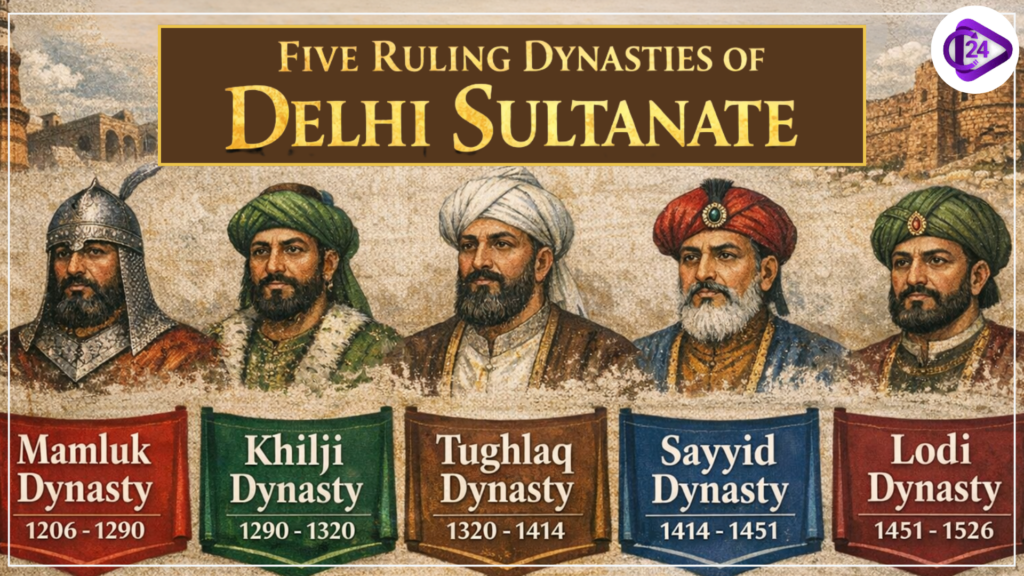
Delhi Sultanate was one of the periods in Indian history characterised by the governance of five strong dynasties that contributed to the politics, culture, and government of medieval India. It was founded in the early 13th century and formed the basis of centralised rule and implemented novel structures in the military and taxation. The five ruling dynasties, Mamluk, Khilji, Tughlaq, Sayyid, and Lodi, each had their share, both in the expansion of territories and in the development of architecture. They had a stable and a challenging reign, which shaped the social and cultural history of the subcontinent. The knowledge of these dynasties aids in the comprehension of the development of governance in the pre-Mughal era.
Overview Delhi Sultanate
- Delhi Sultanate originated in 1206 AD during the reign of Qutb-ud-din Aibak.
- It lasted until 1526 AD, when the Lodi dynasty was defeated by Babur.
- Five major dynasties governed the Sultanate, including Mamluk, Khilji, Tughlaq, Sayyid, and Lodi.
- It developed a powerful centralised government in India during the Middle Ages.
- The leaders brought about effective mechanisms of taxation and armed structures.
- This is the period when Delhi turned into a significant political and economic center.
- The Sultanate encouraged commerce, metropolises, and assimilation.
- It saw the construction of important monuments and architecture.
- This era was instrumental in developing the culture of Indo-Islam.
- It was the basis of the emergence of the Mughal Empire in India.
Five Ruling Dynasties of Delhi Sultanate
Learn about the five dynasties of the Delhi Sultanate and their contribution to modern India.
Mamluk or Slave Dynasty (1206 – 1290 AD)
The Mamluk (Slave) Dynasty (1206–1290 AD) was founded by a former slave, Qutb-ud-din Aibak, who became the first Sultan of Delhi. He was the founder of the Delhi Sultanate, and he is known to have started the Qutub Minar in Delhi, which is one of the most iconic monuments in India, a symbol of Indo-Islamic architecture.
Khilji Dynasty (1290 – 1320 AD)
- Period of Rule: 1290–1320 AD
- Founder: Jalal-ud-din Khilji
- Last Ruler: Qutb-ud-din Mubarak Shah Khilji.
- Military conquests were used to extend the Delhi Sultanate.
- Market reforms, price control, and revenue administration.
- Had a powerful and well-trained army.
- The Alai Darwaza was built in the Qutb complex in Delhi.
- Sugarcane arts, literature, and Indo-Islamic culture were encouraged.
- Established a basis of greater centralisation of power in the Sultanate.
Tughlaq Dynasty (1320 – 1412 AD)
- Dynasty Administration: 1255-1326.
- Period of Rule: 1320–1412 AD
- Founder: Ghiyas-ud-din Tughlaq
- Last Ruler: Nasir-ud-din Mahmud Tughlaq.
- Famous throughout the expansion of the Delhi Sultanate in northern and central India.
- Improved new administrative and revenue reforms.
- Constructed such cities as Tughlaqabad and fortified their strengths.
- Indo-Islamic architecture promoted tombs and forts.
- Experienced domestic unrest and local unrest.
- Heritage: Sophisticated systems of government, army systems, and grand architecture, which shaped succeeding sultanates in India.
Sayyids Dynasty (1412 – 1451 AD)
- Period of Rule: 1412–1451 AD
- Founder: Khizr Khan
- Last Ruler: Ala-ud-din Alam Shah.
- Accessed power following the loss of Tughlaq Dynasty.
- Maintained dominance over Delhi and the areas that surrounded it.
- Focused on political stability and not expansion.
- Encouraged administration continuity and collection mechanisms.
- Had domestic unrest and uprisings in the regions.
- Legacy: Maintained the Delhi Sultanate when it was in a weak state and established the Lodi Dynasty.
Lodi Dynasty (1451 – 1526 AD)
Lodi Dynasty, which reigned between 1451 and 1526 AD, was the successor to the Sayyad Dynasty and was established by Bahlul Lodi, an Afghan noble. The former ruler was Ibrahim Lodi, who experienced opposing internal uprisings and increasing opposition that later led to the collapse of the dynasty against Babur in the First Battle of Panipat. The Lodi rule empowered the reign of the Delhi Sultanate, a disciplined army, and led to the acquisition of more territories in the northern region of India. They have also helped in Indo-Islamic architecture, such as forts and tombs, leaving an indelible cultural and historical background before the emergence of the Mughal Empire.
List of Delhi Sultanate Rulers Chronology
| Dynasty | Founder | Last Ruler | Reign Period |
| Mamluk (Slave) Dynasty | Qutb-ud-din Aibak | Muiz-ud-din Bahram | 1206 – 1290 AD |
| Khilji Dynasty | Jalal-ud-din Khilji | Qutb-ud-din Mubarak Shah Khilji | 1290 – 1320 AD |
| Tughlaq Dynasty | Ghiyas-ud-din Tughlaq | Nasir-ud-din Mahmud Tughlaq | 1320 – 1414 AD |
| Sayyid Dynasty | Khizr Khan | Ala-ud-din Alam Shah | 1414 – 1451 AD |
| Lodi Dynasty | Bahlul Lodi | Ibrahim Lodi | 1451 – 1526 AD |
Impact of Delhi Sultanate or Arab Rule
Delhi Sultanate, which was formed in 1206 AD, was very influential in shaping the political, cultural, and social life of India. It brought in a centralised form of rule, which gave the groundwork to subsequent empires such as the Mughals. The Sultanate spread the Indo-Islamic architecture, which can be traced in the monuments such as Qutub Minar, Alai Darwaza, and Tughlaqabad Fort. Its rule led to the flourishing of trade and urbanisation, uniting India with the West and Central Asia. Military organisation and taxation systems, as well as legal administration, were also other aspects impacted by the Sultanate and incorporated Persian and Indian measures.
- Brought about a powerful centralised government and army structure.
- The spread of the Indo-Islamic culture and architecture, such as the mosques, tombs, and forts.
- Fostered urbanisation and commerce by opening India up to Central Asia and the Middle East.
- Taxation and revenue systems were reformed to make the empire stable.
- Art, literature, and education were influenced, and Persian would become the official language of administration.
- Promote cultural hybridisation, the combination of local customs and Islamic ones.
- Enforced the concept of the centralised monarchy, which in turn informed Mughal rule.
- Contributed to the formation of religious and social policies, which have impacted Indian society over the centuries.
Delhi Sultanate Architecture
Indo-Islamic architecture that was combined with the local Indian styles provided a rich architectural heritage left by the Delhi Sultanate (1206–1526 AD). The kings constructed forts, mosques, tombs, and state buildings, which demonstrated their strength, their religiosity, and their taste in art. These monuments blended practicality with beauty using red sandstone, marble, and complicated carvings. The Sultanate, too, introduced the use of arches, domes, and minarets in India, which are hallmarks of the later Mughal architecture.
- Main characteristic: Indo-Islamic blend, a mixture of Persian and Afghan components and Indian ones.
- Monuments: Tughlaqabad Fort, Firoz Shah Kotla, Alai Darwaza, Qutub Minar.
- Architectural innovation: Domes, minarets, vaulted roofs, and arches.
- The medium employed: Red sandstone, marble, and decorative stucco.
- Religious architecture: Mosques and tombs with references to Islamic ideas of architecture.
- Military barriers: Walls and fortresses.
- Legacy: The architecture and urban layout of later Mughal works were inspired by it.
- Art: Calligraphy, geometric patterns, and lattice screens (jali work).
Delhi Sultanate Administration
Delhi Sultanate (1206–1526 AD) brought in a centralised and organised form of rule in India, and this was part of later empires, such as the Mughals. The ultimate power was the Sultan, who was supported by a council of ministers. The government was concentrated on the structure of the military forces, taxation, policing, and the judiciary. Persian was declared the official language, and provincial officials were chosen. The government of the Sultanate established the basis of effective government, taxation, and political stability in medieval India.
- Sultan was the almighty ruler who had the final power to decide on the affairs of the state.
- Governors (Walis) governed provinces, collecting revenue and enforcing law and order.
- Revenue collection: Kharaj – land tax, trade taxes, and the jizya of non-Muslims.
- Military administration: Had a standing army, cavalry, and forts as a defence mechanism.
- Judiciary: Qazis (judges) imposed the use of Islamic law (Sharia) combined with local traditions.
- Officials: Diwan (finance), Amir-i-umara (chief nobles), and local officers oversaw the daily ruling.
- The Roman state language was Persian, which was used as the language of administration, culture, and record-keeping.
- Political stability and territorial control of northern India were due to centralised governance.
Conclusion – Delhi Sultanate
Delhi Sultanate(1206-1526 AD) was one of the times when Indian history changed its face and gave birth to centralised rule, the military system, and Indo-Islamic culture. Sultanate spread administration reform, revenue collection techniques, and architectural designs such as Qutub Minar and Tughlaqabad Fort through its five ruling dynasties, which included Mamluk, Khilji, Tughlaq, Sayyid, and Lodi. It encouraged trade, urban centres, and the fusion of cultures that incorporated Persian, Afghan, and Indian cultures. Despite the inner uprisings and political troubles, the heritage of the Sultanate reflected on the inner empires to come, especially those of the Mughals, whose legacy remains important in the way India was governed and in art, architecture, and society, which continue to exist centuries later.