
Daily Quizzes
Mock Tests
No tests attempted yet.
Select Category
Presidents and Prime Ministers in the news

Enquire Now
Presidents and Prime Ministers in the news is one of the most frequently asked static-cum-current GK topics across SSC, Railway, Banking, and state-level competitive exams. Every year, exam papers include at least one or two questions asking candidates to match a country with its current head of state or head of government.
Since world leaders keep changing due to elections, resignations, or coups, this topic demands regular updates rather than one-time memorisation. This guide covers presidents and prime ministers in the news from India, neighbouring countries, and major world powers in a simple, exam-ready format.
What Does "Presidents and Prime Ministers in the News" Mean?
Presidents and Prime Ministers in the news refers to world leaders who are currently active or have recently taken office, making them relevant for current affairs sections of exams. This topic blends static GK with recent developments.
Exams generally test two types of questions on this topic:
- Who is the current President/Prime Minister of a given country
- Which leader recently took office, replacing whom
Why Presidents and Prime Ministers in the News Matter for Exams
Presidents and Prime Ministers in the news form a core part of the General Knowledge and Current Affairs sections in almost every government exam, from SSC CGL to Railway NTPC and banking exams.
Recruiters test this topic because it shows whether a candidate stays updated with global events, not just Indian affairs. A single leadership change abroad can generate multiple exam questions, making it essential to track this topic month by month rather than cramming it just before the exam.
India: President and Prime Minister in the News
Before looking at other nations, candidates preparing for presidents and prime ministers in the news must be absolutely clear about India's own top constitutional positions, as this is asked in almost every exam.
| Post | Name |
|---|---|
| President of India | Droupadi Murmu |
| Prime Minister of India | Narendra Modi |
| Vice President of India | Refer to latest official notification |
Neighbouring Countries: Presidents and Prime Ministers in the News
India's neighbouring countries frequently make headlines due to political changes, and this section of presidents and prime ministers in the news is a favourite among exam setters for SSC and state-level papers.
| Country | President | Prime Minister |
|---|---|---|
| Pakistan | Asif Ali Zardari | Shehbaz Sharif |
| Nepal | Ram Chandra Poudel | Balendra Shah |
| Bangladesh | Mohammed Shahabuddin | Tarique Rahman |
| Sri Lanka | Anura Kumara Dissanayake | T. B. Sarath |
| Maldives | Mohamed Muizzu | — (Presidential system) |
| Bhutan | (Constitutional Monarchy) | Refer to latest official notification |
| Myanmar | Min Aung Hlaing (Acting) | — |
| Afghanistan | (Taliban-led interim government) | Hasan Akhund (Acting) |
Major World Powers: Presidents and Prime Ministers in the News
Global powers such as the USA, Russia, China, and major European nations are consistently in the news, making this list of presidents and prime ministers essential for banking and SSC current affairs sections.
| Country | Head of State/Government |
|---|---|
| United States of America | President Donald Trump |
| United Kingdom | Prime Minister Keir Starmer |
| Russia | President Vladimir Putin |
| China | President Xi Jinping |
| France | President Emmanuel Macron |
| Germany | Chancellor Friedrich Merz |
| Japan | Prime Minister Sanae Takaichi |
| Italy | Prime Minister Giorgia Meloni |
| Canada | Prime Minister Mark Carney |
| Australia | Prime Minister Anthony Albanese |
| Israel | Prime Minister Benjamin Netanyahu |
| Ukraine | President Volodymyr Zelenskyy |
Recently Changed Presidents and Prime Ministers in the News
Recently changed presidents and prime ministers in the news are the most exam-sensitive part of this topic since question setters prefer testing fresh changes over long-standing leaders.
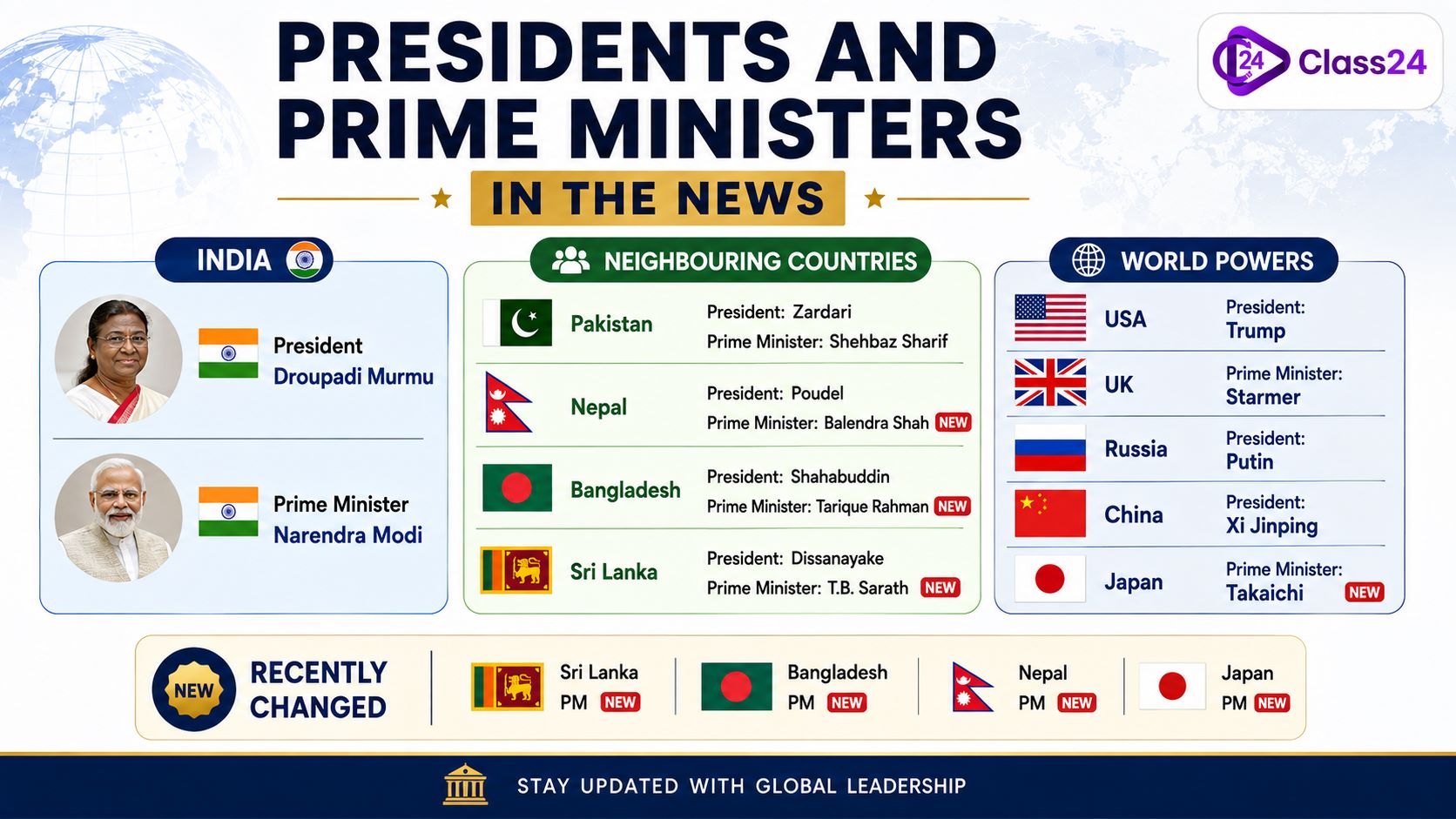
- Sri Lanka: T. B. Sarath became Prime Minister in April 2026, succeeding Harini Amarasuriya
- Bangladesh: Tarique Rahman became Prime Minister in February 2026 under President Mohammed Shahabuddin
- Nepal: Balendra Shah became Prime Minister in March 2026 alongside President Ram Chandra Poudel
- Japan: Sanae Takaichi became Prime Minister in October 2025, the first woman to hold the post
- Vietnam: Tô Lâm serves as President while Lê Minh Hưng became Prime Minister in April 2026
Important Points to Remember About Presidents and Prime Ministers
Certain patterns help candidates avoid common mistakes while preparing presidents and prime ministers in the news for exams, especially regarding the type of government each country follows.
- Some countries have only a President (presidential system) with no separate Prime Minister, such as the USA and Maldives
- Some countries have only a Prime Minister as the real head of government, with a ceremonial President, such as India and Germany
- Monarchies like Bhutan and Saudi Arabia have Kings alongside elected or appointed Prime Ministers
- Leadership positions can change quickly due to elections, resignations, or political instability, so always verify from the latest source before the exam
How to Prepare Presidents and Prime Ministers in the News for Exams
A focused approach towards presidents and prime ministers in the news helps candidates retain names accurately instead of getting confused between similar-sounding countries and leaders.
- Make a monthly one-page list instead of trying to memorise everything at once
- Focus first on India and neighbouring countries, as they carry higher weightage
- Follow reliable current affairs sources weekly rather than reading once before the exam
- Revise using flashcards pairing country name with leader name
- Practise previous year questions to understand the exact pattern used by exam setters
Presidents and Prime Ministers in the News: Quick Revision Table
This quick revision table summarises the most exam-relevant presidents and prime ministers in the news, combining India, neighbouring countries, and world powers for fast last-minute recall.
| Region | Country | Leader(s) |
|---|---|---|
| India | India | President Droupadi Murmu, PM Narendra Modi |
| Neighbour | Pakistan | President Zardari, PM Shehbaz Sharif |
| Neighbour | Nepal | President Poudel, PM Balendra Shah |
| Neighbour | Bangladesh | President Shahabuddin, PM Tarique Rahman |
| Neighbour | Sri Lanka | President Dissanayake, PM T. B. Sarath |
| World Power | USA | President Donald Trump |
| World Power | Russia | President Vladimir Putin |
| World Power | China | President Xi Jinping |
| World Power | UK | PM Keir Starmer |
| World Power | Japan | PM Sanae Takaichi |
Conclusion
Presidents and Prime Ministers in the news will always remain a scoring topic if approached with regular updates rather than last-minute memorisation. Start with India and neighbouring countries since they carry the highest weightage, then move on to major world powers and recent leadership changes. With consistent monthly revision, this topic can become one of the easiest scoring areas in your current affairs preparation.
| Important Links | |
|---|---|
| current affairs | monthly current affairs |
| Nepal Prime Minister | Pakistan current affairs |
| India–Sri Lanka relations | India–UAE relations |
| BIMSTEC Summit | President Droupadi Murmu |
Frequently Asked Questions