
Daily Quizzes
Mock Tests
No tests attempted yet.
Select Category
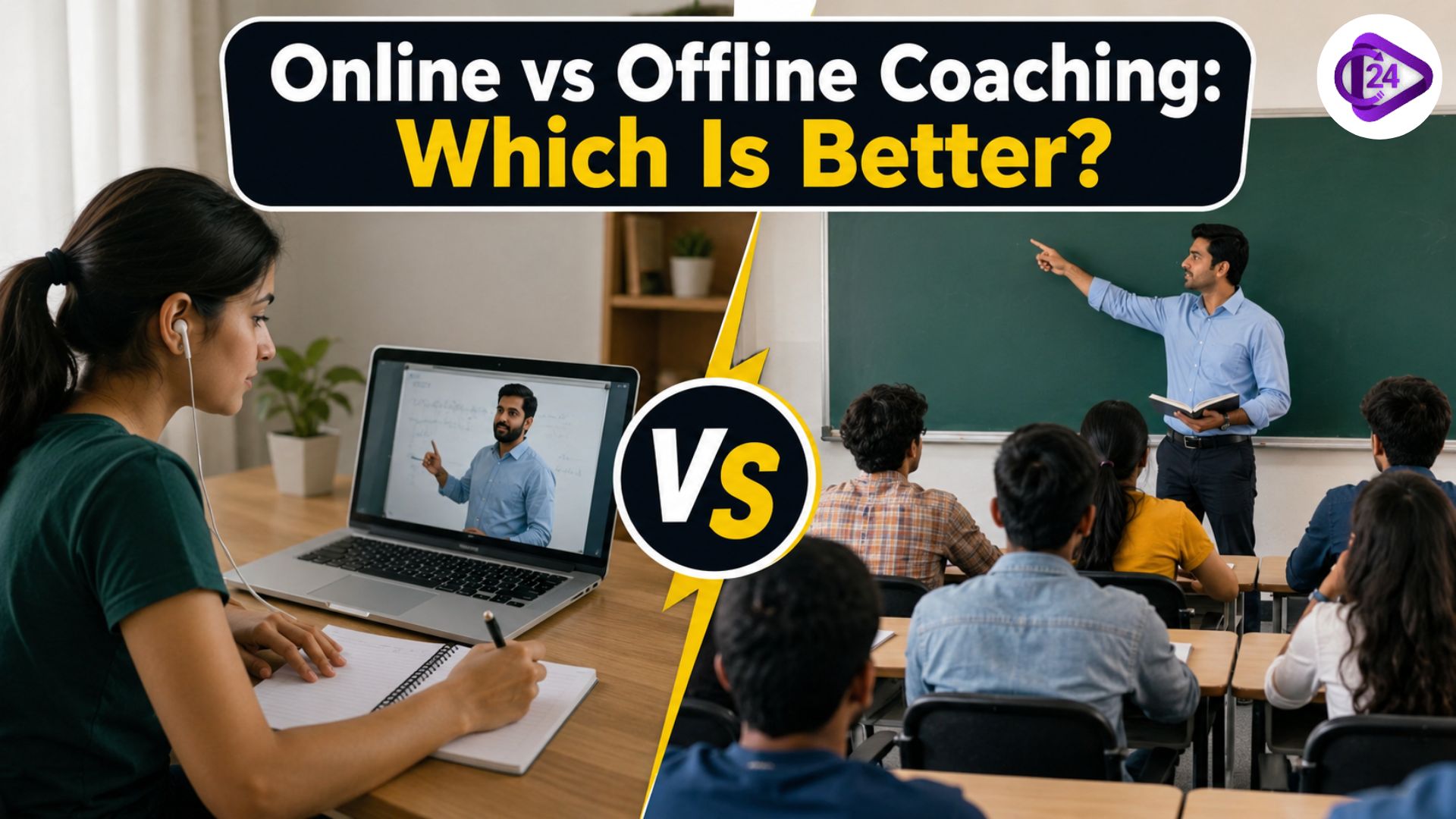
Online vs Offline Coaching: Which Is Better?

Enquire Now
Online vs Offline Coaching: One of the most critical choices that a student has to make today is whether to opt for online coaching or offline coaching. The current trend of e-learning platforms and the surge of distance learning has opened up numerous opportunities for students. But which mode of action has better effects? From cost and flexibility to results and interaction, we've got you covered in this all-encompassing guide to help you decide for your objectives.
Everyone from students taking JEE, NEET, UPSC, and board exams will be better off knowing the difference between online and offline coaching because it will save a lot of time, money, and stress!
What Is Online Coaching?
Online coaching is instruction conducted via a computer, through Zoom, Google Meet, or other ed-tech apps. Students enjoy live lectures, recorded lectures, access to study materials and mock tests – all from the comfort of their homes. Top platforms such as BYJU'S, Unacademy, Vedantu and Physics Wallah have rendered study possible for millions of students across the country, including those from rural and semi-urban areas in India.
Key Features of Online Coaching
- Self-paced learning: Study at your own pace, and review recorded lectures at any time.
- Interactive sessions: Clear up doubts live with video communication.
- Payments which are not expensive: No travel, hostel, or commute costs
- Digital study material: E-notes, PDFs and video material available 24/7.
- No need to relocate to get access to the best faculty: Rural students can get access from anywhere.
What Is Offline Coaching?
Offline coaching (also called classroom coaching) occurs in a coaching institute that is held physically and students come to attend classes physically. It is the normal approach that is adopted by institutes like Aakash, Allen, Resonance and Career Launcher. Students are on a set schedule, have classroom-based learning and are face-to-face with teachers.
Key Features of Offline Coaching
- Structured environment: Discipline is automatic with a fixed timetable
- Intervention 1: Direct teacher interaction, instant doubt solving in the classroom.Intervention 1: Direct teacher interaction, instant doubt solving in the classroom.
- Peer learning: students are motivated in a competitive atmosphere
- Printed study material: Good-quality books and practice sheets
- Research: Carrying out research of their own choosing.Writing: Writing of their own design.
Online Coaching vs Offline Coaching: Key Differences
Here is a side-by-side comparison to help you understand both modes clearly:
| Feature | Online Coaching | Offline Coaching |
|---|---|---|
| Accessibility | Anywhere with internet | Fixed location only |
| Cost | Generally affordable | Higher fees + commute |
| Flexibility | Self-paced & scheduled | Fixed time slots |
| Interaction | Chat/video-based | Face-to-face direct |
| Study Material | Digital notes, recordings | Printed material |
| Doubt Clearing | Asynchronous/delayed | Instant in class |
| Self-Discipline | High discipline needed | Structured environment |
| Best For | Working students, remote areas | Younger students, structure-seekers |
Online vs Offline Coaching Fees Comparison
| Expense Category | Online Coaching (₹/year) | Offline Coaching (₹/year) |
|---|---|---|
| Coaching / Tuition Fees | ₹5,000 – ₹30,000 | ₹40,000 – ₹1,20,000 |
| Study Material / Books | ₹0 – ₹2,000 (Digital) | ₹5,000 – ₹15,000 |
| Hostel / Accommodation | ₹0 | ₹40,000 – ₹80,000 |
| Daily Travel / Commute | ₹0 | ₹6,000 – ₹18,000 |
| Test Series / Mock Tests | ₹500 – ₹3,000 | ₹3,000 – ₹10,000 |
| Device / Internet Cost | ₹3,000 – ₹6,000 | ₹0 |
| Total Estimated Cost | ₹8,500 – ₹41,000 | ₹94,000 – ₹2,43,000 |
Advantages of Online Coaching
1. Cost-Effective Education
There are many benefits of online coaching, and one of the greatest is that it is affordable. Students save on the cost of coaching, commuting, hostel, and relocation. There are many platforms providing free content and reasonable subscription packages, thereby making quality education accessible to students irrespective of their economic classes.
2. Accessibility for Rural Students
Students can now access the best faculty on the e-learning platform without having to move to the big cities without any trouble through tier-2, tier-3 cities and rural areas. This has contributed to the democratization of education in India to a great extent.
3. Flexible Schedule
Distance learning provides an opportunity for students to manage their studies along with other obligations. Online study is especially useful for the working professional, school students and those with health restrictions.
4. Recorded Lectures & Revision
Along with offline classes, online coaching will enable students to review recorded classes several times. Especially helpful in revision periods prior to exams, to reinforce ideas.
5. Wide Variety of Courses
Students can access an array of thousands of courses on one platform, ranging from academic coaching to skill development. The diversity of online coaching is much greater than any one coaching institute can provide.
Advantages of Offline Coaching
1. Real-Time Doubt Solving
In a traditional classroom setting, students can address their questions immediately and receive explanations from the faculty in person. The immediacy of interaction is a quality that a lot of online coaching can't get.
2. Structured Learning Environment
A coaching institute has a strict schedule, testing and attendance rules. This is a natural way to develop discipline, particularly for younger children who may not be self-motivated in an online environment.
3. Peer Competition & Motivation
When studying with fellow serious students, there is a natural competitive environment. May be able to motivate students to do better through peer learning and healthy competition, which is not easy to achieve in a non-interactive online setting.
4. Better for Young Students
The offline coaching structure is more beneficial for students in classes 6–10. It is easier to focus and there is less distraction when the teacher is directly involved in supervision.
5. Consistent Mentorship
Many of the teachers at offline coaching centers know their students personally, monitor them closely and offer personalized advice that is often not available in online coaching centers.
Disadvantages: Online vs Offline Coaching
Disadvantages of Online Coaching
- Needs self-discipline: If there is no structure, there is a high risk of procrastination.
- Internet dependency: Learning is compromised in many places due to a lack of connection to the Internet.
- Long hours on screens have a negative impact on health and concentration. Screen fatigue – long screen time has a negative impact on health and concentration.
- Limited social interaction: Isolation can impact motivation over time
Disadvantages of Offline Coaching
- Higher cost: Coaching fees + travel + accommodation add up quickly
- Geographic constraint: Students in small towns do not have good institutions.
- No flexibility as regards students with other commitments (fixed schedule).
- Commute time: One to two hours/day lost on commuting to school could have been spent studying
Which Is Better for Competitive Exams?
Online vs Offline Coaching for JEE / NEET
In the case of highly competitive exams like JEE and NEET, both the modes have produced toppers. But the set of test series is the most important, along with the quality of the doubt clearing and faculty expertise. Platforms such as PW, Unacademy, Aakash Online, etc. provide comprehensive online test series which are as good as offline coaching. Those who have self-discipline and are consistent with their studies consistently score these exams using online coaching.
Online vs Offline Coaching for UPSC
Many UPSC aspirants enroll in optional subject coaching offline and prepare GS syllabus and current affairs online. The ideal method to UPSC is a blended one that maximizes the benefits of face-to-face mentorship and combines the flexibility of digital materials.
Online vs Offline Coaching for Government Jobs (SSC, Banking)
In recent years, online coaching has been the leading option for SSC CGL, IBPS and bank exams. Such exams can be prepared through any of the platforms like Adda247, Testbook, Oliveboard etc which provide affordable and more targeted preparation than the local offline coaching centers.
The Rise of Hybrid Coaching: Best of Both Worlds
In 2025-2026, a new pattern is emerging which blends the classroom experience with online resources, known as Hybrid Learning. For instance, a student can take classes for 3 days a week, and practice daily tests, clear doubts and revise the lectures on the remaining days using online platforms.
This model overcomes both formats and maintains their merits. With the realization that education doesn't exist in a binary world of digital or physical, many of the best coaching institutes are now providing hybrid packages.
Online vs Offline Coaching: Which Should You Choose?
This will depend on your own learning style, objectives, location, and budget. This is a handy decision guide:
- Select Online Coaching when: You are in an isolated area, have a limited budget, need flexibility, or are self-disciplined.
- Use Offline Coaching if: You are in junior classes, prefer face-to-face interaction, need structured learning, or do not have access to the internet.
- Use Hybrid when: You need structure and flexibility and can spend time in both.
Conclusion
There is no single right answer when it comes to online coaching vs offline coaching. In both modes, they have proven to perform well when employed properly. E-learning has removed the barriers of distance and cost, and classroom learning still provides unsurpassed structure and personal mentoring.
Education in India is quickly transitioning towards hybrid learning and students who make the best of both worlds will benefit from it the most. Consider your objectives, your commitment and your available tools and resources and choose a path that suits you best.
Frequently Asked Questions