

Daily Quizzes
Mock Tests
No tests attempted yet.
Select Category
List of International Organizations and Headquarters

Enquire Now
International organizations play a vital role in maintaining global peace, economic development, public health, trade, education, environmental protection, and humanitarian assistance. These organizations bring together multiple countries to address common global challenges through cooperation, policy-making, and coordinated action. For students preparing for competitive examinations such as SSC, Banking, Railway, UPSC, State PSC, Defence, and Rajasthan Government Exams, questions related to the List of International Organizations and Headquarters are frequently asked in General Awareness and Current Affairs sections.
Understanding the headquarters, founding year, objectives, and member countries of important international organizations not only strengthens general knowledge but also improves performance in competitive exams. This article provides a comprehensive overview of the world's major international organizations, their headquarters, key functions, and importance in global governance.
What Are International Organizations?
International organizations are institutions established by multiple countries to promote cooperation in specific areas such as peace, health, finance, trade, education, environment, and security. They help member nations solve international issues through dialogue, agreements, and coordinated initiatives.
Why Are International Organizations Important?
International organizations promote collaboration among nations while addressing global challenges that cannot be solved by one country alone. Their work supports sustainable development, humanitarian aid, global health, financial stability, and peaceful international relations.
Major Functions
-
Promoting international peace
-
Supporting economic development
-
Protecting global health
-
Encouraging international trade
-
Providing humanitarian assistance
-
Promoting education and culture
-
Addressing climate change
-
Supporting financial stability
-
Protecting human rights
-
Encouraging scientific cooperation
Major International Organizations and Their Headquarters
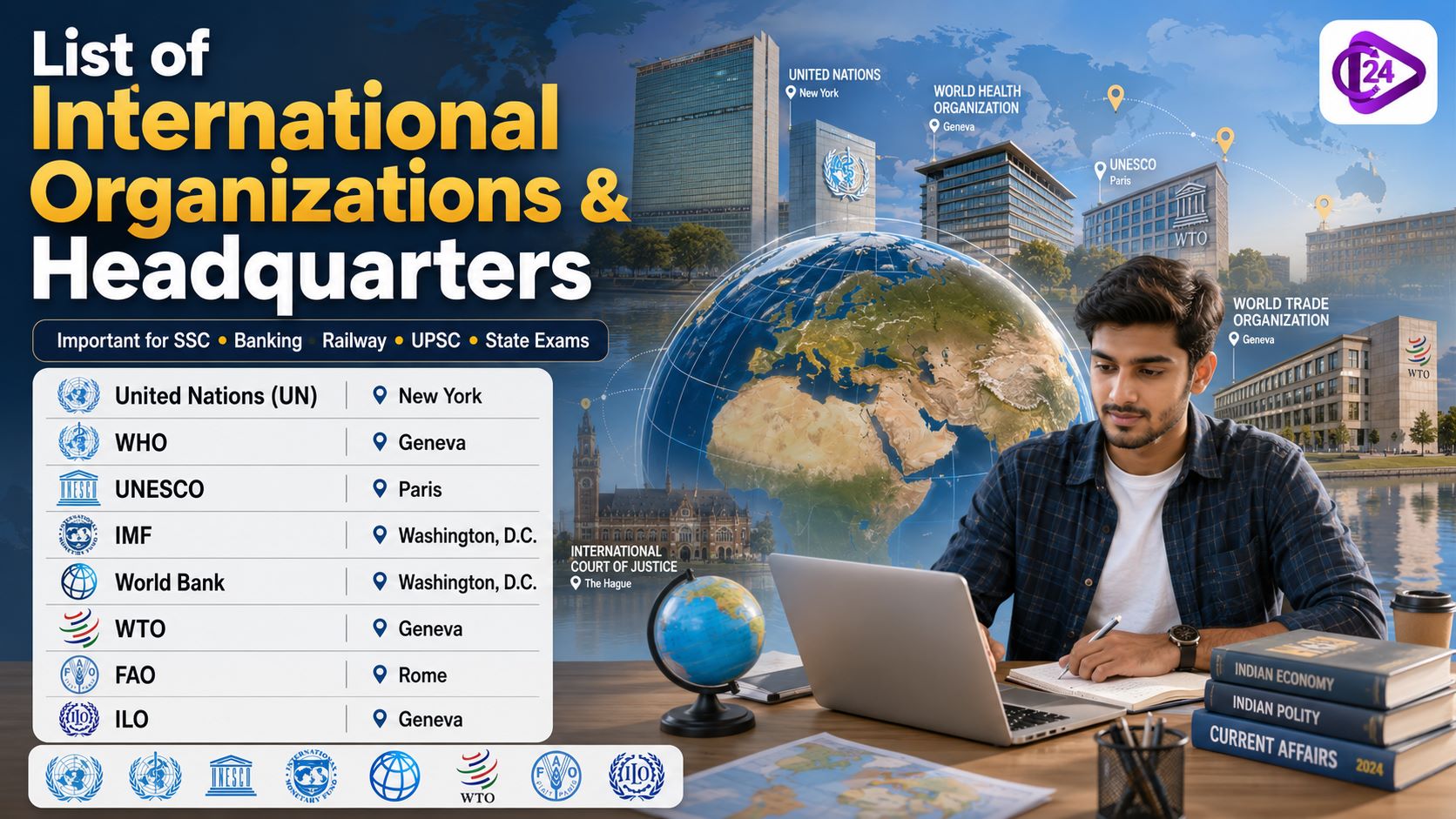
The following table includes some of the most important international organizations frequently asked in competitive examinations. Learning their headquarters and primary functions is essential for General Awareness preparation.
| Organization | Headquarters | Primary Role |
|---|---|---|
| United Nations (UN) | New York, USA | Peace and international cooperation |
| World Health Organization (WHO) | Geneva, Switzerland | Global public health |
| UNESCO | Paris, France | Education, science and culture |
| UNICEF | New York, USA | Child welfare |
| International Monetary Fund (IMF) | Washington, D.C., USA | Global financial stability |
| World Bank | Washington, D.C., USA | Development finance |
| World Trade Organization (WTO) | Geneva, Switzerland | International trade |
| Food and Agriculture Organization (FAO) | Rome, Italy | Food security and agriculture |
| International Labour Organization (ILO) | Geneva, Switzerland | Labour standards |
| International Court of Justice (ICJ) | The Hague, Netherlands | Judicial organ of the UN |
| International Atomic Energy Agency (IAEA) | Vienna, Austria | Peaceful use of nuclear energy |
| Asian Development Bank (ADB) | Manila, Philippines | Regional development |
| Asian Infrastructure Investment Bank (AIIB) | Beijing, China | Infrastructure financing |
| Organisation for Economic Co-operation and Development (OECD) | Paris, France | Economic cooperation |
| INTERPOL | Lyon, France | International police cooperation |
| OPEC | Vienna, Austria | Petroleum policies |
| NATO | Brussels, Belgium | Collective defence alliance |
| European Union (EU) | Brussels, Belgium | Political and economic union |
| BRICS | No Permanent Headquarters | Economic cooperation among member nations |
| G20 | No Permanent Headquarters | International economic cooperation |
The organizations listed above are among the most important for competitive examinations. Candidates should remember both their headquarters and primary functions because they are commonly asked in one-liner General Knowledge questions.
United Nations and Its Specialized Agencies
The United Nations (UN) is the world's largest international organization, established in 1945 to maintain international peace, security, and cooperation. Several specialized agencies work under the broader UN system in different sectors.
Important UN Agencies
-
WHO – Public Health
-
UNESCO – Education & Culture
-
UNICEF – Child Welfare
-
FAO – Food & Agriculture
-
ILO – Labour Rights
-
IMF – Monetary Cooperation
-
World Bank – Development Finance
-
ICAO – Civil Aviation
-
IMO – Maritime Safety
-
WMO – Meteorology
These agencies support countries through research, funding, technical assistance, policy guidance, and emergency response programs across different sectors.
International Financial Organizations
Financial organizations support global economic growth by providing loans, technical assistance, and policy advice to developing and developed countries. Their decisions often influence international financial markets and economic reforms.
Major Financial Institutions
-
International Monetary Fund (IMF)
-
World Bank
-
Asian Development Bank (ADB)
-
Asian Infrastructure Investment Bank (AIIB)
-
New Development Bank (NDB)
These organizations finance infrastructure projects, poverty reduction initiatives, economic reforms, disaster recovery programs, and sustainable development across member nations.
International Trade and Economic Organizations
Trade organizations promote fair international commerce and economic cooperation while reducing trade barriers among member countries.
Key Organizations
-
World Trade Organization (WTO)
-
OECD
-
G20
-
BRICS
-
OPEC
Understanding the role of these organizations helps students answer economy and international affairs questions in competitive examinations.
Tips to Remember Headquarters Easily
Learning headquarters becomes easier when students revise regularly using smart techniques instead of memorizing random facts.
Preparation Tips
-
Prepare short revision notes.
-
Use flashcards for daily revision.
-
Revise country-wise headquarters.
-
Solve previous year questions.
-
Attempt weekly GK quizzes.
-
Create mind maps.
-
Practice one-liner questions.
-
Read monthly current affairs.
Importance for Competitive Exams
Questions related to international organizations appear regularly in SSC, Banking, Railway, UPSC, Defence, Teaching, and State Government examinations. Knowing headquarters, headquarters countries, objectives, and abbreviations improves General Awareness scores significantly.
Conclusion
International organizations have transformed global cooperation by promoting peace, economic development, education, healthcare, trade, and humanitarian assistance. From the United Nations to the World Trade Organization and the International Monetary Fund, every organization serves a unique purpose in addressing worldwide challenges.
For competitive exam aspirants, preparing the List of International Organizations and Headquarters is essential because it remains one of the most frequently asked General Knowledge topics. Regular revision, practice quizzes, and understanding each organization's purpose will help candidates answer these questions accurately in the examination.
Frequently Asked Questions