

Daily Quizzes
Mock Tests
No tests attempted yet.
Select Category
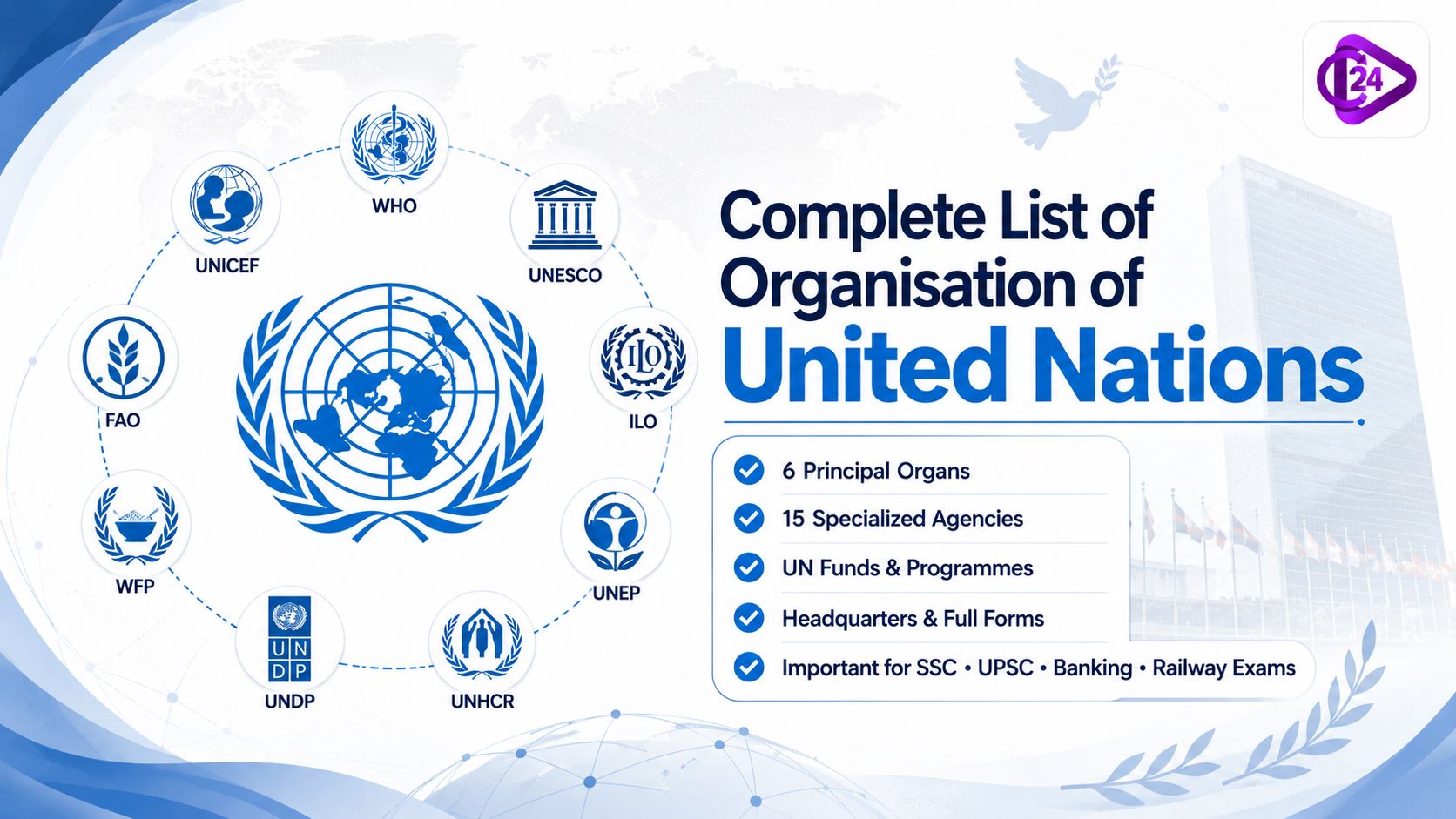
Complete List of Organisation of United Nations

Enquire Now
The Complete List of Organisation of United Nations is an important topic for candidates preparing for SSC, UPSC, RRB, Banking, Defence, State PSC, Teaching, and other competitive exams. Questions related to United Nations Organizations, UN Specialized Agencies, UN Funds and Programmes, and their Headquarters are frequently asked in General Awareness and Current Affairs sections.
The United Nations (UN) is the world's largest international organization, established to maintain international peace, promote human rights, improve global health, encourage economic development, and strengthen cooperation among nations. Today, the UN works through several specialized organizations, funds, programmes, and subsidiary bodies to address global challenges.
This article explains the Complete List of Organisation of United Nations, their full forms, headquarters, establishment years, and major functions in a simple and exam-oriented manner.
Overview of Complete List of Organisation of United Nations
The Complete List of Organisation of United Nations includes Principal Organs, Specialized Agencies, Funds, Programmes, and Other Related Organizations. Together, these organizations work to solve global issues such as poverty, education, health, food security, climate change, labour rights, and humanitarian crises.
| Particular | Details |
|---|---|
| Organization Name | United Nations (UN) |
| Established | 24 October 1945 |
| Headquarters | New York City, United States |
| Founder Members | 51 Countries |
| Present Member States | 193 Countries |
| Official Languages | Arabic, Chinese, English, French, Russian, Spanish |
| Main Objective | International Peace and Security |
| Secretary-General | António Guterres |
| Official Day | 24 October (United Nations Day) |
The above table provides a quick overview of the United Nations. These facts are frequently asked in SSC, UPSC, Banking, Railway, Defence, and State Government competitive examinations.
What is the United Nations?
The United Nations (UN) is an international organization founded after World War II to promote peace, security, cooperation, and sustainable development worldwide. It provides a common platform where countries work together to solve global problems through diplomacy and international cooperation.
Main Objectives of the United Nations
- Maintain international peace and security.
- Promote friendly relations among countries.
- Protect human rights.
- Support sustainable development.
- Improve healthcare worldwide.
- Reduce poverty and hunger.
- Promote quality education.
- Provide humanitarian assistance.
- Protect refugees.
- Address climate change and environmental issues.
These objectives guide every organization working under the United Nations system and form the foundation of global cooperation.
Classification of United Nations Organizations
The Complete List of Organisation of United Nations is divided into different categories based on their responsibilities. Understanding these categories helps candidates remember the organizations more easily during exam preparation.
| Category | Number | Purpose |
|---|---|---|
| Principal Organs | 6 | Governance and administration of the UN |
| Specialized Agencies | 15 | Independent agencies working with the UN |
| Funds and Programmes | Multiple | Development and humanitarian assistance |
| Related Organizations | Several | International cooperation in specific sectors |
| Subsidiary Bodies | Various | Support the work of the General Assembly and ECOSOC |
The classification table helps students understand how different UN organizations are structured. Instead of memorizing randomly, candidates can prepare category-wise for better retention.
Principal Organs of the United Nations
The United Nations has six principal organs established under the UN Charter. These organs are responsible for decision-making, international peace, justice, economic development, and administration.
United Nations Principal Organs at a Glance
| Principal Organ | Headquarters | Main Function |
|---|---|---|
| General Assembly (UNGA) | New York | Policy-making and discussion |
| Security Council (UNSC) | New York | International peace and security |
| Economic and Social Council (ECOSOC) | New York | Economic and social cooperation |
| International Court of Justice (ICJ) | The Hague, Netherlands | Judicial organ of the UN |
| Secretariat | New York | Administrative work |
| Trusteeship Council | New York | Supervised trust territories (inactive since 1994) |
The six principal organs form the backbone of the United Nations. Questions related to their headquarters, roles, and functions are common in government examinations.
United Nations General Assembly (UNGA)
The United Nations General Assembly (UNGA) is the main deliberative body of the UN where all 193 member countries have equal voting rights regardless of their size or economic status.
Key Functions of UNGA
- Discuss international issues.
- Approve the UN budget.
- Elect non-permanent Security Council members.
- Appoint the Secretary-General (on Security Council recommendation).
- Promote international cooperation.
- Adopt global resolutions.
United Nations Security Council (UNSC)
The United Nations Security Council (UNSC) is responsible for maintaining international peace and security. It is considered one of the most powerful bodies within the United Nations.
Key Facts
- Total Members: 15
- Permanent Members (P5): 5
- Non-Permanent Members: 10
- Permanent Members have Veto Power.
Permanent Members (P5)
- China
- France
- Russia
- United Kingdom
- United States
Major Responsibilities
- Prevent international conflicts.
- Approve peacekeeping missions.
- Impose sanctions.
- Authorize military action when necessary.
Economic and Social Council (ECOSOC)
The Economic and Social Council (ECOSOC) coordinates the economic, social, cultural, educational, and humanitarian work of the United Nations and its specialized agencies.
Main Functions
- Promote sustainable development.
- Coordinate UN specialized agencies.
- Improve healthcare and education.
- Reduce poverty.
- Support employment opportunities.
- Promote social development.
International Court of Justice (ICJ)
The International Court of Justice (ICJ) is the principal judicial organ of the United Nations. It settles legal disputes between countries according to international law.
Important Facts
| Particular | Details |
|---|---|
| Headquarters | The Hague, Netherlands |
| Established | 1945 |
| Judges | 15 |
| Term | 9 Years |
The ICJ plays an important role in resolving disputes peacefully. Questions on its headquarters and judicial role are regularly asked in competitive exams.
United Nations Secretariat
The United Nations Secretariat carries out the daily administrative work of the organization. It supports all UN bodies and ensures the implementation of decisions taken by the General Assembly and Security Council.
Major Responsibilities
- Organize UN meetings.
- Prepare reports.
- Conduct peacekeeping administration.
- Coordinate global operations.
- Provide research and policy support.
Trusteeship Council
The Trusteeship Council was established to supervise trust territories and help them move towards self-government or independence. It suspended operations in 1994 after fulfilling its mandate.
Key Points
- Headquarters: New York
- Status: Inactive
- Suspended Operations: 1994
Complete List of UN Specialized Agencies
The UN Specialized Agencies are autonomous international organizations linked to the United Nations through agreements with ECOSOC. These agencies focus on specific global sectors such as health, labour, food, education, aviation, finance, agriculture, and industry.
The table below introduces the major United Nations Specialized Agencies. Their headquarters, full forms, and functions are among the most frequently asked topics in competitive examinations.
| Agency | Full Form | Headquarters | Established | Main Work |
|---|---|---|---|---|
| FAO | Food and Agriculture Organization | Rome, Italy | 1945 | Food security and agriculture |
| WHO | World Health Organization | Geneva, Switzerland | 1948 | Global public health |
| UNESCO | United Nations Educational, Scientific and Cultural Organization | Paris, France | 1945 | Education, science and culture |
| ILO | International Labour Organization | Geneva, Switzerland | 1919 (UN agency since 1946) | Labour standards and workers' rights |
| IMF | International Monetary Fund | Washington, D.C., USA | 1944 | Global financial stability |
| World Bank | International Bank for Reconstruction and Development (IBRD) Group | Washington, D.C., USA | 1944 | Development finance |
| ICAO | International Civil Aviation Organization | Montreal, Canada | 1944 | Civil aviation standards |
| IFAD | International Fund for Agricultural Development | Rome, Italy | 1977 | Rural development |
| UNIDO | United Nations Industrial Development Organization | Vienna, Austria | 1966 | Industrial development |
| WMO | World Meteorological Organization | Geneva, Switzerland | 1950 | Weather and climate |
| UPU | Universal Postal Union | Bern, Switzerland | 1874 | International postal services |
| ITU | International Telecommunication Union | Geneva, Switzerland | 1865 | Telecommunications |
| WIPO | World Intellectual Property Organization | Geneva, Switzerland | 1967 | Intellectual property protection |
| IMO | International Maritime Organization | London, United Kingdom | 1948 | Maritime safety |
| UN Tourism | United Nations Tourism (formerly UNWTO) | Madrid, Spain | 1975 | Sustainable tourism development |
The above agencies form the core of the Complete List of Organisation of United Nations. Candidates should remember their full forms, headquarters, establishment years, and primary functions, as these are frequently asked in SSC, UPSC, RRB, Banking, Defence, and State-level competitive examinations.
UN Funds and Programmes
The UN Funds and Programmes are an important part of the Complete List of Organisation of United Nations. These organizations are created by the United Nations General Assembly to provide humanitarian assistance, promote sustainable development, protect human rights, and improve the quality of life across the world. They play a significant role in disaster relief, child welfare, refugee protection, environmental conservation, and women's empowerment.
Major UN Funds and Programmes
| Organization | Full Form | Headquarters | Established | Main Function |
|---|---|---|---|---|
| UNICEF | United Nations Children's Fund | New York, USA | 1946 | Child protection, education, nutrition and healthcare |
| UNDP | United Nations Development Programme | New York, USA | 1965 | Sustainable development and poverty reduction |
| UNHCR | United Nations High Commissioner for Refugees | Geneva, Switzerland | 1950 | Protection and rehabilitation of refugees |
| WFP | World Food Programme | Rome, Italy | 1961 | Food assistance and emergency relief |
| UNEP | United Nations Environment Programme | Nairobi, Kenya | 1972 | Environmental protection and climate action |
| UN Women | United Nations Entity for Gender Equality and the Empowerment of Women | New York, USA | 2010 | Gender equality and women empowerment |
| UNFPA | United Nations Population Fund | New York, USA | 1969 | Reproductive health and population issues |
| UN-Habitat | United Nations Human Settlements Programme | Nairobi, Kenya | 1978 | Sustainable urban development |
| UNAIDS | Joint United Nations Programme on HIV/AIDS | Geneva, Switzerland | 1996 | HIV/AIDS prevention and awareness |
The organizations listed above are among the most important United Nations Organizations for competitive examinations. Candidates should remember their headquarters, full forms, and primary functions for quick revision.
UNICEF
The United Nations Children's Fund (UNICEF) works for the welfare of children around the world. It supports education, vaccination, nutrition, child protection, emergency relief, and healthcare programmes in more than 190 countries.
Key Functions of UNICEF
- Protect children's rights.
- Improve primary education.
- Provide vaccination support.
- Reduce child malnutrition.
- Supply emergency relief during disasters.
United Nations Development Programme (UNDP)
The United Nations Development Programme (UNDP) is the leading UN agency working to eliminate poverty, improve governance, create employment opportunities, and promote sustainable development across developing countries.
Major Responsibilities
- Reduce poverty.
- Promote sustainable development.
- Strengthen democratic governance.
- Support climate resilience.
- Improve public institutions.
United Nations High Commissioner for Refugees (UNHCR)
The UNHCR protects refugees, asylum seekers, and displaced people who are forced to leave their homes due to war, conflict, or natural disasters.
Main Functions
- Refugee protection.
- Emergency shelter.
- Legal assistance.
- Rehabilitation support.
- Voluntary resettlement.
World Food Programme (WFP)
The World Food Programme (WFP) is the world's largest humanitarian organization fighting hunger. It provides emergency food assistance during conflicts, disasters, and humanitarian crises.
Key Responsibilities
- Emergency food distribution.
- School meal programmes.
- Nutrition support.
- Disaster relief.
- Food security initiatives.
United Nations Environment Programme (UNEP)
The United Nations Environment Programme (UNEP) coordinates international efforts to protect the environment and promote sustainable development.
Main Areas of Work
- Climate change.
- Biodiversity conservation.
- Pollution control.
- Plastic waste reduction.
- Environmental awareness.
UN Women
UN Women promotes gender equality and women's empowerment by supporting governments in creating equal opportunities for women in education, employment, leadership, and social development.
Major Objectives
- Gender equality.
- Women's safety.
- Economic empowerment.
- Leadership opportunities.
- Equal rights.
Other Important Organizations Associated with the United Nations
Apart from specialized agencies and funds, several organizations work closely with the United Nations to strengthen global cooperation in areas such as trade, nuclear safety, migration, and international commerce.
Important Related Organizations
| Organization | Full Form | Headquarters | Main Function |
|---|---|---|---|
| IAEA | International Atomic Energy Agency | Vienna, Austria | Peaceful use of nuclear energy |
| WTO | World Trade Organization | Geneva, Switzerland | International trade regulation |
| IOM | International Organization for Migration | Geneva, Switzerland | Migration management |
| CTBTO Preparatory Commission | Comprehensive Nuclear-Test-Ban Treaty Organization | Vienna, Austria | Nuclear test monitoring |
These organizations are often included in General Awareness questions because of their international importance and close association with the United Nations.
Full Forms of Important United Nations Organizations
Remembering the full forms of UN organizations is essential for SSC, Banking, UPSC, Railway, Defence, and State PSC examinations.
| Short Form | Full Form |
|---|---|
| UN | United Nations |
| WHO | World Health Organization |
| UNESCO | United Nations Educational, Scientific and Cultural Organization |
| UNICEF | United Nations Children's Fund |
| UNDP | United Nations Development Programme |
| UNHCR | United Nations High Commissioner for Refugees |
| UNEP | United Nations Environment Programme |
| FAO | Food and Agriculture Organization |
| ILO | International Labour Organization |
| IMF | International Monetary Fund |
| ICAO | International Civil Aviation Organization |
| IFAD | International Fund for Agricultural Development |
| ITU | International Telecommunication Union |
| IMO | International Maritime Organization |
| WIPO | World Intellectual Property Organization |
| UPU | Universal Postal Union |
| WMO | World Meteorological Organization |
| UNIDO | United Nations Industrial Development Organization |
| WFP | World Food Programme |
| UNFPA | United Nations Population Fund |
The above full forms are among the most frequently asked one-liner questions in competitive examinations and should be revised regularly.
Headquarters of Major United Nations Organizations
Questions related to headquarters are commonly asked in government exams. Learning them together helps improve retention and quick recall during revision.
| Organization | Headquarters |
|---|---|
| United Nations | New York, USA |
| WHO | Geneva, Switzerland |
| UNESCO | Paris, France |
| FAO | Rome, Italy |
| UNICEF | New York, USA |
| UNDP | New York, USA |
| UNHCR | Geneva, Switzerland |
| WFP | Rome, Italy |
| UNEP | Nairobi, Kenya |
| ILO | Geneva, Switzerland |
| ICAO | Montreal, Canada |
| WIPO | Geneva, Switzerland |
| UPU | Bern, Switzerland |
| IMO | London, United Kingdom |
| UNIDO | Vienna, Austria |
| IAEA | Vienna, Austria |
| WTO | Geneva, Switzerland |
Importance of United Nations Organizations for Competitive Exams
The Complete List of Organisation of United Nations is a high-scoring topic in General Awareness. Every year, questions are asked about UN agencies, headquarters, full forms, establishment years, and their major functions.
Preparation Tips
- Revise organizations category-wise.
- Memorize headquarters using tables.
- Learn all important full forms.
- Focus on establishment years.
- Read current affairs related to UN agencies.
- Practice previous year questions regularly.
Quick Revision of Complete List of Organisation of United Nations
The following points will help candidates revise the entire topic quickly before examinations.
- United Nations was established on 24 October 1945.
- Headquarters of the United Nations is New York, USA.
- The UN currently has 193 Member States.
- The United Nations has 6 Principal Organs.
- There are 15 Specialized Agencies associated with the UN.
- WHO works for global public health.
- UNESCO promotes education, science, and culture.
- FAO focuses on agriculture and food security.
- ILO protects labour rights.
- UNICEF works for children's welfare.
- UNDP supports sustainable development.
- UNHCR protects refugees.
- UNEP promotes environmental protection.
- WFP provides emergency food assistance.
- UN Women promotes gender equality.
Conclusion
The Complete List of Organisation of United Nations is one of the most important topics for competitive examinations because it covers international organizations that frequently appear in General Awareness and Current Affairs sections. Understanding the United Nations Organizations List, UN Specialized Agencies, UN Funds and Programmes, their full forms, headquarters, and functions helps candidates score better in SSC, UPSC, Banking, Railway, Defence, Teaching, and State Government exams. Instead of memorizing individual facts, students should prepare category-wise and revise regularly using summary tables for better retention.
| Important Links | |
|---|---|
| climate change | food security |
| health | education |
| labour rights | environmental protection |
Frequently Asked Questions