
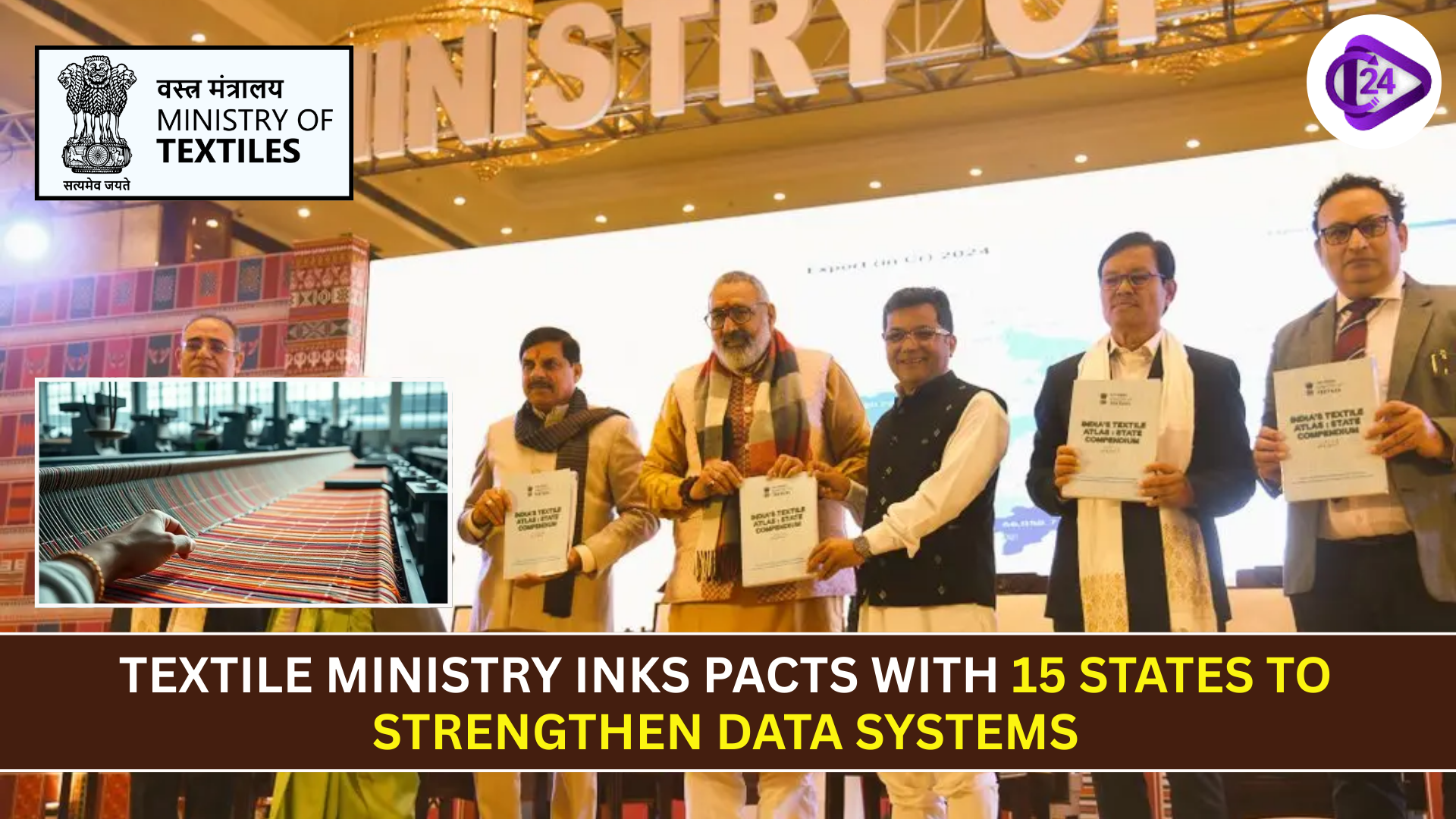
The Ministry of Textiles signed memorandums of understanding with 15 states and Union Territories under the TexRAMPS (Textiles‑focused Research, Assessment, Monitoring, Planning and Start‑Up) scheme to enhance data systems for the textile industry. The new project is expected to increase the coverage, quality, timeliness and credibility of textile-related statistical data and research to support evidence-based policymaking and strong operational frameworks. These agreements were ratified in the National Textiles Ministers Conference in Guwahati, wherein the government gave states financial assistance yearly to enhance the collection and analysis of data. The initiative promotes combined planning in the field of handlooms, handicrafts, apparel and technical textiles, which contributes to growth and investment.
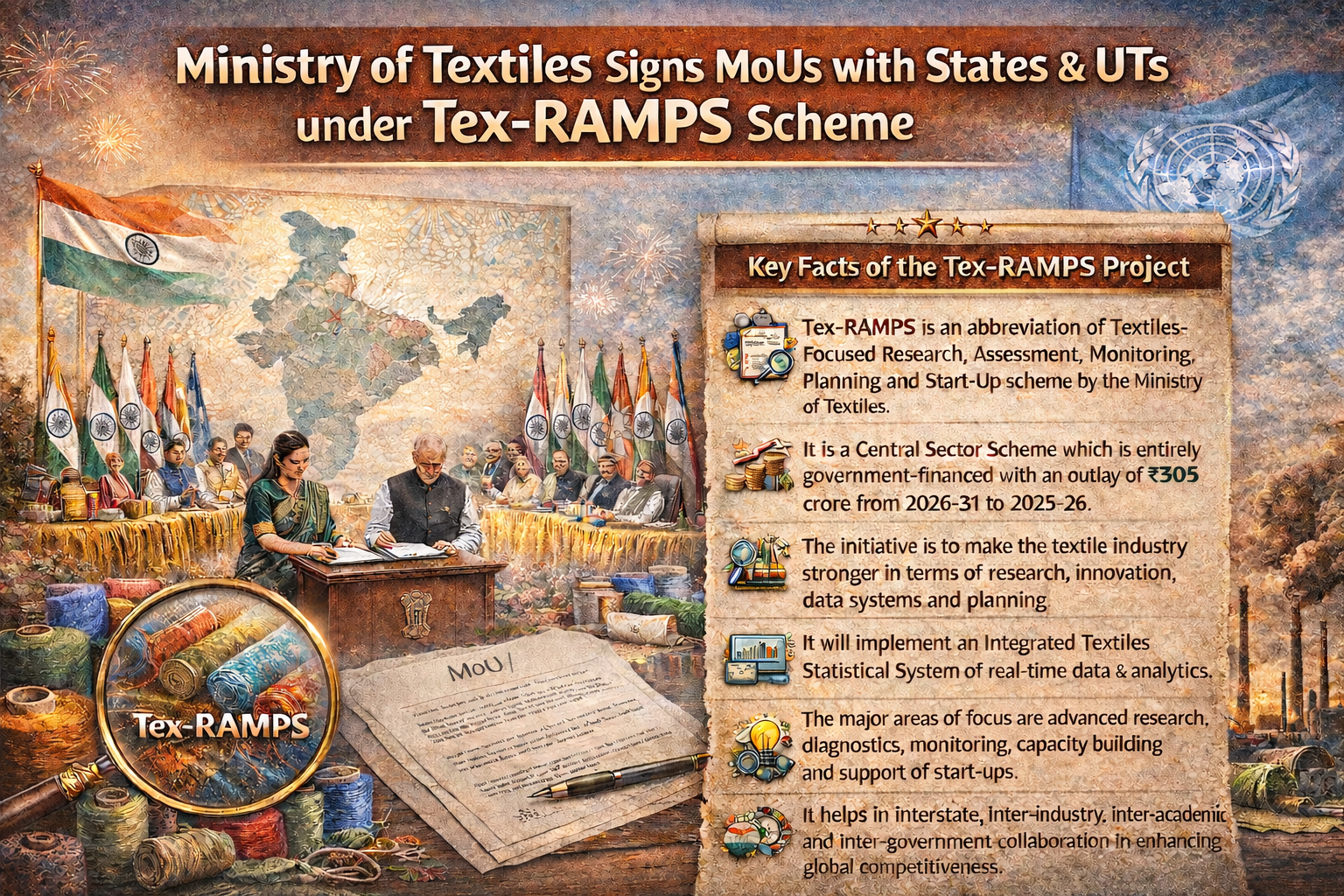
Key Facts of the Tex-RAMPS Project
-
Tex-RAMPS is an abbreviation of Textiles-Focused Research, Assessment, Monitoring, Planning and Start-Up scheme by the Ministry of Textiles.
-
It is a Central Sector Scheme which is entirely government-financed with an outlay of 305 crore from 2026-2031 to 2025-26.
-
The initiative is to make the textile industry stronger in terms of research, innovation, data systems and planning.
-
It will implement an Integrated Textiles Statistical System of real-time data and analytics.
-
The major areas of focus are advanced research, diagnostics, monitoring, capacity building and support of start-ups.
-
It helps in interstate, inter-industry, inter-academic and inter-government collaboration in enhancing global competitiveness.
Recently Asked Questions and Answers: Textile Industry
| Exam | Year | Question | Answer |
|---|---|---|---|
| UPSC Prelims Geography | 2020 | Consider the following statements: (1) “Textiles and textile articles” constitute an important item of trade between India and Bangladesh. Which is correct? |
Statement 2 only (Yes) |
| UPSC Geography Prelims | — | Consider the following statements regarding the cotton textile industry: (1) It faces stiff competition with synthetic fibres and has now shown a declining trend in many countries. Which statements are correct? |
Only statement 3 is correct |
| WBCS Mains | 2023 | The Indian textile industry faces competition from: (1) China, (2) South Korea, (3) Japan, and (4) all of the above. |
All of the above |
| UPSC CSE Mains | 2013 | Analyse the factors for the highly decentralised cotton textile industry in India. | Explanation of decentralisation from traditional mills to power loom and handloom sectors |
| UPSC CSE Mains | 2020 | What are the challenges and opportunities facing the cotton textile industry in India in global competition? | Global competition, technology adoption, labour issues, productivity and sustainability |
| Various State PSC Geographies | 2010 | Tamil Nadu is a leading producer of mill-made cotton yarn due to rich, skilled labour. | Correct: Rich, skilled labour (Statement 2) |
| CTET Paper 2 | 2021 | Read the statements: (A) Indian textiles declined because of tough competition from European & American textiles; (B) declined due to very high duties on imports into Britain. Which is correct? |
A is false, B is true |
Conclusion
The Textile Ministry has established a partnership with 15 states are a major stride towards enhancing data systems amongst India textile industry. The initiative allows making the evidence-based policymaking process, facilitating transparency, encouraging innovations, improving efficiency, and promoting sustainable development and competitiveness in the handloom, silk, cotton, and jute sectors across the country.