

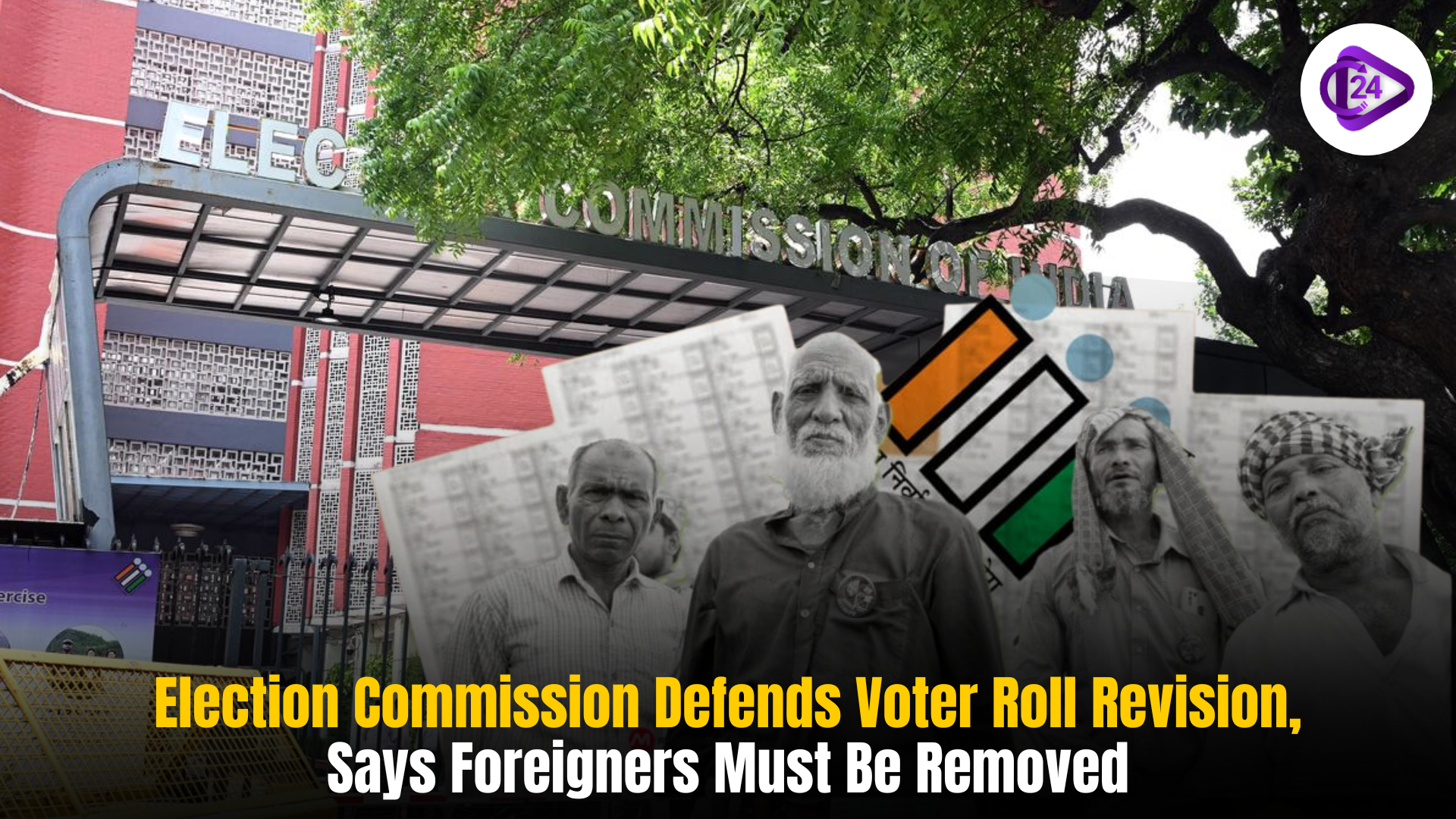
The Indian Election Commission (ECI) has informed the Supreme Court that it has the constitutional power and duty to update the electoral roll and exclude any foreign nationals from the voter roll. During hearings on the Special Intensive Revision (SIR) of the electoral rolls, the poll panel argued that it should exclude non-citizens from the voter roll under Articles 324 and 326 of the Constitution, which state that only Indian citizens should be included on the voter roll. The commission emphasised that it has the obligation to promote the integrity of these elections by maintaining precise and accurate voter lists containing citizens only.
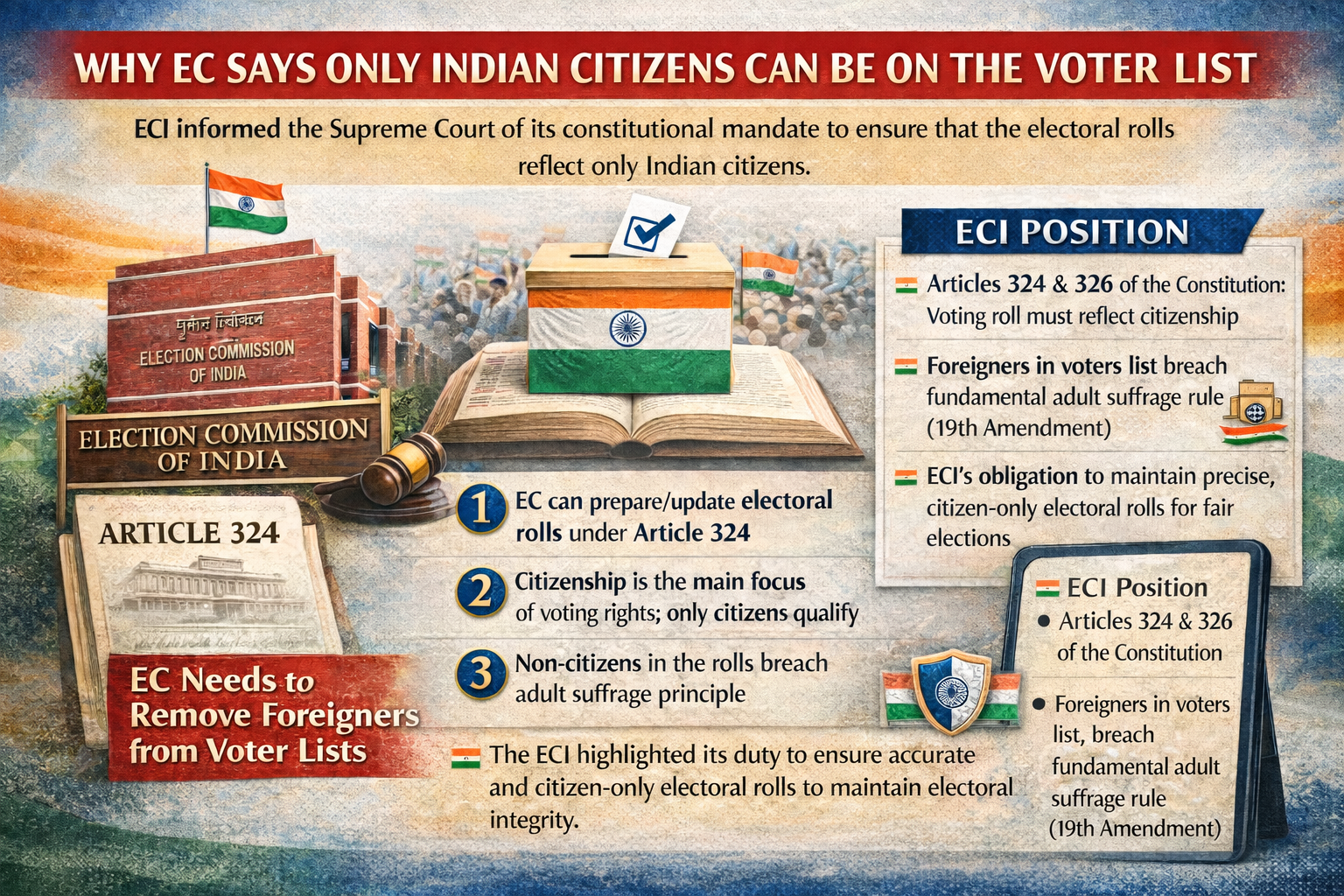
Why EC Says Only Indian Citizens Can Be on the Voter List
-
The Election Commission of India (ECI) informed the Supreme Court of its constitutional mandate to ensure that the electoral rolls reflect only Indian citizens.
-
The EC can prepare and update electoral rolls under Article 324 of the Constitution.
-
The EC contended that citizenship is the main focus of voting rights and that only citizens must be considered for voter registration.
-
The commission explained that including non-citizens in the rolls would breach the core principle of adult suffrage and the provisions of the 19th Amendment, which regulate the election process.
-
Thus, the EC indicated that it needs to remove foreigners from the voters' lists.
MCQs for Upcoming Exams
Q. Which case established the “basic structure doctrine” limiting Parliament’s power to amend the Constitution?
A) Golaknath v. State of Punjab
B) Kesavananda Bharati v. State of Kerala
C) Minerva Mills v. Union of India
D) Indira Nehru Gandhi v. Raj Narain
Answer: B) Kesavananda Bharati v. State of Kerala
Explanation: The Supreme Court held that Parliament cannot alter the basic structure of the Constitution.
Q. Under the Representation of the People Act, which authority adjudicates disputes regarding the election of the President?
A) Supreme Court
B) High Court
C) Election Commission
D) Parliament
Answer: A) Supreme Court
Explanation: Election petitions for presidential elections are decided by the Supreme Court.
Q. Which of the following writs is not ordinarily issued against the Election Commission’s decision?
A) Habeas Corpus
B) Certiorari
C) Mandamus
D) Prohibition
Answer: A) Habeas Corpus
Explanation: Habeas corpus is for personal liberty; EC decisions are typically challenged by Certiorari, Mandamus, or Prohibition.
Q. The principle of ‘one person, one vote’ was first applied to Indian elections in:
A) Supreme Court directions in the 1960s
B) A constitutional amendment
C) A judgment in Indira Gandhi v. Raj Narain
D) A Law Commission report
Answer: C) A judgment in Indira Gandhi v. Raj Narain
Explanation: The Supreme Court read ‘one person, one vote’ into Article 326 during this case.
Q. Which article gives the Election Commission powers to supervise elections to Panchayats and Municipalities?
A) Article 324
B) Article 243K & 243ZA
C) Article 356
D) Article 327
Answer: B) Article 243K & 243ZA
Explanation: These articles give State Election Commissions power for local bodies; ECI supervises only Parliament/Assembly polls.
Q. In judicial review of election laws, the Supreme Court can strike down provisions that:
A) Violate fundamental rights
B) Conflict with constitutional provisions
C) Deprive citizens of free and fair elections
D) All of the above
Answer: D) All of the above
Explanation: The Court ensures election laws conform to fundamental rights and democratic principles.
Q. The removal of an Election Commissioner (not CEC) requires:
A) A simple majority in the Lok Sabha
B) A special resolution in Parliament
C) The same process as CEC removal
D) President’s discretion
Answer: C) The same process as CEC removal
Explanation: Election Commissioners have protection like the CEC; removal is akin to a Supreme Court Judge (impeachment).
Q. Which doctrine restricts the Supreme Court's appointments from being influenced by the Executive?
A) Doctrine of Eclipse
B) Doctrine of pith and substance
C) Judicial Independence Doctrine under Art. 124
D) Federalism Doctrine
Answer: C) Judicial Independence Doctrine under Art. 124
Explanation: Article 124 ensures the independence of the judiciary; the collegium reinforces this.
Q. The Election Commission’s power to order re‑polling is derived from:
A) Constitution directly
B) Representation of the People Act
C) Supreme Court judgments
D) Model Code of Conduct
Answer: B) Representation of the People Act
Explanation: The RPA gives statutory authority to the ECI for re‑polls in case of corrupt practices/violence.
Q. Which judgement expanded the Supreme Court’s review powers over political party decisions (e.g., recognition/symbols)?
A) S. R. Bommai v. Union of India
B) Kihoto Hollohan v. Zachillhu
C) Lily Thomas v. Union of India
D) Union of India v. Association for Democratic Reforms
Answer: D) Union of India v. Association for Democratic Reforms
Explanation: Expanded transparency and judicial scrutiny over parties/Election Commission functions.
Q. The concept of ‘election manifesto’ being justiciable (subject to judicial review) was considered in:
A) Common Cause v. Union of India
B) PUCL v. Union of India
C) Subramanian Swamy v. Election Commission
D) None of the above
Answer: C) Subramanian Swamy v. Election Commission
Explanation: The Supreme Court discussed the limits of manifesto promises vis‑à‑vis free & fair poll standards.
Q. Under Article 324, the term “superintendence, direction, and control” of elections includes:
A) Delimitation of constituencies
B) Powers to amend election laws
C) Conduct and preparation of electoral rolls
D) Formation of political parties
Answer: C) Conduct and preparation of electoral rolls
Explanation: Article 324 empowers ECI over electoral rolls and poll processes; delimitation is by law.
Q. Which case held that the Election Commission must give reasons for its decisions?
A) T.N. Seshan v. Union of India
B) Mohinder Singh Gill v. Chief Election Commissioner
C) People’s Union for Civil Liberties v. Union of India
D) Rameshwar Prasad v. Union of India
Answer: C) People’s Union for Civil Liberties v. Union of India
Explanation: The SC affirmed that ECI’s actions must be reasoned, promoting transparency.
Q. The Supreme Court’s advisory jurisdiction under Article 143 can be invoked:
A) Only by the President
B) By the President and Governors
C) By CEC
D) By the Parliament Speaker
Answer: A) Only by the President. Explanation: Only the President can seek advisory opinions from the SC.
Q. An election petition challenging the MLA election is filed within:
A) 30 days
B) 45 days
C) 60 days
D) 90 days
Answer: B) 45 days
Explanation: As per RPA provisions, 45 days from the result declaration.
Conclusion
The Election Commission has explained that it is vital to revise the voter roll by ensuring that the electoral integrity is upheld. It highlighted the fact that all the ineligible voters, and foreigners included, should be cleared to allow fair elections. This will enhance democracy, hinder malpractices, and safeguard the rights of the citizens, and reaffirm the citizens' belief in the electoral system and governance in India.