

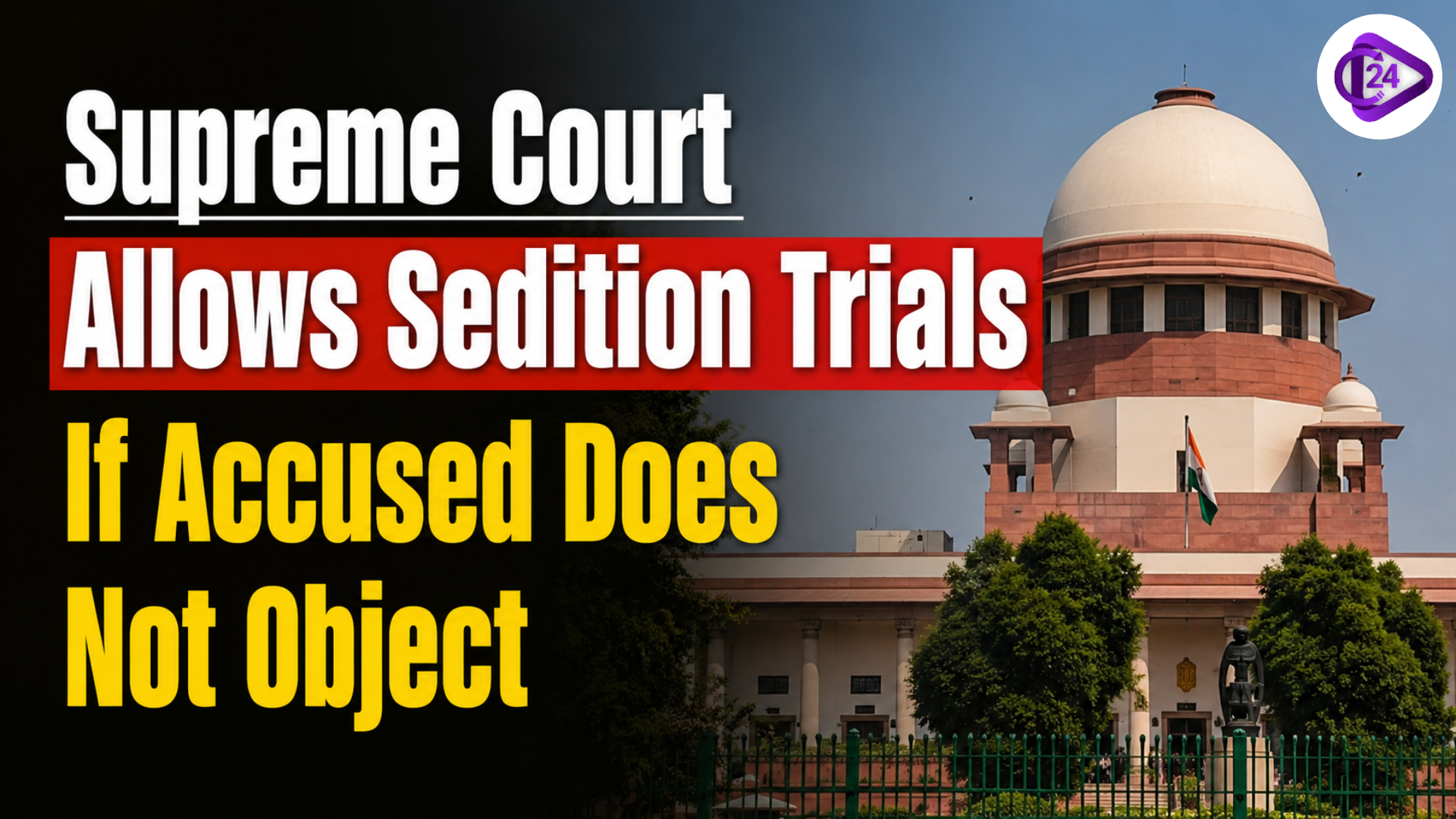
The Supreme Court has ruled that if an accused does not seek a review, he can continue to be charged and can also appeal in courts with regard to sedition charges under the British-era Indian Penal Code (IPC) Section 124A. This clarification was given in response to an accused person who has been arrested for almost 17 years and whose appeal was pending before the Madhya Pradesh High Court. The Supreme Court had in 2022 struck down the sedition law’s constitutionality and suspended the trial of the Sedition lawsuit. This clarification seeks to avoid any further sustenance given to the delay in justice and uphold the “right” to speedy trial under Article 21 of the Constitution.
Key Highlights of the Supreme Court on Sedition Cases
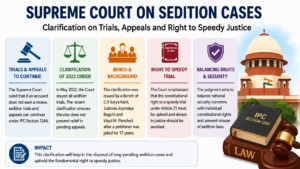
- The Supreme Court said sedition trials and appeals will be allowed without any objections raised by the accused.
- The clarification is about the definition of sedition under Section 124A of the IPC.
- In May 2022, the Supreme Court had instructed that all pending sedition trials and cases should be pulled and impeded.
- It is a clarification by a Bench of Chief Justice Surya Kant, Justices Joymalya Bagchi and Vipul M. Pancholi.
- The decision came after a hearing by a Petitioner who had been in jail for 17 years.
- The petitioner had an appeal with the Madhya Pradesh High Court.
- The Court made it a point to highlight that the constitutional right to a speedy trial under Article 21 has to be respected.
- Section 124A of the IPC has been a matter of discussion and controversy as to its threat to freedom of speech and misuse of the term sedition.
- The Supreme Court is also taking up a petition challenging Section 152 of Bharatiya Nyaya Sanhita (BNS), which critics refer to the old sedition law.
- The Court explained that the previous stay order should not prevent the accused persons from being provided with relief on disposal of the pending Appeals.
- This judgment could ease the pendency of old cases of sedition in criminal courts in India.
- The judgment will emphasise the importance of striking a balance between national security interests and individual constitutional rights.
Important PYQs for Exams
| Exam Name | Year | Question | Options | Answer |
| UPSC Prelims | 2021 | Article 21 of the Indian Constitution is related to? | A. Freedom of Religion B. Right to Equality C. Right to Life and Personal Liberty D. Constitutional Remedies | C. Right to Life and Personal Liberty |
| SSC CGL | 2022 | Sedition under the old IPC was defined under which section? | A. Section 302 B. Section 124A C. Section 420 D. Section 498A | B. Section 124A |
| CDS Exam | 2020 | Which court in India has the power of judicial review? | A. District Court B. High Court Only C. Supreme Court and High Courts D. Parliament | C. Supreme Court and High Courts |
| State PCS | 2023 | The right to speedy trial is considered part of which Article? | A. Article 14 B. Article 19 C. Article 21 D. Article 32 | C. Article 21 |
| NDA Exam | 2021 | Which fundamental right is most closely associated with freedom of speech and expression? | A. Article 14 B. Article 19(1)(a) C. Article 21 D. Article 25 | B. Article 19(1)(a) |
India, Italy Upgrade Ties with Special Strategic Partnership
Conclusion: Supreme Court Balances Speedy Justice and Legal Safeguards
The Supreme Court’s clarification in a sedition trial comes with a motive to maintain balance between the constitutional freedoms and efficiency in the courtrooms. The Court allowed the courts to start acting on the cases even when the accused is not opposed to that, thus preventing the cases from being perpetually left hanging. It also gives a boost to the concept of ‘swift justice’ as enshrined in Article 21 of the Constitution of India. Meanwhile, the constitutionality of the sedition provisions is still being challenged. The move is crucial for the Indian criminal justice system, where, one way or the other, it was finding it difficult to curb unnecessary stays in custody while trying to keep the legal proceedings intact in sensitive national security-related cases.