

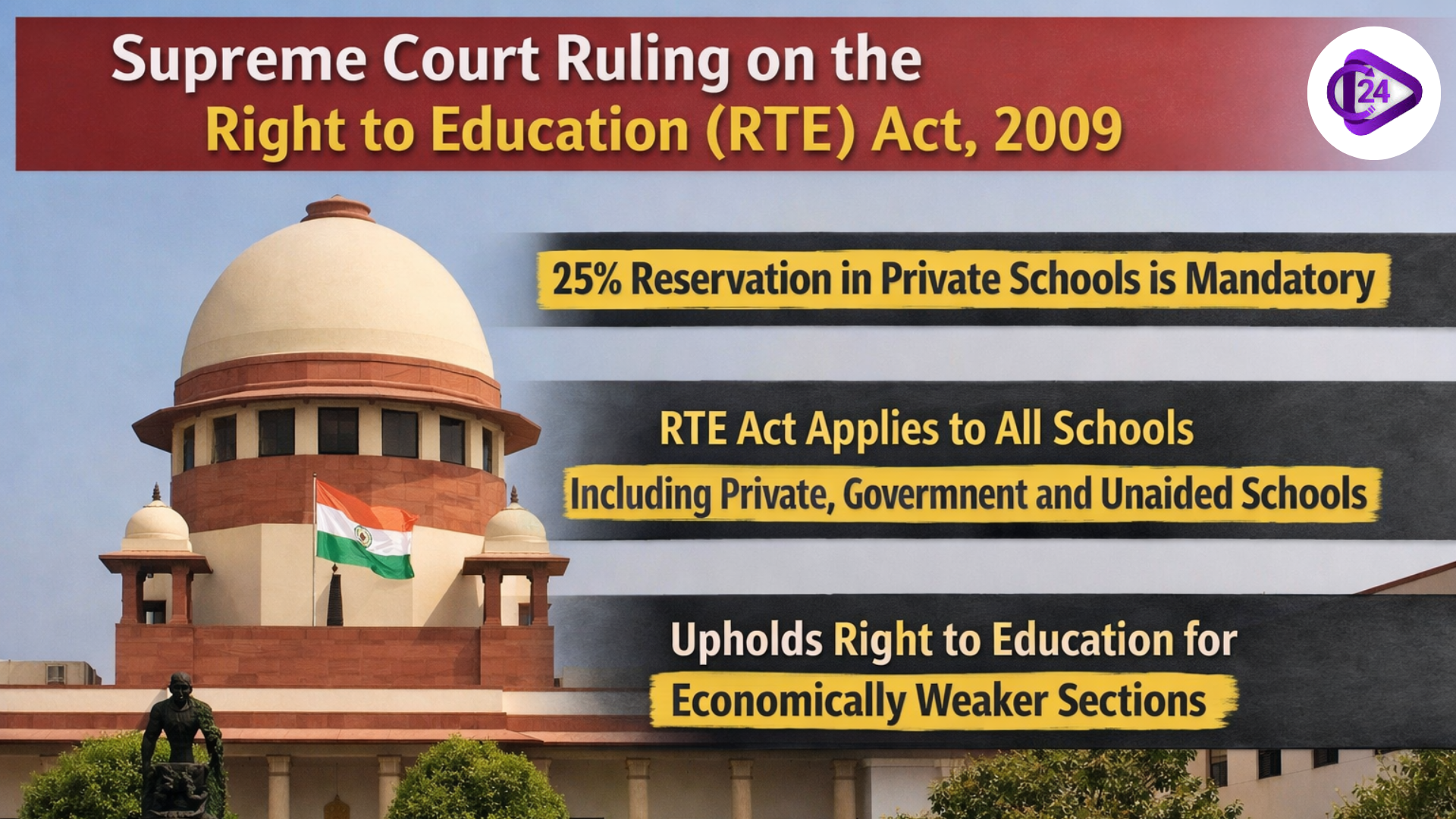
The Supreme Court of India has just strengthened the significant provisions of the Right of Children to Free and Compulsory Education Act, 2009 (RTE Act), with the objective of inclusive education being emphasised as a constitutional objective. In the January 13, 2026, decision, the Court made strides so that 25 seats were to be reserved for children of the economically poor and disadvantaged section, according to the requirements of the Act that social inclusiveness and equal opportunities had to be followed. It is also important to note that in the verdict, it is noted that free and compulsory elementary education is indispensable to the medium of achieving the spirit of Article 21A of the Constitution and ensuring educational equity in the country.
What the Supreme Court’s Latest Ruling Means for the RTE Act, 2009
-
The Supreme Court has reinforced Act 12(1)(c) of the Right to Education (RTE) Act, 2009.
-
It made it clear that the 25-per-cent quota of children from economically less advantaged sections in private unaided schools is binding.
-
It is mandated that states and the local authorities should ensure strict adherence to this provision.
-
The 25 per cent quota cannot be ignored or symbolic in schools.
-
The decision encourages social inclusion because it brings together children of diverse social and economic standings.
-
It consolidates the constitutional requirement of free and compulsory education in the Articles 21A.
-
Governments should establish clear guidelines and surveillance systems to be executed.
-
The ruling will ease the inequality in terms of accessing quality education.
Previous Year Questions on RTE Act
| Exam | Year | Question | Answer |
|---|---|---|---|
| UPSC CSE Prelims | 2021 | Which Constitutional Amendment made education a Fundamental Right for children aged 6–14 years? | 86th Constitutional Amendment Act |
| SSC CGL Tier-I | 2020 | Article 21A of the Constitution provides the right to ________. | Education |
| SSC CGL Tier-I | 2025 | Article 21A, making education a fundamental right, was inserted by which amendment? | 86th Constitutional Amendment Act |
| OPSC ASO | 2022 | Article 21A refers to which right? | Right to Education |
| Tripura TET | 2019 | The right to elementary education in India has been included under which article? | Article 21A |

Conclusion (Right to Education (RTE) Act, 2009)
The Act of 2009 is a social justice and inclusive development move known as the Right to Education Act. It empowers equality by ensuring that all children between the ages of 6 and 14 years have free and compulsory education, which minimises social differentiation and sets the foundation of a progressive, educated, and empowered nation.