
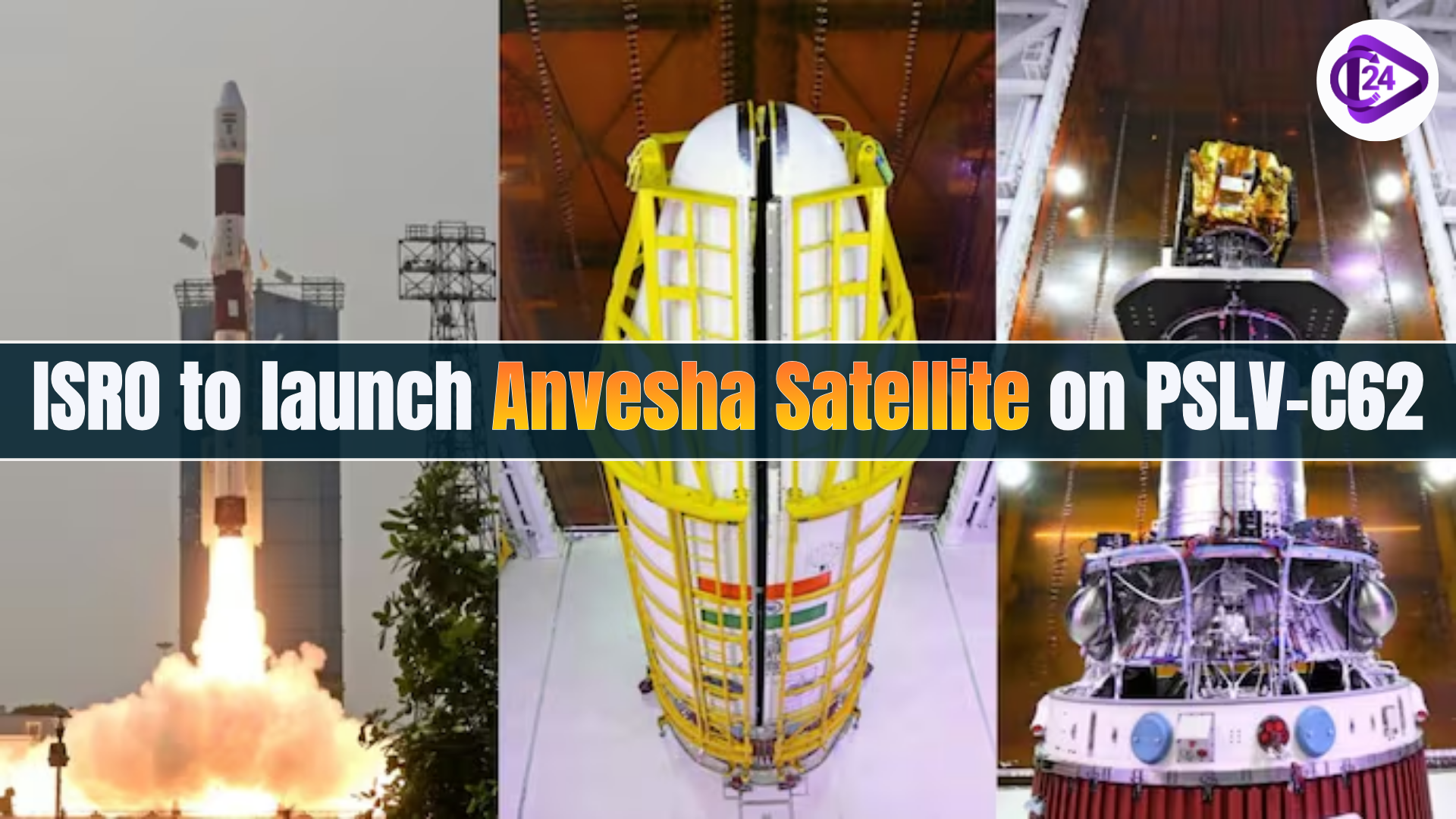
India's Indian Space Research Organisation (ISRO) plans to launch the PSLV-C62 mission on January 12, 2026, from the mission control centre at the Satish Dhawan Space Centre, Sriharikota, marking the start of the Indian space calendar for the year. The main payload is the EOS-N1 satellite, also known as Anvesha, a hyperspectral Earth-observation satellite built to serve three main purposes as a tool for surveillance, environmental monitoring, and resource mapping. The launch will be conducted using the Polar Satellite Launch Vehicle (PSLV), ISRO's workhorse satellite launch vehicle, which will also place several co-passenger satellites into orbit, reflecting the growing Indian presence in space technology and commercial launch services.
ISRO’s PSLV-C62 Successfully Launches Anvesha Satellite
-
PSLV-C62 refers to the Polar Satellite Launch Vehicle of ISRO, which is the 64th launch.
-
The launch was done at Satish Dhawan Space Centre, Sriharikota.
-
The main payload is that of EOS-N1, which is known as Anvesha.
-
Anvesha is a hyperspectral satellite of the Earth.
-
It is intended to be used to monitor the environment, including the monitoring of resources and mapping.
-
This satellite was placed in a sun-synchronous orbit.
-
There were also several co-passenger satellites onboard the mission.
-
It is the ISRO's initial launching mission of 2026.
-
The introduction enhances India's Earth observation and strategic capabilities.
-
It equally sustains the rising business space launch in India.
PYQs Asked in Different Exams
| Exam | Year | Question | Answer |
|---|---|---|---|
| UPSC Prelims | 2016 | Mangalyaan was launched by ISRO. Which of these statements are correct? | 1 and 3 only |
| UPSC Prelims | 2010 | What is Bhuvan? | ISRO’s geoportal with 3D imaging |
| UPSC Prelims | 2018 | Which statement about PSLV & GSLV is correct? | PSLV for polar, GSLV for heavy payload |
| UPSC Mains GS-3 | 2016 | What is the significance of the Mars Orbiter Mission? | Low-cost deep space capability |
| UPSC Mains GS-3 | 2019 | India’s plan for its own space station? | Modular station after Gaganyaan |
| SSC CGL | 2021 | Which organisation launched Chandrayaan? | ISRO |
| SSC CHSL | 2020 | Which launch vehicle is ISRO’s workhorse? | PSLV |
| SSC GD | 2019 | Full form of ISRO? | Indian Space Research Organisation |
| SSC MTS | 2018 | What was India’s first Mars mission called? | Mangalyaan |
| RRB NTPC | 2019 | India’s first interplanetary mission? | Mars Orbiter Mission |
| RRB Group D | 2022 | Which ISRO mission studies the Sun? | Aditya-L1 |
| RRB ALP | 2021 | What is NavIC? | India’s navigation satellite system |
| SBI Clerk | 2023 | Name India’s human spaceflight mission | Gaganyaan |
| SBI PO | 2024 | Which mission was launched to observe the Sun? | Aditya-L1 |
| SBI Clerk | 2024 | Name two recent ISRO missions | Aditya-L1, XPoSat |
| IBPS PO | 2022 | Which is India’s first astronomy satellite? | AstroSat |
| IBPS Clerk | 2021 | Chandrayaan-3 was launched to? | Soft land on the Moon |
| NDA | 2020 | Which launch vehicle places satellites in polar orbit? | PSLV |
| CDS | 2021 | What is the function of a cryogenic engine? | Heavy payload to a higher orbit |
| State PCS | 2022 | What is the objective of the Gaganyaan mission? | Send humans to space and return safely |

Conclusion (Isro to launch Anvesha satellite on PSLV-C62)
India has been demonstrating increased capabilities in Earth observation and hyperspectral imaging, as evident in the ISRO PSLV-C62 mission, which carried the Anvesha (EOS-N1) satellite. The successful launch of the multi-satellites boosts the Indian standing in space technology and market satellite applications via NSIL and comes as a clear victory in the prevailing responses and matchmaking tasks.