


The Supreme Court of India has demarcated a key legal position on the Dowry Prohibition Act, holding that the dowry givers, usually the bride and her family, will not be prosecuted provided they are treated as wronged. The law, in a technical sense, criminalises both dowry giving and dowry taking. However, this was not the focus of the court since they focused on the victim-centred approach as a way of guaranteeing justice to those who are being harassed or abused. This demystification is supposed to ensure that the victims are not punished due to their actions, which in most cases are motivated by social pressure. The decision enhances legal safeguards of vulnerable people and does not relent in fighting against those who request dowries.
Supreme Court on Dowry Law: Protection for Dowry Givers & Legal Implications
-
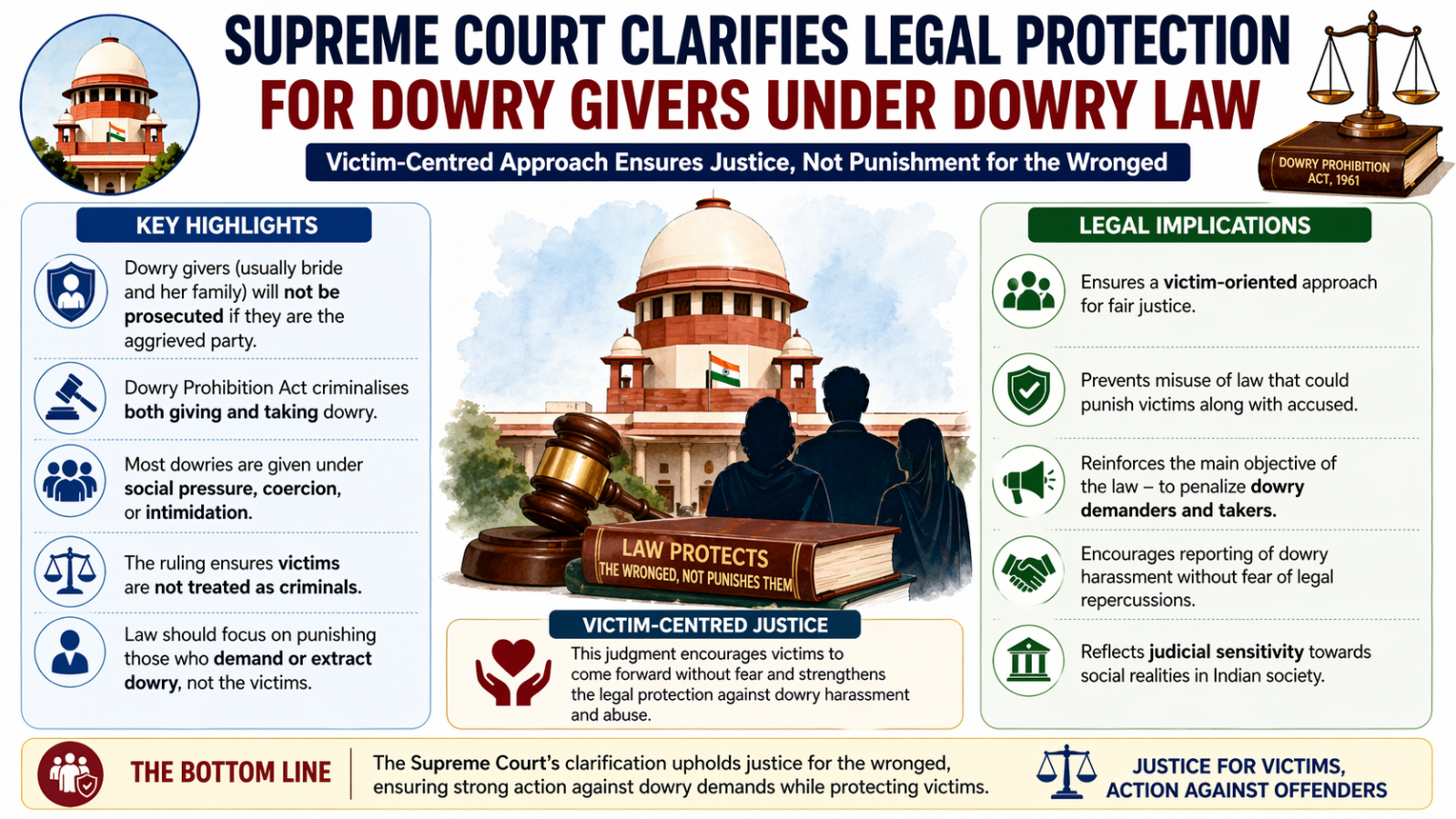
The Supreme Court of India elaborated that dowry givers are exempt from facing prosecution in case they are the aggrieved party in a case.
-
According to the Dowry Prohibition Act, both giving and accepting a dowry are technically punishable offences.
-
The court was, however, aware that in the overwhelming majority of cases, dowry is being paid under social compulsion, under duress or intimidation.
-
The ruling ensures that victims (primarily brides and their families) are not considered criminals.
-
The decision takes a more victim-oriented approach to law as a means to bring justice and fair play.
-
It averts the abuse of law provisions, which otherwise would punish victims as well as the accused individuals.
-
The Court pointed out that the main objective of the law is to punish individuals who may demand or extract dowry.
-
This explanation will incite the victims to come out and not be afraid of legal reprisals.
-
It enhances defence against dowry bullying and mistreatment over marriage matters.
-
The decision also shows judicial delicacy over the ground realities in Indian society.
-
It has been in line with the bigger initiatives of doing away with the social evil of dowry while safeguarding victims.
-
The case can impact the ways in which the laws that govern dowry are interpreted in courts at a lower level.
-
On the whole, the verdict strikes a balance between tough enforcement of anti-dowry laws and humanity.
MCQs on Dowry
Q. Which of the following acts is also known as the Sarda Act?
A. Dowry Prohibition Act, 1961
B. Child Marriage Restraint Act, 1929
C. Hindu Marriage Act, 1955
D. Special Marriage Act, 1954
Answer: B
Explanation: The Child Marriage Restraint Act, 1929, is popularly known as the Sarda Act, aimed at preventing child marriages.
Q. The Dowry Prohibition Act was enacted in which year?
A. 1955
B. 1961
C. 1976
D. 1986
Answer: B
Explanation: The Dowry Prohibition Act was passed in 1961 to prohibit giving and taking dowries.
Q. Under the Dowry Prohibition Act, giving a dowry is
A. Not punishable
B. Punishable only for the groom
C. Punishable for both giver and receiver
D. Punishable only if reported
Answer: C
Explanation: The Act makes both giving and taking dowry an offence, though courts may protect victims (givers) in certain cases.
Q. Which IPC section deals with cruelty by husband or relatives related to dowry?
A. Section 302
B. Section 304B
C. Section 498A
D. Section 376
Answer: C
Explanation: Section 498 A IPC deals with cruelty by a husband or his relatives, often linked to dowry harassment.
Q. Dowry death is defined under which section of the IPC?
A. Section 306
B. Section 304B
C. Section 498A
D. Section 302
Answer: B
Explanation: Section 304B IPC defines dowry death, applicable when a woman dies under abnormal circumstances within 7 years of marriage.
Q. The minimum punishment under the Dowry Prohibition Act is:
A. 6 months imprisonment
B. 1 year imprisonment
C. 5 years imprisonment
D. Only fine
Answer: C
Explanation: The Act prescribes a minimum of 5 years imprisonment along with a fine.
Q. Dowry includes:
A. Gifts given voluntarily without demand
B. Property given before, during, or after marriage in connection with marriage
C. Only cash given at marriage
D. Only gifts to the bride
Answer: B
Explanation: Dowry includes any property or valuable security given in connection with marriage.
Q. Which of the following is NOT related to dowry laws?
A. Dowry Prohibition Act, 1961
B. Section 498A IPC
C. Protection of Women from Domestic Violence Act, 2005
D. Right to Information Act, 2005
Answer: D
Explanation: The RTI Act is unrelated to dowry or women’s protection laws.
Q. Presumption of dowry death is given under which Evidence Act section?
A. Section 24
B. Section 113A
C. Section 113B
D. Section 120
Answer: C
Explanation: Section 113B of the Indian Evidence Act presumes dowry death if conditions are met.
Q. The main objective of the Dowry Prohibition Act is to
A. Regulate marriage expenses
B. Prevent child marriage
C. Prohibit the dowry system
D. Provide divorce rights
Answer: C
Explanation: The Act aims to eliminate the social evil of dowry.
Sawan Barwal Breaks 48-Year-Old Marathon Record
Conclusion – No Punishment for Dowry Givers
The elucidation that dowry givers will not be subject to punishment but regarded as an aggrieved party is a balanced and humane way of implementing anti-dowry laws. Although the law still forbids giving or taking dowry, with clarity, the victims should be given priority since, in most cases, they are under duress or compelled by societal pressures to do so. Such a reading invites the afflicted families to report harassment without having the fear of incrimination. Concurrently, it exercises a high degree of responsibility towards those demanding a dowry. Generally, the strategy reinforces the delivery of justice and contributes to the whole purpose of eradicating the dowry system in society.