

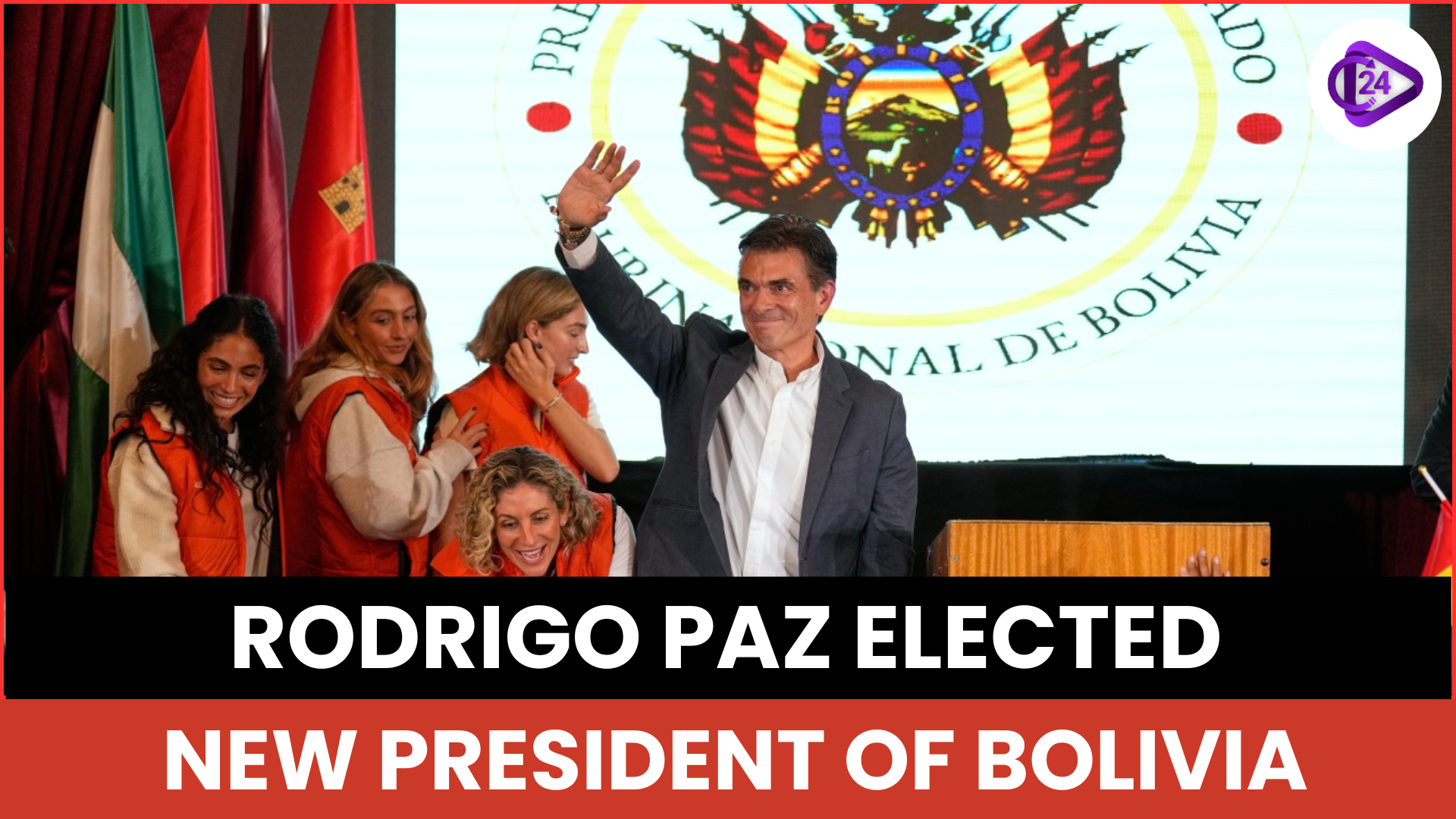
Rodrigo Paz Pereira became the President of Bolivia after winning the country’s 2025 presidential run-off election. His victory marked a major political change in Bolivia, ending nearly two decades of dominance by the Movement Toward Socialism (MAS), which had been associated with former President Evo Morales and his political movement.
Paz, the candidate of the Christian Democratic Party (PDC), defeated former President Jorge “Tuto” Quiroga in the second round of voting held on 19 October 2025. According to Bolivia’s official electoral authority, Paz secured 54.96% of valid votes, while Quiroga received 45.04%.
Rodrigo Paz was sworn in as President on 8 November 2025. His government faces major challenges, including economic instability, shortages of foreign currency, rising living costs and the need to restore investor confidence.
Rodrigo Paz Election 2025: Key Highlights
| Particulars | Details |
| President | Rodrigo Paz Pereira |
| Country | Bolivia |
| Political Party | Christian Democratic Party (PDC) |
| Election | Bolivia General Election 2025 |
| Run-off Date | 19 October 2025 |
| Winning Vote Share | 54.96% |
| Main Opponent | Jorge “Tuto” Quiroga |
| Oath of Office | 8 November 2025 |
| Previous President | Luis Arce |
| Capital | Sucre (constitutional capital); La Paz (seat of government) |
Who Is Rodrigo Paz Pereira?
Rodrigo Paz Pereira is a Bolivian politician and economist who became President in November 2025.
He comes from a politically active family. His father, Jaime Paz Zamora, served as President of Bolivia from 1989 to 1993.
Before becoming President, Rodrigo Paz held several public offices. He served as a member of Bolivia’s Chamber of Deputies and later as a senator representing the department of Tarija. He also served as Mayor of Tarija from 2015 to 2020.
His political experience at municipal and national levels helped establish his public profile before the 2025 presidential election.
Paz contested the election as the candidate of the Christian Democratic Party. His campaign focused on economic recovery, institutional reform, investment and changes to the country’s economic management.
Bolivia Presidential Election 2025: How Did Rodrigo Paz Win?
Bolivia’s 2025 presidential election took place amid serious economic difficulties. The country was dealing with foreign currency shortages, fuel supply problems, inflationary pressure and declining public confidence in the economy.
The first round of voting was held on 17 August 2025. No candidate secured the required majority to win the presidency directly, making a second round necessary.
The two candidates who advanced to the run-off were:
- Rodrigo Paz Pereira of the Christian Democratic Party.
- Jorge “Tuto” Quiroga of the Libre Alliance.
The second round was held on 19 October 2025.
Official Results of the Second Round
Bolivia’s Supreme Electoral Tribunal (TSE) officially proclaimed the final results on 27 October 2025.
| Candidate | Party / Alliance | Vote Share |
| Rodrigo Paz Pereira | Christian Democratic Party (PDC) | 54.96% |
| Jorge “Tuto” Quiroga | Libre Alliance | 45.04% |
Paz received 3,579,534 valid votes, while Quiroga secured 2,884,661 votes.
The result confirmed Rodrigo Paz as the winner of the presidential run-off.
Why Was Rodrigo Paz’s Victory Significant?
The 2025 election marked a major change in Bolivia’s political landscape.
The Movement Toward Socialism had played a dominant role in national politics for nearly two decades. Its period in power included the presidencies of Evo Morales and Luis Arce.
The election took place during a period of economic pressure and political divisions. Voters were concerned about fuel shortages, high prices, access to US dollars and the country’s economic future.
Paz’s victory represented a shift in national leadership and created expectations of changes in economic policy and international engagement.
However, his government also faced the challenge of working with a divided political environment and limited legislative support.
Major Challenges Before Rodrigo Paz
The new government inherited several economic and administrative challenges.
1. Economic Crisis
Bolivia faced a difficult economic situation, including shortages of foreign currency and pressure on public finances. Restoring economic stability became one of the government’s major priorities.
2. Fuel Shortages
Fuel supply problems affected transportation, businesses and daily life. Improving the availability of fuel became an important public concern.
3. Inflation and Cost of Living
Rising prices of essential goods affected households and increased pressure on the government to improve economic conditions.
4. Foreign Investment
Bolivia has significant natural resources, including lithium and other minerals. Attracting investment while developing these resources is an important economic challenge.
5. Political Cooperation
The President needs support from different political groups to implement reforms and pass legislation. Building consensus in the legislature is therefore important for the government’s policy agenda.
India-Bolivia Relations: Strategic and Political Cooperation
India and Bolivia maintain friendly diplomatic relations based on mutual respect and cooperation. Both countries have identified opportunities to expand economic and technical partnerships.
India opened its resident diplomatic mission in La Paz in September 2024, strengthening its direct diplomatic engagement with Bolivia. Bolivia has maintained its embassy in New Delhi since 2012.
The two countries cooperate in several important areas.
1. Lithium and Mineral Resources
Lithium is one of the most important areas of cooperation between India and Bolivia.
Bolivia possesses substantial lithium resources, which are important for electric vehicle batteries, energy storage systems and renewable energy technologies.
Both countries have explored cooperation in lithium carbonate, mineral extraction, battery materials and related technologies.
2. Health and Pharmaceuticals
India is an important producer of affordable medicines and pharmaceutical products.
Cooperation between the two countries includes opportunities in pharmaceuticals, medical equipment, healthcare and traditional systems of medicine.
3. Information Technology and Space
India and Bolivia have explored cooperation in information technology, capacity building and space-related activities.
India has also supported training programmes to develop technical capabilities in Bolivia.
4. Infrastructure and Development Cooperation
India has offered development assistance to Bolivia, including a US$100 million Line of Credit announced during the 2019 State Visit of former Indian President Ram Nath Kovind.
The credit line was intended to support development projects of interest to Bolivia.
5. Renewable Energy and Sustainable Development
Both countries have opportunities to cooperate in renewable energy, climate-related initiatives and sustainable use of natural resources.
Bolivia also signed the International Solar Alliance Framework Agreement in 2019, providing another platform for international cooperation.
Recent Development in India-Bolivia Relations
India and Bolivia continued to strengthen their mineral and geological cooperation in 2025.
On 24 October 2025, the two countries signed a protocol extending their Memorandum of Understanding on cooperation in geology and mineral resources for another five years, until 28 March 2029.
The agreement aims to promote technical cooperation, investment, technology transfer and continued work through the Joint Working Group on Minerals.
Another important development took place during Rodrigo Paz’s presidential inauguration.
India’s Minister of State for External Affairs and Textiles, Pabitra Margherita, attended the swearing-in ceremony on 8 November 2025. He also held a meeting with the new President.
During the visit, he inaugurated the new building of the Embassy of India in La Paz.
These developments provide an opportunity for India and Bolivia to continue cooperation in critical minerals, trade, technology and development.
Conclusion
Rodrigo Paz Pereira’s victory in Bolivia’s 2025 presidential run-off marked an important political transition. He defeated Jorge “Tuto” Quiroga with 54.96% of valid votes and took office on 8 November 2025.
His government faces major challenges related to economic stability, fuel availability, inflation, investment, and political cooperation.
For India, the change in Bolivia’s leadership also creates an opportunity to continue strengthening bilateral relations. Cooperation in lithium, mineral resources, pharmaceuticals, information technology, and development assistance remains important for both countries.