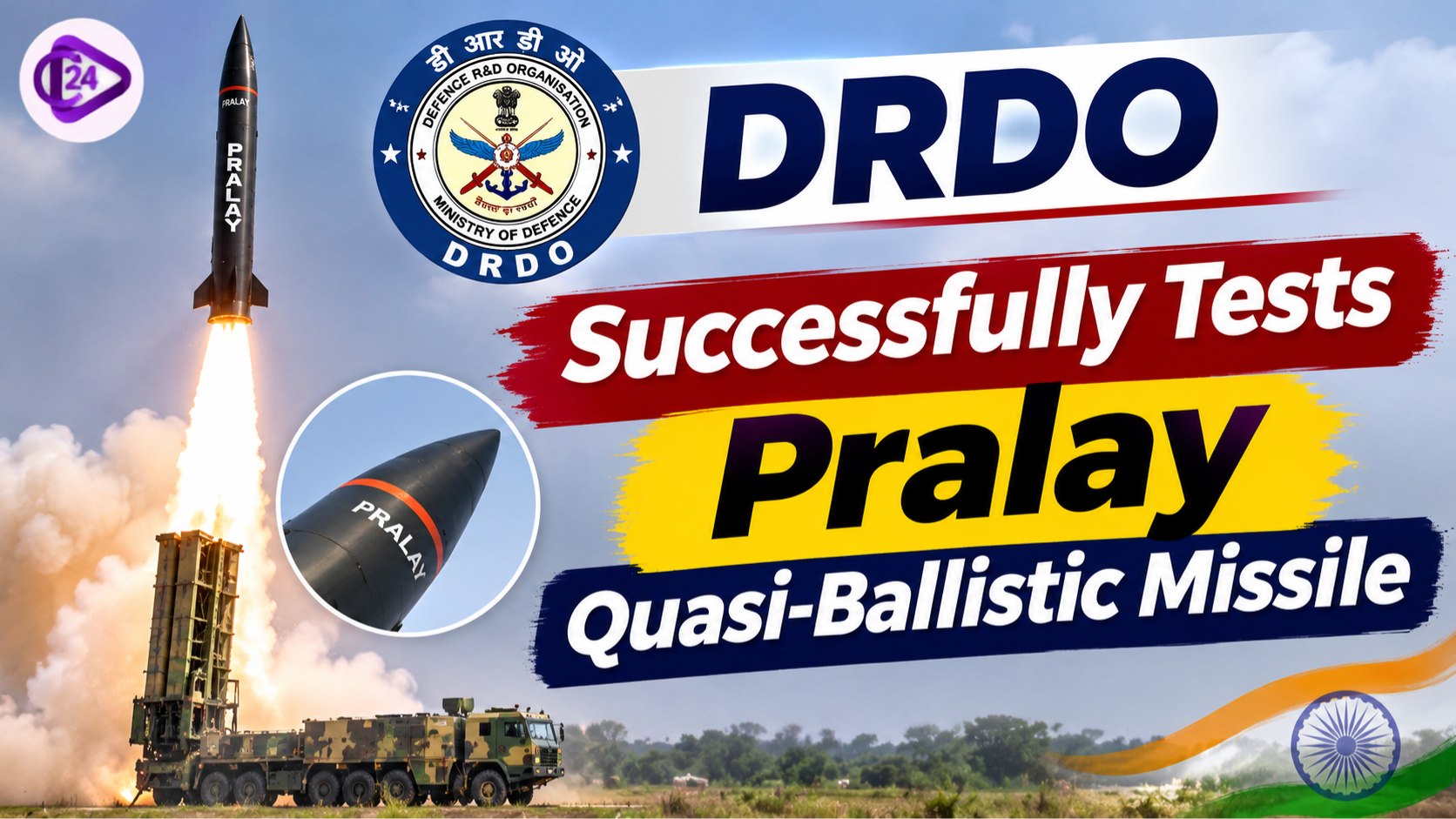


India has achieved another significant milestone in its defence technology programme as the Defence Research and Development Organisation (DRDO) successfully conducted a flight test of the indigenously developed Pralay quasi-ballistic missile on 5 November 2026.
The missile was tested from Dr APJ Abdul Kalam Island, located off the coast of Odisha, at approximately 11:10 AM. According to the Ministry of Defence, all test objectives were successfully achieved, as confirmed by data recorded through various range instruments deployed by the Integrated Test Range (ITR), Chandipur.
The successful test marks an important step towards the operational induction of Pralay into the Indian Armed Forces and strengthens India’s indigenous missile development capabilities.
Key Highlights of the Pralay Missile Test
- Missile Name: Pralay
- Developed By: Defence Research and Development Organisation (DRDO)
- Missile Category: Quasi-Ballistic Missile
- Type: Surface-to-Surface Missile
- Test Date: 5 November 2026
- Launch Location: Dr APJ Abdul Kalam Island, Odisha
- Launch Time: Approximately 11:10 AM
- Main Development Agency: Research Centre Imarat (RCI), Hyderabad
- Production Partner: Bharat Dynamics Limited (BDL)
- Defence Minister: Rajnath Singh
- Purpose: Strengthening India’s conventional defence capabilities
What is the Pralay Missile?
Pralay is an indigenously developed, solid-propellant, surface-to-surface quasi-ballistic missile designed to carry conventional warheads.
It is a short-range tactical missile developed to engage different types of ground-based targets with high precision. The missile incorporates advanced guidance and navigation technologies that improve its accuracy and operational effectiveness.
One of its important features is its ability to manoeuvre during flight, making its trajectory less predictable and creating additional challenges for enemy air defence systems.
Pralay is reported to have an operational range of approximately 150 to 500 kilometres and a payload capacity of around 500 to 1,000 kilograms.
What is a Quasi-Ballistic Missile?
A quasi-ballistic missile combines characteristics of conventional ballistic missiles with the ability to manoeuvre during flight.
Unlike traditional ballistic missiles, which generally follow a predictable curved trajectory, quasi-ballistic missiles can fly at relatively lower trajectories and change their course during flight.
This manoeuvrability makes interception more challenging for enemy missile defence systems.
Pralay’s advanced navigation and guidance systems are designed to provide improved accuracy against different categories of targets.
Development of the Pralay Missile
The Pralay missile has been developed by Research Centre Imarat (RCI), Hyderabad, in collaboration with several other DRDO laboratories.
Bharat Dynamics Limited (BDL) is one of its development-cum-production partners and has manufactured the missile system.
The missile’s first successful flight tests were conducted in December 2021. Since then, the programme has undergone several development and evaluation trials to validate its performance and operational capabilities.
The latest successful flight test was conducted as part of user evaluation trials involving the Defence Forces.
Strategic Importance for India’s Defence
The successful testing of Pralay is important for India’s national security and military modernisation.
Strengthening Conventional Strike Capability: Pralay will provide the armed forces with an advanced conventional missile system for engaging important enemy targets.
Boost to Indigenous Defence Manufacturing: Its development supports the Government of India’s Atmanirbhar Bharat initiative and reduces dependence on foreign defence technologies.
Improved Military Preparedness: Advanced guidance, navigation and manoeuvrability can improve operational flexibility against emerging security threats.
Modernisation of Armed Forces: The missile is intended for induction into the Indian Army and Indian Air Force, strengthening India’s tactical strike capabilities.
Important Organisations Associated with the Test
- DRDO: Responsible for research and development of the missile.
- Research Centre Imarat: Main development laboratory located in Hyderabad.
- Bharat Dynamics Limited: Development-cum-production partner.
- Integrated Test Range: Responsible for monitoring and collecting flight-test data at Chandipur, Odisha.
- Ministry of Defence: Announced the successful test.
Conclusion
The successful flight test of the indigenous Pralay quasi-ballistic missile represents an important achievement in India’s defence and technological development. It highlights the growing capabilities of DRDO and Indian defence industries in developing advanced missile systems.
With successful user evaluation trials, Pralay is moving closer to induction into the Indian Armed Forces. The missile will contribute to India’s conventional military capabilities, operational preparedness and long-term defence self-reliance.