

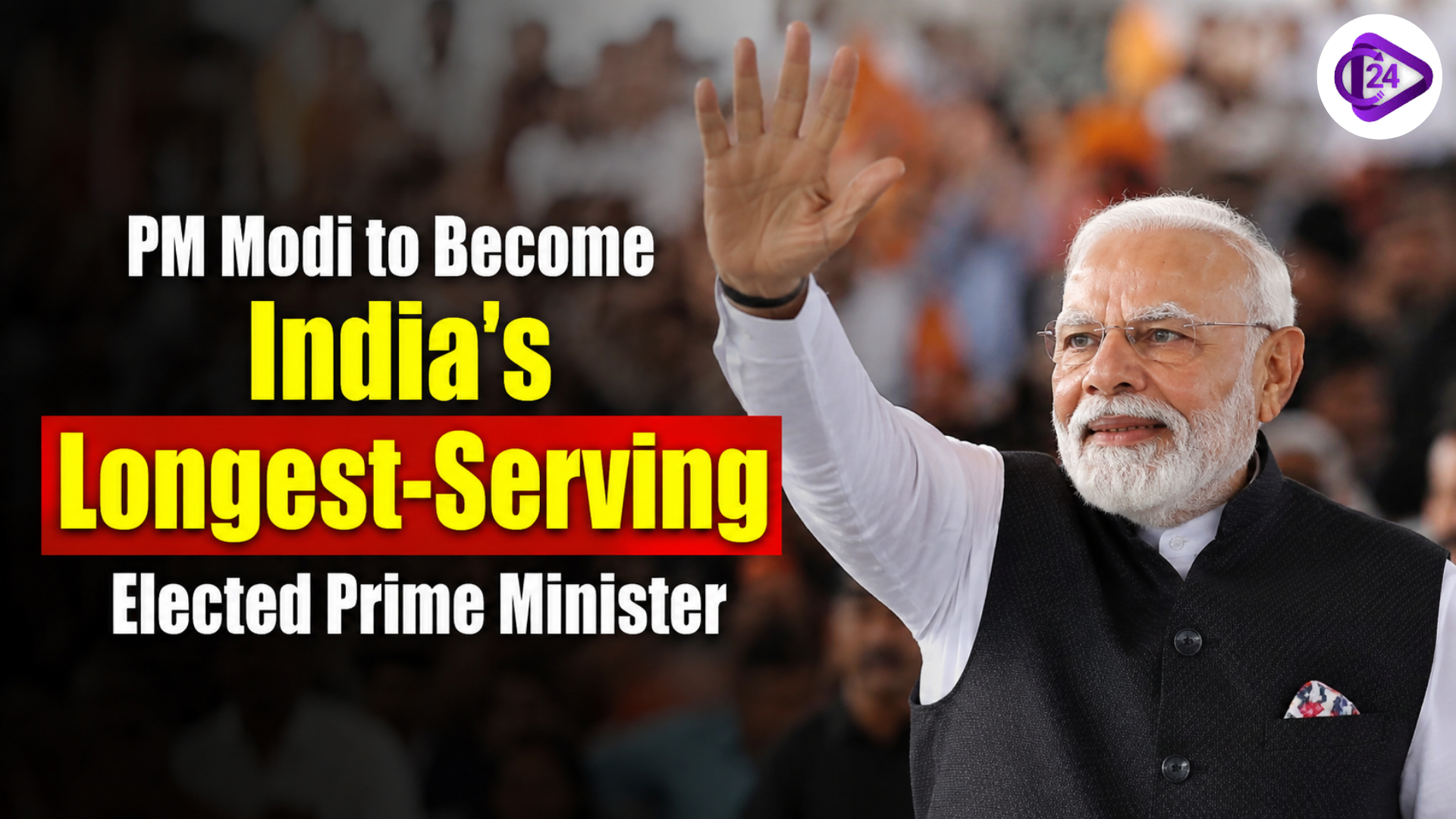
Modi’s coming to become India’s longest-serving elected prime minister has hooked the local audience. PM Narendra Modi will create a historical moment in his political career, as no previous Prime Ministers had achieved. Political continuity, electoral success and long-term governance in the world’s largest democracy have resulted in this achievement.
Narendra Modi has guided the nation to undertake several reforms, economic measures, infrastructure projects and international initiatives since he assumed office in May 2014. Therefore, this news has become important as India announced its PM will become the longest-tenured Prime Minister in the nation.
Key Highlights of PM Modi’s 4,399-Day Milestone
| Particulars | Details |
|---|---|
| Prime Minister | Narendra Modi |
| Assumed Office | 26 May 2014 |
| Political Party | Bharatiya Janata Party (BJP) |
| Consecutive Terms | Three |
| Milestone | PM Modi to Become India’s Longest-Serving Elected Prime Minister |
| Previous Record Holder | Jawaharlal Nehru |
| Current Status | Serving Prime Minister |
| Country | India |
| Constitutional Position | Head of Government |
| Appointed By | President of India |
Political Journey of Narendra Modi
- Narendra Modi started his political journey in the Rashtriya Swayamsevak Sangh (RSS), where he hail of organizational and leadership skills from early on.
- In the 1980s, he joined the Bharatiya Janata Party (BJP) and actively worked to build the organisation of the party in Gujarat.
- He was a high potential in the BJP due to his strategic planning and management of elections.
- He served in several significant positions or memberships during the 1990s and helped to grow the party at the state and national level.
- Narendra Modi first came out on the political landscape as the Chief Minister of Gujarat in October 2001.
- He was the Chief Minister of Gujarat for almost 13 years, one of the longest-serving Chief Ministers of the state.
- With his leadership, Gujarat experienced transformative changes in the areas of infrastructure, industry, investment promotion and governance reforms.
- Narendra Modi became the 14th Prime Minister of India when he led the BJP to a historic Government and established a record-wide 272 seats on 26 May 2014 in the 2014 General Election.
- During the initial phase, he championed various schemes and initiatives like Digital India, Make in India, Swachh Bharat Mission, financial inclusion and infrastructure.
- He won a second consecutive election to office with an even bigger popular mandate in 2019.
- His government made significant changes and welfare measures and enhanced Indian presence internationally.
- In 2024, Narendra Modi was re–elected as the Prime Minister for the third time in a row.
- He has now been in power for more than a decade, becoming the first person to reach the high bar of the longest-serving elected Prime Minister of India; his journey to office is a milestone in the nation’s democratic experience.
Previous Year Questions (PYQs)
| Exam & Year | Question | Options | Answer |
| UPSC Prelims 2023 | Under which Article of the Constitution is the Prime Minister appointed? | (A) Article 74
(B) Article 75 (C) Article 76 (D) Article 78 |
(B) Article 75 |
| SSC CGL 2023 | Who appoints the Prime Minister of India? | (A) Chief Justice of India
(B) Parliament (C) President of India (D) Vice President |
(C) President of India |
| SSC CHSL 2022 | The Prime Minister of India is the head of: | (A) State
(B) Judiciary (C) Government (D) Legislature |
(C) Government |
| RRB NTPC 2022 | The Prime Minister is the chairperson of which body? | (A) Election Commission
(B) NITI Aayog (C) UPSC (D) Finance Commission |
(B) NITI Aayog |
| SSC GD 2021 | The Council of Ministers is collectively responsible to: | (A) President
(B) Rajya Sabha (C) Lok Sabha (D) Supreme Court |
(C) Lok Sabha |
| SSC MTS 2021 | Who was the first Prime Minister of India? | (A) Sardar Patel
(B) Jawaharlal Nehru (C) Rajendra Prasad (D) Lal Bahadur Shastri |
(B) Jawaharlal Nehru |
| RRB Group D 2020 | The Prime Minister is usually a member of: | (A) Rajya Sabha only
(B) Lok Sabha only (C) Either House of Parliament (D) Supreme Court |
(C) Either House of Parliament |
| SSC CPO 2020 | Which Article deals with the duties of the Prime Minister towards the President? | (A) Article 74
(B) Article 75 (C) Article 77 (D) Article 78 |
(D) Article 78 |
| SSC CGL 2019 | Who was India’s first non-Congress Prime Minister? | (A) Charan Singh
(B) Morarji Desai (C) V.P. Singh (D) Atal Bihari Vajpayee |
(B) Morarji Desai |
| RRB ALP 2019 | Who was India’s first woman Prime Minister? | (A) Pratibha Patil
(B) Sarojini Naidu (C) Indira Gandhi (D) Sonia Gandhi |
(C) Indira Gandhi |
Jai Prakash Narayan Bird Sanctuary Becomes India’s 100th Ramsar Site
Conclusion
India has reached a moment in its democracy with the achievement that PM Modi will become India’s longest-serving elected Prime Minister. Narendra Modi has been the Prime Minister of India since 2014; he has won several elections under his rule and has initiated big policies. The piece emphasises political continuity, democratic participation and longevity as he nears this historic milestone. Also, Inside, PM Modi to Become India’s Longest-Serving Elected Prime Minister.
|